Lake Victoria’s shoreline crisis: Beachfront hotels, sewage and a disappearing buffer zone
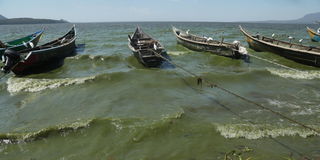
Green algae covers the water surface of Lake Victoria in Homa Bay Town on October 14, 2026. Increasing pollution in the lake is promoting algal blooms.


What you need to know:
- In Homa Bay Town, for example, the sewerage treatment plant is within a stone's throw of the lake shore. During high winds and heavy rains, water can flow between the two.
If you grew up in Kisumu City before 2019, you most probably knew Lwang'ni Beach.
The famous eatery was known for its delicious fish that attracted people from different parts of the country. As they ate, some left their cars at the beach to be washed. It was an experience many wanted to have at least once.
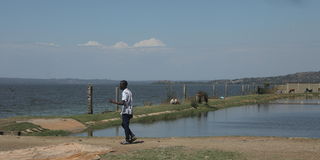
A sewage treatment plant at the edge of Lake Victoria in Homa Bay Town on October 14, 2026. Environmentalists say encroachment on riparian land is leading to ecological challenges in the lake.
The beach was named Lwang'ni because it drew many flies attracted by fish markets there.
Although the unpleasant name stuck, Lwang'ni was a sight to behold, offering not only exceptional fish delicacies but also water sports, bird watching and other recreational activities.
Lwang'ni overlooked Kisumu International Airport to the north-east.
Its proximity to the town centre made it a favourite spot for tourists who could not make it to further places such as Dunga Bay, Kiboko Bay and Dunga Hill Camp.
If you drove straight on Oginga Odinga Street, you would get to a stony path sloping into the lake.
Halfway down the slope was a dormant railway line cutting across and surrounded by reeds and banana plantations that partially concealed the Lwang'ni eateries.
Your visit to Kisumu by then was incomplete without a stop at this famous bay.
However, behind the fried fish and other meals served to tourists lay a serious environmental concern that few spoke about.
The eateries were built on riparian land, right at the edge of the lake. Solid waste from the food kiosks, including food wrappers and plastic bottles, ended up in the water.
Cars washed at the beach discharged engine oil that floated on the surface and likely affected fish health.
Seven years ago, the structures were demolished to pave the way for the multi-billion-shilling rehabilitation and expansion of Kisumu Port.
It looked like a plan to save the lake from pollution. And it worked, but only on the section where the port now stands.
Most of the eateries relocated to other sites still within the lake's edge, with many now concentrated at Dunga Beach.
The effects they cause on the water are still visible, mirroring what similar establishments across the Nyanza region are doing to the freshwater body.
Besides hotels and eateries, other structures have been built on riparian land, posing a serious threat to the lake.
In Homa Bay Town, for example, the sewerage treatment plant is within a stone's throw of the lake shore. During high winds and heavy rains, water can flow between the two.
Many parts of the lake now have water that has changed in colour and produces a foul smell.
In Mbita, Rusinga and Mfangano, beach hotels are built right at the edge of the lake.
Guests use toilets which are not connected to a sewerage system, leaving many to question where the waste is channelled to.
Experts, academics and environmental stakeholders are worried that the lake is choking and will soon become hazardous if no action is taken.
They warn that continued encroachment on riparian land, discharge of untreated waste, and unregulated commercial activities along the shoreline are degrading water quality, threatening aquatic life and endangering livelihoods that depend on Lake Victoria.
They are calling for strict enforcement of the 30-metre riparian buffer, proper waste management systems for lakeside businesses, and relocation of harmful infrastructure to save Africa's largest freshwater lake.
Joshua Ager, the Nyanza secretary of the Environmental Institute of Kenya, says the problem is not the absence of environmental policies but the failure to enforce them consistently.
“Lake Victoria has been facing issues, and there are a number of developments coming up. People have put structures very close to the lake, and we have seen what is happening. The implementation of those policies is lacking, as the lake is a shared resource,” he says.
Ager says raw sewage continues to flow into the lake, pointing to weaknesses in enforcement and waste management.
“Policies are very clear, but the issue is implementation and enforcement. We have loose enforcement policies that do not address the current environmental needs of Lake Victoria, with a lot of raw sewage still flowing into it,” he adds.
He says the capacity of the National Environment Management Authority (Nema) to monitor and enforce environmental standards is constrained by limited personnel.
Experts say chemicals entering the lake through domestic wastewater, industrial processes and agricultural activities can remain in the environment even when conventional treatment systems are in place.
Prof Francis Orata Omoto, director of Research and Postgraduate Support at Masinde Muliro University of Science and Technology, says chemicals of emerging concern (CECs) in Lake Victoria and its catchment are becoming a major environmental challenge.
CECs are substances used in everyday life and industrial activities that are either unregulated or inadequately regulated, allowing them to enter the environment through different pathways.
“These contaminants give many challenges to remove from water systems and other environmental matrices. They tend to persist in the environment and resist both biotic and abiotic degradation,” Prof Orata says.
The substances include pharmaceuticals and personal-care products, endocrine-disrupting chemicals, phthalates, pesticides, brominated flame retardants, per- and polyfluorinated substances, industrial chemicals and polychlorinated biphenyls (PCBs).
Dioxins and furans, which can be produced unintentionally through certain industrial and combustion processes, are also among the pollutants of concern.
Their entry into the lake is linked to a range of human activities. Pharmaceuticals and other micropollutants can reach water systems through wastewater, while pesticides and chemical fertilisers used in agriculture can be carried into rivers and the lake through runoff.
Plastics, textiles, laundry detergents, personal-care products and manufacturing processes provide additional pathways through which chemicals can enter the environment.
The presence of these substances presents a challenge to wastewater treatment plants, many of which are not designed to remove a wide range of micropollutants effectively.
“Wastewater treatment plants are not effective and efficient in removal of most of the micro-pollutants,” Prof Orata says, describing the situation in many low- and middle-income countries in sub-Saharan Africa.
Some contaminants may also accumulate in treatment residues rather than being completely eliminated.
Prof Orata warns that certain pharmaceuticals can attach to biological solids and become concentrated in sewage sludge, which may subsequently be applied to agricultural land as fertiliser.
“Some pharmaceuticals can adsorb onto biosolids and subsequently accumulate in sludge within wastewater treatment plants and can be transferred to agricultural fields when sludge is applied as fertiliser,” he says.
According to him, this creates a wider environmental management challenge, as pollutants can move between water, soil and other parts of the ecosystem rather than being removed entirely.
Dr Elijah Omollo, a lecturer at Kampala International University in Uganda, says protecting Lake Victoria requires cooperation among the countries that share the water body.
“Being a shared resource, all legislation should be transboundary. What Kenya is doing, Uganda, Tanzania and other countries sharing the lake should align under a joint committee to manage Lake Victoria,” he says.
Dr Omollo points to Kenya’s Environmental Management and Co-ordination Act, 1999, and other environmental regulations governing wetlands, riparian areas and land use.
He says zoning is intended to guide development in designated areas, but population growth and expanding economic activities are putting pressure on the available space.
He also highlights the constitutional right to a clean and healthy environment under Article 42 of the Constitution of Kenya, 2010, alongside the responsibilities of county governments in domestic waste management.
However, he says gaps remain between legislation and implementation, including inadequate waste management infrastructure, limited public awareness in some areas and shortcomings in operationalising regulations under the Sustainable Waste Management Act.
Extended producer responsibility, which requires producers to take responsibility for the waste generated by their products, is another area where implementation needs to improve, he says.
Dr Omollo says environmental protection must begin with better waste handling at the source and continue through collection, treatment and final disposal.
“Awareness is key,” he says, noting that environmental agencies and enforcement mechanisms must reach communities beyond major urban centres.
Kisumu Nema County Director Leonard Ofula says the authority’s enforcement capacity is constrained by a shortage of staff across the country.
“We have a limited number of Nema officials across the country. This may impact our roles,” he says.
Ofula says the recommended buffer zone along the lake is 30 metres, although the authorities often extend it to about 50 metres. However, he notes that changes in the lake’s shoreline have complicated efforts to determine whether some developments encroach on protected areas.
“The lake has receded in some areas, and the shoreline has moved to where some houses were constructed. It is the responsibility of the Water Resources Authority to undertake pegging to establish whether the structures fall within the restricted zone. We have been carrying out this exercise jointly with the authority,” he says.
Prof Orata calls for a circular economy, use of renewable energy and pollution control as a means of protecting the lake from the threats it faces.
His proposals were presented to delegates and experts during the inaugural Lake Victoria Basin International Conference and Exhibition held in Kisumu on October 5 to 9.
Clifford Omondi, the national coordinator of the conference, says the meeting provided an opportunity for experts to share ideas on how to overcome environmental challenges.