Lost tilapia: The race to save Lake Victoria’s most fragile species
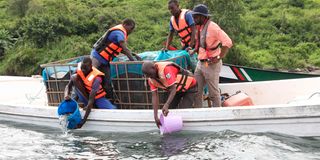
Mike Ouya (in a hat), an official at Victory Farms, supervises fishermen restock Oreochromis esculentus at Kosodo Beach in Suba South, Homa Bay County.

What you need to know:
- Several factors are attributed to the decline in fish populations in Lake Victoria, with environmental pressure playing a major role.
- The lake suffers from massive pollution, intense effects of climate change, overfishing, and destruction of fish breeding grounds.
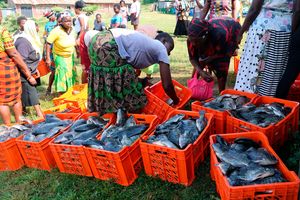
Fifty years ago, Lake Victoria’s fishermen filled their nets with thousands of Oreochromis esculentus, a tilapia prized for its taste. It was one of the common delicacies in homes around the lake region alongside other fish like silver cyprinid (omena), African catfish, and marbled lungfish, which were caught in rivers and swamps.
According to fishermen in Suba South, Oreochromis esculentus, locally known as ngege makuar, was supplied to markets in bulk as it was the dominant species in the lake.
Fishing then was sustainable, and prices were fair to most people.
Maurice Muswaya, 73, born and raised in the fishing village of Kosodo beach in Gwassi South, recalls when colleagues would catch one tonne of fish a day, sorting by species for market. Business was good; no one struggled.
But over the years, daily catches shrank. Despite harder effort, the tonnage kept falling. Muswaya says old hunting-and-gathering methods no longer help: “Fishermen can spend hours on the lake and return empty-handed. At my beach, we might get just one kilogram after two days.”
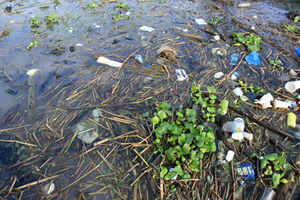
Several factors are attributed to the decline in fish populations in Lake Victoria, with environmental pressure playing a major role. The lake suffers from massive pollution, intense effects of climate change, overfishing, and destruction of fish breeding grounds.
Muswaya points an accusing finger at people who dump raw sewage into the lake. “The rate at which the lake is being polluted surpasses conservation efforts. This affects the fish population, which keeps declining. Some sections of the lake have become toxic for fish.”
All these environmental and human factors combined have led some fish species to near extinction in the lake. One of the fish on the verge of extinction is Oreochromis esculentus, which has been wiped off the menu.
“Younger fishermen say they have never seen it. If we continue with the same practices, more fish will disappear from the lake. We will only be reading about them in books,” he says.
Muswaya is among the fishermen who support conservation efforts aimed at protecting fish from being wiped out completely.
According to Dr Chrisphin Nyamweya, assistant director at the Kenya Marine and Fisheries Research Institute (KMFRI), Oreochromis esculentus was the predominant species in the lake until aggressive introduced species such as Nile perch and O. niloticus, plus poor water quality, drove it to near extinction.
Dr Nyamweya notes that other fish compete for food and nesting grounds. But since ngege makuar is docile, the others were able to outnumber it in population. Now, KMFRI, Conservation International, and Victory Farms, Kenya’s leading aquaculture company, are implementing a massive project to restock the fish in the lake, aiming to bring it
back onto people’s plates.
The fisheries research organisation gave broodstock to the aquaculture firm, which uses it to produce fingerlings at its hatchery before transferring the juvenile fish into Lake Victoria.
The process involves putting female fish in ponds for up to six weeks before they lay eggs, which are then fertilised.
Victory Farms’ Senior Partnership and Development Manager Mike Ouya says the ponds are designed to resemble the natural environment where the fish would have been in the
wild.
More than 200,000 fingerlings were introduced at Kosodo beach in March. It was the third time the fish had been taken to the lake. Previously, the same species was introduced at Roo and Sindo Gateway beaches.
Using this system, Victory Farms hopes to help ngege makuar grow in population as the firm aims to balance the lake’s biodiversity while also empowering fishermen through sustained production.
Experts believe the number of Oreochromis esculentus will multiply if fishermen adhere to the rules set for sustainable fishing. Ouya, who specialises in aquaculture production, says the fish can mature within seven months after which they can be harvested.
The company has partnered with three beaches in Suba and identified community conservation areas where the endangered species is being introduced. Fishermen are restricted from these protected areas, which are off‑limits. No one is allowed to conduct fishing activities in the conservation zones.
They can, however, wait until the fish mature and swim into deeper waters before fishing for them.
“We are partnering with Beach Management Units to protect sections of the lake, ensuring there is no illegal fishing, overfishing, or use of chemicals, while also promoting the return of a species that was nearly extinct,” Ouya says.
The fisheries expert says fishermen will start getting ngege makuar in their nets in a few years.
Before then, some fishermen have already begun reporting catches of the species; likely those introduced when the programme began in 2023.
At Ukula Beach, fishermen are now finding Oreochromis esculentus in their nets. Charles Odhiambo, a fisherman, explains that different species are sorted after an expedition and sold.
“Those who have never seen ngege makuar always admit that it is their first time seeing the fish species. This means the fish is slowly multiplying in population,” he says.
Victory Farms’ Community Engagement Officer David Otieno says the initiative shows signs of good progress based on testimonies from fishermen.
Dr Nyamweya notes that it is possible for Oreochromis esculentus to grow in number. He explains, however, that this is only possible if the lake is managed well and protected from pollution. The expert says an increased population of the species will also play a significant role in the lake’s ecological balance.
“Fishermen should desist from beach seining and other destructive fishing methods because they contribute a great deal to the decline in fish populations. Using wrong nets contributes to the decline of fragile species.”
Fishermen like Muswaya are upbeat that with such conservation efforts, the lake will regain its lost glory, when it used to feed hundreds of families. His main concern, however, is the use of rogue fishing methods that continue to hurt the lake. He says many families are being supplied with juvenile fish, ones that should be left to mature and breed.
“We need civic education so that fishermen can understand the significance of using the correct fishing methods and the need to conserve the lake,” Muswaya says.