Life after my womb: Kenyan women share the pain, stigma and relief of hysterectomy

A woman undergoes surgery in a theatre.

What you need to know:
- In Kenya, women facing hysterectomy battle with more than illness—they confront stigma, lost dreams, and societal judgment.
- Doctors stress hysterectomy as a last resort, yet many women still suffer shame and high treatment costs.
The bright theatre lights cast an unforgiving glare as Marion Okoth lay on the surgical table, her future hanging in the balance. For the second time in three weeks, she found herself questioning a decision that would change her life forever.
“So, this is it? The procedure is irreversible, you said?” Marion asked the anaesthetist, her voice barely masking the uncertainty that had plagued her for months.
It was a question she already knew the answer to after several therapy sessions—an irreversible procedure to remove her uterus. Her hesitation was so palpable that the medical team cancelled the session, ushering her back to the gynaecologist's office for yet another counselling session. Her understanding doctor allowed her to go home and rethink the decision that would end her 17-year battle with a condition that had stolen her dreams, her career, and nearly her life.
Marion Atieno Okoth
Her story begins in the quiet village of Askote, Vihiga County, where a cool breeze now welcomes visitors to her peaceful home. As villagers hurry to the nearby market, she tends to her poultry with remarkable ease, sweeps her compound, and prepares dinner for her family. The woman in her late 30s moves with a vitality that would astound anyone who knew her just two years ago, when these simple tasks were nearly impossible to execute.
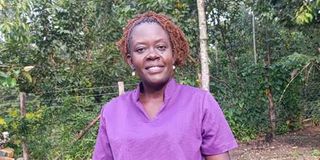
Marion Atieno Okoth during an interview in Askote ,Vihiga County, on July 18, 2025. She underwent hysterectomy in May 2024 after suffering from abnormal vaginal bleeding bleeding for 17 years.
"I suffered from constant, heavy and painful vaginal bleeding for over 15 years. I lost six pregnancies in the process whilst my health only kept deteriorating. Hysterectomy was my only chance to survive," Marion tells Healthy Nation.
Before childbirth, Marion recalls leading a relatively normal life, though her menstrual flow was irregular.
"In a year, I would have my menses four to five times. The flow was heavy with a lot of blood clots and would be accompanied by a lot of pain," she says, adding that menstruation would last five to seven days.
After finishing secondary school, she conceived and delivered a baby girl. Her supportive family promised to care for the child so Marion could pursue her dream of becoming a teacher at college. Little did she know that this dream would be shattered by a health condition that would remain undiagnosed for years.
What Marion initially dismissed as an unusually heavy menstrual flow soon revealed itself as something far more sinister.
"By the second day, I had lost a lot of blood and ended up fainting. I was rushed to a nearby hospital for blood transfusion, and later, the health worker prescribed drugs to be used as blood boosters," Marion recalls.
Within days of discharge, she was back at the hospital, bleeding heavily again. After a medical examination, doctors confirmed she wasn't menstruating and hinted that something was amiss with her uterus. The then 17-year-old was placed on medication to stop the blood flow, whilst doctors administered drugs to boost her blood supply.
Her condition only worsened with each episode. The pain was unbearable, and the heavy clots made daily life impossible. Her only remedy was being rushed to hospital and placed on medication each time bleeding occurred.
She soon identified triggers for the vaginal flow: walking long distances, standing or sitting for extended periods, using stairs, or walking on hilly paths would all result in bleeding. “I could no longer engage in heavy household activities or carry heavy loads,” Marion explains.
The bleeding was manageable initially, but by the second day, she would invariably end up being rushed to hospital, usually after fainting. The blood flow couldn't be contained by sanitary towels—it would escape her pads, and before she knew it, her body and clothes would be soiled with blood.
"Those who didn't know what I was going through branded me a lazy woman who couldn't take care of herself. To them, I was just a weakling who avoided housework," she explains, describing the stigma that compounded her physical suffering.
Marion's dreams of education crumbled when she secured admission to teacher training college only to drop out within months due to her condition. She took to wearing black clothes constantly, never knowing when the bleeding would start again. The condition robbed her of her self-esteem as stigma grew around her.
Employment proved equally challenging. She secured a security job with a local organisation, but her constant requests for sick leave during heavy bleeding episodes led to retrenchment. A second job ended similarly after she was hospitalised for fainting at work. “The company notified me that my hospital bills had exceeded their health cover. After settling the bill, I was excused from work,” she recalls.
A dejected Marion eventually abandoned her job search and spent her days at her parents' home.
In 2010, she married and moved in with her husband. Together, the couple sought medical solutions for her heavy bleeding.
“Over the years, I was always anaemic whilst my health kept deteriorating. I had also miscarried six times,” she explains.
The inability to find permanent treatment after visiting numerous hospitals left Marion struggling with her mental wellness, eventually leading her to use sleeping pills.
"There are days I wish death would come, but I think my time is not up yet," she says.
Last year, Marion was introduced to a new doctor who, after a series of medical tests, revealed that she had uterine polyps—uterine lining growths that resulted in abnormal bleeding. The doctor recommended hysterectomy following failed hormonal therapy over the years.
After extensive counselling, the doctor assured her that bleeding would stop once her womb was removed. Her primary concern was that she had yet to give birth despite being married for over 10 years.
"My husband is his late parents' only son. If only I had the ability, my desire would have been to give him children," she explains.
She also worried about societal perceptions. Would people still see her as a woman? Would her extended family understand why she couldn't give her husband children? There were already whispers in the village amongst some extended family members who questioned her fertility. Some had been bold enough to criticise her for not bearing children for her husband.
"I came to the realisation that I needed to prioritise my health. It was a matter of either choosing to please people at the expense of my health or going for a remedy that was long overdue," Marion reflects.
Procedure
Three weeks later, she returned to the Siaya-based private facility, ready for the life-changing procedure. As she was wheeled into theatre on May 3, 2024, her only worry was whether she would survive. For over a decade, she had yearned for a healthy life—she wanted her social life back, one stolen by constant vaginal bleeding.
More than an hour later, she was wheeled back to the recovery room. Just as her gynaecologist had promised, the bleeding had stopped, save for lower abdominal pain that nurses assured her could be managed with painkillers. At last, she had defeated the polyps, though at the expense of her ability to bear children. However, she was grateful to be alive.
Months later, Marion shared her story on social media, but the responses were overwhelming. She was particularly concerned by women asking where they could access the procedure and its cost, viewing it as another birth control method. Marion couldn't help wondering if these women truly understood how difficult her decision had been.
More than a year after the procedure, she takes pride in her bold decision. She now enjoys activities that were impossible for nearly two decades. Her husband has been her main support system throughout the journey. “He is always bold enough to dismiss those who question my fertility. Having witnessed the challenges I went through, he supported the medical procedure,” she explains.
"He has made it so easy navigating an environment that has no mercy for women who are unable to conceive."
Marion says she would have opted for Assisted Reproductive Technology (ART), but her hands remain tied due to high service costs.
Nancy Okoth
This resident of Kisumu shares a remarkably similar story. She recalls conceiving and giving birth at the tender age of 13. Her supportive mother took her back to school, fully aware of the importance of academic empowerment.
Years later, Nancy married and settled with her spouse, later conceiving their first child together. After delivery, her gynaecologist noted that she had a weak uterus and warned the couple not to conceive again soon.
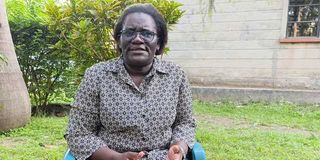
Nancy Okoth at her home in Riat, Kisumu County, on July 22, 2025. She underwent hysterectomy 16 years ago at the age of 30 following abnormal vaginal bleeding.
Two years later, Nancy conceived another baby. Her weak uterus required bed rest for most of the gestation period. “As my delivery date drew nearer, the gynaecologist advised that my womb was too weak and could no longer hold another baby,” says Nancy, who opted for tubal ligation—a surgical procedure for permanent female sterilisation—immediately after delivery.
Months later, she returned to hospital following heavy vaginal bleeding. Medical tests revealed that her womb was weak and bulky, whilst her ovaries were inflamed. The doctor advised that her uterus, cervix, and ovaries all had to be removed. This would stop all bleeding, including menstruation, and likely cause early menopause due to the absence of ovaries. “It took me eight months to come to terms with the fact that I would no longer have a womb,” says Nancy, who had desired more children.
Besides the inability to conceive, the surgical procedure caused Nancy to experience early menopause. She recalls sudden temperature rises, which her specialist identified as menopausal symptoms.
The couple decided never to share these developments with family members to avoid stigma.
"I have heard people speak about HIV/Aids, cancer, amongst other health conditions. Until the procedure, however, I had yet to hear anything about hysterectomy, let alone see someone who had undergone the procedure," says Nancy.
"I was married with a child—societal expectations were that I was to give my spouse more babies," she adds.
Nancy, now a project manager at an international organisation, decided to speak openly about the procedure after years of advocacy, despite having stopped experiencing symptoms for nearly two decades.
The gender expert explains that common concerns about hysterectomy include inability to conceive and the impact on marriage. “The fears range from their spouse remarrying, being separated from their spouses, or the shame of facing their communities knowing they cannot carry a child," Nancy says.
Patricia Sarah Ngadi, a counselling psychologist, says inability to have children is a topic people avoid due to societal perceptions. Women are often judged harshly without understanding the circumstances behind their condition.
"We have seen individuals openly celebrating recovery journeys after battling illness. Talk about inability to give birth, and people will point fingers, making acceptance a difficult journey," she says.
Patricia explains that loss of the uterus subjects women to grief whilst coming to terms with their inability to have children, coping with their new body, and hormonal changes. Such women struggle with acceptance whilst society doesn't make the journey easier. Although some women receive societal and family support, many struggle with stigma.
A woman's self-esteem is at its lowest, with some comparing themselves to other women whilst feeling worthless or less of a woman. “Society may not understand the years of bleeding a woman had to endure or the life-threatening medical conditions that robbed them of the ability to bear children," she says.
The psychologist advocates awareness creation to help women accept and embrace their new bodies. She recommends counselling before and after the procedure, and suggests linking women to support groups of those who have undergone similar procedures for group counselling.
"Society should be made aware that a woman's inability to have children should not at any point be their identity," she concludes.
Medical insights
To better understand the procedure that transformed Marion and Nancy's lives, Dr Paul Ogolla, a consultant obstetrician and gynaecologist from Kisumu, provides crucial medical insight into hysterectomy—a surgical removal of the uterus.
The procedure can involve either total removal of the uterus and cervix (known as total hysterectomy) or subtotal hysterectomy, where the womb is removed partially, leaving the cervix behind. "In terms of the surgical approach, the procedure can be grouped into total abdominal, vaginal, or laparoscopic hysterectomy," explains Dr Ogolla.
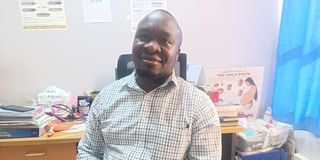
Consultant Obstetrician and Gynaecologist Paul Ogolla during an interview on July 24, 2025.
Before any woman undergoes the procedure, however, the medical expert emphasises that health professionals must receive informed consent from the patient. This informed consent includes explaining the importance of the surgical procedure, its impacts, and the risks involved.
"Hysterectomy is usually a last resort. A medic must have tried other available forms of treatment options before opting for removal of the womb," he stresses.
Conditions
Dr Ogolla identifies several medical conditions that could necessitate hysterectomy, categorising them into benign (non-cancerous) conditions, malignant (cancerous) conditions, and obstetric emergencies.
Benign health conditions include fibroids, which account for 30 per cent of hysterectomy cases. The procedure could also be prescribed for endometriosis, abnormal uterine bleeding, and uterine prolapse. The health expert cautions that abnormal vaginal bleeding, when untreated, can result in infections and severe anaemia, leading to untimely death.
Malignant cases, including cancer of the cervix, ovary, and uterus, could also result in removal of the reproductive organ. Other conditions include postpartum haemorrhage, uterine rupture, and growth of placental tissue into the pelvic organ, preventing normal delivery. “There are also women who are at high risk of cancers who may opt for the procedure as a preventive option,” says Dr Ogolla, adding that there have been cases of women visiting hospitals seeking the medical service for private reasons.
Once the uterus is removed, patients can no longer experience monthly menstrual flow or become pregnant. Other impacts of the procedure include depression, especially amongst women who may feel they've lost their femininity and ability to give birth.
However, Dr Ogolla emphasises that the procedure doesn't necessarily include removal of ovaries unless their presence could result in medical complications. The ovaries present women of reproductive age with opportunities to explore other fertility options, such as surrogacy. “The ovaries are what makes a woman. They are responsible for producing oestrogens and hormones. Their presence also allows the woman to explore other fertility options," he says, adding that couples can also explore adoption if needed.
Surrogacy
In this legal arrangement, a woman agrees to carry a pregnancy to term on behalf of a couple. It remains largely unregulated in Kenya. In an effort to make these services accessible, Suba North MP Millie Odhiambo tabled the ART Bill 2022 to help couples struggling with involuntary childlessness.
The bill aims to make ART services affordable, as current costs are only accessible to high-income Kenyans. However, during a parliamentary session last year, the MP lamented that despite the bill being listed on the order paper and presented before other proposals, it has been delayed at the committee stage whilst other legislators' ideas have sailed through.