Livestock vaccination resumes, farmers now to pay
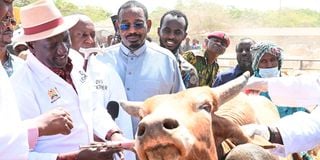
President William Ruto vaccinates a cow during the flagging off of animal vaccination and the National Livestock Restocking Programme at Soko Ng'ombe in Garissa County On February 6, 2025. Looking on is Daadab MP Farah Maalim.

Nine months after launching one of the most ambitious livestock vaccination campaigns, the government is resuming the programme this month but with a fundamental change.
Farmers will now pay subsidised fees of Sh50 per animal for Foot and Mouth Disease (FMD) vaccines and Sh3 for Peste des Petits Ruminants (PPR) vaccines.
The shift marks a dramatic departure from the free nationwide vaccination drive that began in January 2025, which managed to inoculate over 4.4 million sheep and goats and more than 750,000 heads of cattle before officials halted the programme to develop a digital delivery system.
"The government will only do free vaccinations during an emergency situation or when mass vaccination drives are necessary in order to achieve herd health management," said Dr Allan Azegele, the director of veterinary services, explaining the new cost-sharing model designed to create a sustainable framework for farmer cooperatives.
"The tiered pricing structure reflects the different vaccination schedules required for each disease. Cattle farmers will pay Sh50 per animal for FMD vaccines, which must be administered every six months. Sheep and goat farmers will pay just Sh3 per animal for PPR vaccines, which provide lifelong immunity with a single dose," he said.
For a smallholder farmer with 100 goats, the one-time PPR vaccination would cost Sh300. However, a cattle farmer with 50 animals would face Sh2,500 per vaccination cycle and Sh5,000 annually, given the six-month revaccination requirement for FMD.
The programme targets to vaccinate 22 million cattle, 23 million sheep, and 35 million goats over three years, focusing primarily on two diseases that have long hampered Kenya's access to lucrative international livestock markets.
The subsidised fee structure is aimed at establishing what Dr Azegele describes as a sustainable model for farmer cooperatives to ensure their members can access animal health services beyond government-funded campaigns.
Financial foundation
The approach is a departure from fully subsidised programmes that often collapse once donor funding ends or government priorities shift. By requiring farmer organisations to collect fees from members, officials hope to create a financial foundation that can support ongoing vaccination programmes even without continuous government intervention.
"The extended pause since January wasn't due to vaccine shortages or safety concerns or that we ran out of money, no," Dr Azegele said. "Instead, the government spent months building an electronic voucher system that will eliminate the corruption and inefficiency that have plagued previous agricultural subsidy programmes."
The platform works by sending SMS-based vouchers to farmers, linked to the Kenya Integrated Agriculture Management Information System (Kiamis) database. Farmers can only redeem these vouchers through animal health service providers accredited by the Kenya Veterinary Board.
"This platform builds on the success of the fertiliser subsidy scheme. The model routes services through Farmer Producer Organisations at the ward level, supported by County Veterinary Directorates to ensure vaccine quality, cold-chain integrity, and professional service delivery," he added.
Pilot programs were conducted earlier this year in Uasin Gishu and Baringo counties, and the government states that these trials demonstrate the digital model's effectiveness at scale. However, the introduction of user fees introduces a new variable not present in the initial tests.
Beyond domestic animal health, the Directorate of Veterinary Services is currently mapping disease-free compartments across the country, designated zones where animals exist under strict biosecurity protocols with verified disease-free status.
"This will establish subpopulations of animals within one or more farms under a common biosecurity management system with a distinct health status with respect to FMD and PPR," the Directorate explains in program documents, noting that "surveillance, control and biosecurity measures will be applied for the purpose of international trade."
"Currently, only Kenchic Hatcheries has achieved disease-free compartment status in Kenya. The government's goal is to enable every county to establish and maintain such compartments, potentially unlocking markets that have been closed to Kenyan livestock products for decades," said the DVS.
Government documents indicate that if vaccinations proceed consistently for three consecutive years, Kenya could eradicate PPR by 2027, three years ahead of the 2030 global target set by the World Organization for Animal Health.