Mercury poisoning: The silent killer of Kenya's forgotten women miners
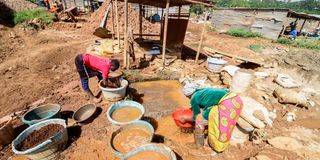
Women washing soil in basins of water in efforts to obtain gold at Osiri gold mining site in Nyatike, Migori County.


What you need to know:
- The tragic stories of Benice, Eunice and Caroline reveal a devastating public health crisis unfolding in artisanal gold mining communities.
- These women—and thousands like them—face an impossible choice between economic survival and their health, as mercury poisoning silently ravages their bodies, families, and futures.
As dawn breaks in Osiri Matanda, Migori County, Benice Akinyi starts her day with a heavy heart. Near her doorstep lies a small grave — a painful reminder of the hidden cost of her source of livelihood.
For nearly 10 years, the mother of five has processed gold using mercury with bare hands, unprotected from its toxic effects.
This dangerous work cost her her youngest child, who was born with severe defects and died at just 18 months in 2022. Doctors confirmed that mercury in Benice’s body caused the birth defects.
“Doctors found that mercury in my body caused her condition,” she says, too scared to risk another pregnancy.
Benice recalls the most heart-wrenching and soul-shattering experience imaginable — helplessly watching her baby die in her hands. “That day I came home from the mining site and noticed that the baby had difficulty breathing. Within 30 minutes, she was gone,” Benice tells Healthy Nation with a heavy, trembling voice.
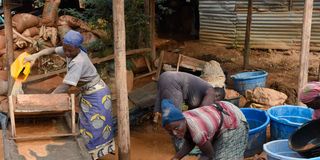
Women wash soil to extract gold at Masiyenze mines in Ikolomani, Kakamega County.
She says the memory of those 30 minutes—the panic, the desperation, the moment her child took her last breath, has never left her mind.
Her pregnancy had been marked by troubling signs. During antenatal visits, her case would draw unusual attention, with up to five medical officers examining her. Only later did she discover through ultrasound that her unborn child had serious problems. The complications necessitated an emergency C-section.
“I am afraid of getting pregnant again because I might deliver another baby with birth defects,” she admits.
Benice, 45, joined the mining industry after getting married at the age of 19.
With no professional training, she started accompanying her husband to a local mining site. Though she briefly worked as an early childhood educator, the income couldn’t match what she earns processing gold, a bitter economic reality that keeps her tied to the very work that took her child’s life.
For close to a decade now, Benice’s backbreaking routine follows an unforgiving rhythm: mixing mercury by hand to extract gold while inhaling toxic vapours.
After grinding down the ore, she concentrates the gold using a traditional sluice washing method. Throughout the process, Benice is exposed to harmful silica dust, which increases the risk of respiratory illnesses like silicosis, chronic bronchitis, and tuberculosis.
Kilometres away in Migori County’s Nyatike, Eunice Atieno, 47, is experiencing health challenges of processing gold using mercury with bare hands. She is one of the women working at Osiri Matanda’s gold mining site whose hair samples were taken in 2016 to test mercury content. The results showed that Eunice had high levels of mercury in her body.
Benice and Eunice are forced to risk their lives (and the lives of their children) every day because they don’t have safer alternative sources of income.
Eunice’s body is breaking down from mercury poisoning, having worked at the site for close to 20 years.
She suffers failing eyesight.”I used to read the Bible—now I can’t see the words. I am becoming blind gradually.”
The weight of school fees for her children, once shared by two working parents, now rests entirely on Eunice’s shoulders. Her husband, once an active miner, can no longer work as mercury poisoning gradually steals his sight.
“At first, I misunderstood his situation,” Eunice confesses. “I thought he was avoiding hard work.”
Heated arguments
That misunderstanding led to heated arguments until the harsh reality became impossible to ignore. “Now he cannot walk without support; he bumps into anything on his path,” she explains.
Even worse, her husband remains untreated. The family that once depended on two incomes cannot afford medical care. “Even though he can feed himself, I must provide everything for him just as I do for our children,” says Eunice, describing her unexpected role as sole provider.
Eunice notes that watching her husband suffer without access to care while financial strain tightens every day is an unbearable weight.
In yet another homestead, Healthy Nation meets Caroline Atieno, who started working at Osiri mining site in 1998.
Caroline reports to work daily at the mining site despite suffering severe skin and chest ailments as quitting would mean starvation for her family. As a widow, Caroline carries the full burden of providing for her children.
“I am a widow, and I carry the full burden of providing for my children.”
Her body is breaking, yet the fear of starvation chains her to the very work that is killing her.
“I cannot afford routine check-up my condition requires,” she explains, her voice revealing resignation to a reality where daily survival takes precedence over one’s health.
Although the majority of the mine workers are women, they are barred from the shafts (where deeper gold is extracted) but still handle crushing, washing, and mercury processing—the most dangerous tasks.
Alfayo Ojung’a, the chairman at Osiri Mining Co-operative Society, acknowledges the dangers of mercury.
“We know that mercury is a dangerous substance and we have been sensitised over time by the county government and the national government. They told us that there is a substitute that is coming to replace the mercury, we are still waiting.”
While families like Eunice’s suffer the consequences of mercury exposure, official acknowledgement remains limited. Clement Ayungo, Migori County’s Public Health director, admits they haven’t conducted local health research on mercury’s effects despite concerning data from other sources.
“Mercury is extremely heavy and sinks into groundwater that people later drink,” Ayungo explains. “When miners dig deep wells, they’re often accessing contaminated water sources.”
For women like Caroline, Benice and Eunice, mining work is brutally demanding with uncertain rewards. They spend exhausting days digging stones, drying them, crushing them into powder, and washing the material, often with no guarantee of finding gold. Their backbreaking labour rarely translates to financial security.
Mr Ayungo acknowledges that peasant miners depend on gold for survival but warns against mercury use, calling it a “major human health concern.”
Yet he notes a troubling pattern: affected miners often withhold information about health impacts, fearing regulatory crackdowns that might threaten their only livelihood.
“They worry that if they report health problems, we might take action to regulate mining,” he says, highlighting the impossible choice facing these families, risking their health or losing their income entirely.
The University of Eldoret’s Department of Environmental Sciences and Natural Resource Management, led by Prof Odipo Osano, conducted a study between August 2023 and August 2024 on mercury exposure within Kakamega Gold Belt.
The study investigated the health hazards associated with mercury exposure in collaboration with researchers from the University of Illinois, Chicago School of Public Health and the Vihiga County Public Health Department.
The researchers analysed water samples from gold mining sites to detect heavy metals, including mercury, within the slurry (water mixed with ore and mercury), and at the crushing site.
Apart from mercury, the researchers found high concentrations of manganese, and lead in mining sites, posing a health risk to humans.
Prof Osano, a lecturer at the University of Eldoret who was part of the study, stated that: “Mercury vapour goes up in the air. When the vapour is released into the atmosphere, it can be transported by wind currents and rain, depositing mercury on land and in water bodies, eventually leading to contamination of soils, vegetation, and water sources.”
He added that mercury can damage many parts of your body, including lungs, kidneys and nervous system (the brain, spinal cord and nerves).
Scientists also link this harmful chemical to birth defects in unborn babies and neurological damage in foetal development during pregnancy.
“If a pregnant woman comes in contact with high levels of mercury, it can lead to a birth defect. Unfortunately, mercury can stay in the body for a long time,” said Prof Osano.
Recent data released by the Friedrich Naumann Foundation for Freedom East Africa shows that there are 157,798 artisanal miners in Migori County. The researchers noted that field findings underscored substantial gender inequalities, with women being assigned lower-yielding income roles such as ore washing and panning, which also expose them to higher health risks due to direct mercury contact.
The report titled “The toxic tools, a poisoned ecosystem and the gender toll,” revealed that gold processing is the leading primary role at small-scale gold mining in Migori County at 78 per cent. Other roles are selling and digging at 32 per cent and 29 per cent respectively.
“Gender pay disparity exists, with men often earning more due to their more physically demanding roles in digging. In contrast, women primarily handle processing, which offers lower pay, often around Sh500 daily compared to Sh1,000-3,000 daily for men,” reads the report.
According to the findings, 62 per cent of the 424 artisanal miners interviewed were women, with 38 per cent being male. The study was conducted within major mining sites in Migori County.
“Women face obstacles in accessing mining equipment and resources, often relying on lower-quality ore discarded by male miners. This dynamic forces women into exploitative agreements, including sexual harassment for access to higher-grade materials, confining them to low-income roles and limited upward mobility,” reads the report.
Dr Nashon Adero, a geospatial and systems modelling expert, led a field report, further showing that women like Caroline, Benice and Eunice, who work as processors, are exposed to higher health risks from direct mercury contact. Mercury, which the report reveals to be extensively used for artisanal gold mining in Migori, is among the top 10 chemicals of public concern.
Mr Kephers Ojuka, a miner and the chairman of Migori County miners’ association, said most challenges miners in the region face are due to a lack of political goodwill.
He noted that 44 mining cooperatives were formed as per government directives to obtain licences, but none have been issued, leading to the use of mercury due to its affordability and lack of viable alternatives.
The father of five highlights the high cost of mercury alternatives and the government’s lack of support in addressing this issue collectively, leaving miners alone to bear the costs.
Ms Faith Furaha, a mining engineer and researcher at Jomo Kenyatta University of Agriculture and Technology, describes the challenges women in the mining sites face as a cry for justice that needs government interventions.
“There is an ongoing project by the Ministry of Environment, which is called Planet Gold. It focuses on transitioning to mercury-free gold mining by working with governments, private sector actors, and mining communities.
“It aims to eliminate mercury use in artisanal and small-scale gold mining and promote safer working environments. So, the government and key players should implement it swiftly.”
For Benice, Eunice, and Caroline, survival hinges on a broken system. Their stories demand urgent, coordinated action to replace mercury with safer livelihoods—before more lives are lost.