More than just painful period: How we struggled, navigated the roller coaster of fibroids
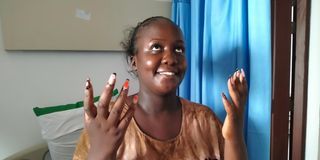
Millicent Atieno, 27, rests shortly after undergoing surgery to remove uterine fibroids at Langoni Hospital in Lamu Old Town on May 8, 2026. She had struggled with the painful growths for five years before receiving free treatment through a medical outreach camp.

What you need to know:
- Fibroids are a common health issue affecting millions of women worldwide. They are smooth muscle growths most often found in the uterus, but can also grow in the fallopian tubes and ovaries.
- They can be symptomatic or non-symptomatic, painful or painless. While they can affect women of all ages, there is a rising trend in diagnosis among young women.
At Langoni Hospital in Lamu Old Town, Millicent Atieno sits upright in her bed. At 27, the debilitating symptoms of uterine fibroids are finally behind her. Resting her hands gently on her bandaged abdomen, her face radiates quiet hope: the pain is gone, and her future is her own again.
For over five years, Millicent, a resident of Mokowe, endured severe pelvic pain and heavy bleeding caused by fibroids. She was diagnosed at 22 while still in college. "I became suspicious after repeated heavy bleeding and painful cramps that disrupted my life. My daily life revolved around my agonising cycle," she says.
"The growing fibroids pressed on my bladder and caused intense cramping, making it impossible to work consistently. Sometimes I was lethargic from blood loss."
Also read: Lupita Nyong'o's battle with fibroid sparks global conversation on hidden women’s health struggles
Initial hospital visits for lower abdominal pain, bloating, and a palpable lump confused fibroids with a hernia.
"First, I was told it was pelvic hernia. I used to experience persistent pain, intense cramping and heavy periods that a normal sanitary pad couldn’t sustain. I then sought advice from a gynaecologist, and after physical exams and imaging, I was diagnosed with fibroids."
Private fibroid surgery in Kenya costs between Sh250,000 and Sh500,000, depending on hospital, procedure type (open or laparoscopic), and fibroid size. Unable to afford treatment and fearing surgery, Millicent turned to herbal medications. "I swallowed lots of herbal concoctions, but they backfired, causing the fibroids to grow larger."
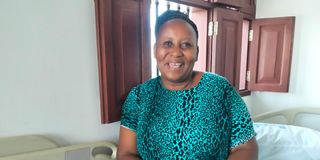
Martha Amuma, 49, sits on her hospital bed at Langoni Hospital in Lamu Old Town on May 8, 2026, shortly after undergoing pelvic clearance surgery to permanently address uterine fibroids she had battled for more than a decade.
Fibroids are a common health issue affecting millions of women worldwide. They are smooth muscle growths most often found in the uterus, but can also grow in the fallopian tubes and ovaries. They can be symptomatic or non-symptomatic, painful or painless. While they can affect women of all ages, there is a rising trend in diagnosis among young women.
A 2022 study published in Nutrients, a peer-reviewed journal of human nutrition, found a strong link between vitamin D deficiency and uterine fibroid formation. The findings also showed that a vitamin A-rich diet may help prevent or limit fibroid growth. Additional research has found that people who eat at least four servings of fruit or vegetables daily are less likely to develop fibroids than those who eat only one serving.
Millicent's struggle mirrors those of many women. At the same hospital, Martha Amuma, 49, from Tana River County, recently underwent a similar procedure. Diagnosed with fibroids over 10 years ago, the mother of three boys endured immense pain, heavy prolonged bleeding, and fertility challenges.
"I used to experience labour-like cramps radiating through my lower back and into my legs. At first, I ignored it. When it grew worse, tests came back positive for fibroids. They told me not to worry and to try getting pregnant since the fibroids were too small," says Martha.
By then, Martha and her husband were yearning for more children.
"We have three boys, but we had planned to add more. We were really hoping for a baby girl," she says.
For several years, she tried to conceive. She joyfully achieved two pregnancies, only for both to end in complications.
Medics explain that submucosal fibroids distort the inner lining of the uterus, preventing the embryo from implanting properly because the growths compromise placental blood supply.
"I conceived twice, but each time I would experience severe pelvic cramping in the first months followed by vaginal bleeding and early miscarriage. It's heartbreaking," says Martha.
She turned to herbalists, spending Sh1,500 a month on bottles of herbal medication. Nothing worked.
Finally, she sought hospital services, but was told she needed at least Sh200,000 for surgery. She did not have the money.
"The fibroids continued to grow. They pressed against my uterus, making me need the restroom constantly. I felt heavy in my lower abdomen.”
Mysara Kahindi, 36, from Malindi in Kilifi County, struggled with fibroids too. Immediately after her wedding in 2013, she tried to get pregnant but was unsuccessful. After four years, she visited a specialist;: not suspecting anything serious, just concerned about the pain, backache, and heavy flow during her periods.
"After gynaecological consultations, I was told I had multiple fibroids growing into the cavity of my uterus. The diagnosis came as a shock," says Kahindi.
She wondered whether the fibroids had been affecting her chances of getting pregnant all along.
"The specialist assured me that women with fibroids could still conceive. He recommended a comprehensive treatment plan. Unfortunately, I didn't have the Sh150,000 top-up for surgery," she says.
For years, she desperately explored treatment options, including herbal remedies, but nothing materialised.
As Martha, Millicent, and Kahindi endured the pain and struggled to raise funds for surgery, help arrived when they learned about a week-long, fully subsidised surgical outreach programme: the Gynaecological Mashinani Medical Camp at Lamu's Langoni Hospital.
The initiative brought together at least 40 medical experts, including consultant obstetricians, gynaecologists, and laparoscopic surgeons, who performed complex surgeries using advanced technology.
The three women were successfully incorporated into the programme. They became part of the 40 women from across the Coast region and beyond who received a new lease of life after undergoing free surgeries during the three-day medical camp in Lamu.
Langoni Hospital Director Nurein Mohidin says the surgeries were offered free of charge, with most expenses covered by the Social Health Authority (SHA).
Dr Mohidin explains that they created the Gynaecological Mashinani programme to assist women, especially those in underserved areas, who had endured long, painful journeys. The three-day outreach initiative brought specialised cancer care and other crucial treatments closer to communities.
"Part of the requirements was that each patient have SHA membership. They didn't pay anything for procedures that ordinarily cost between Sh200,000 and Sh1.5 million," says Dr Mohidin.
Despite fibroids having changed her dream of having more children due to repeated miscarriages, Martha says she is at least happy to have found a permanent solution.
"Together with my husband, our plan was to have a family of four or five children. Now that we have three boys, our hope was to have a baby girl. Unfortunately, fibroids cut that dream short," says Martha, adding: "I am 49 years old. After consultations with my husband and medics, I attended the Lamu medical camp where I opted for pelvic clearance, a radical procedure to remove reproductive and surrounding organs. I am happy the surgery was successful. I thank God for the three boys I have."
As for Millicent, the medical outreach gave her a free procedure that successfully removed her uterine fibroids while preserving her uterus. After a brief hospital stay, she was discharged to recover at home. Her recovery is progressing smoothly.
"Since last week when I had the surgery, I feel emotionally healed. The treatment relieved me of both the physical toll and the lingering anxiety. I am now focused on rebuilding my energy and enjoying a pain-free future," says Millicent.
For Kahindi, the agonising pelvic pain and heavy bleeding that once held her back have completely disappeared.
"I am slowly resuming my daily routine — light household tasks and work — without needing to plan my life around my cycle like I used to," she says.
Martha, Millicent, and Kahindi admit that for the first time in years, their chronic pelvic pressure has lifted.
They can now take deep, unhindered breaths, feeling a surge of physical lightness. Their expressions are a mix of peacefulness and quiet excitement. The anxiety that once shadowed their daily lives has finally been replaced by vivid daydreams of what comes next.
"I look forward to complete recovery so I can at least travel without packing extra changes of clothes and exercise without pain," says Martha
Millicent adds: "I can now pursue the career goals I had almost put on hold because of fibroids. I view this surgery not just as an end to a painful chapter, but as a true second chance at a vibrant, healthy life."
Kahindi says she will not tire of trying to conceive now that her fibroids are gone and her uterus preserved.