More than medicine: The nurse who understands the heart of healing
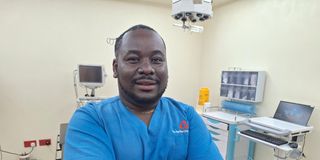
Anthony, an oncology nurse at Aga Khan University Hospital.

What you need to know:
- Apart from taking care of people, nurses like Anthony have to prepare reports for every patient.
- That takes most of their time as they have to document all the details.
When Anthony Mwangi’s relatives wimped out of taking care of his ailing great-grandfather, he jumped at the chance and did so with so much love.
He was only 15 at the time, and he knew that he wanted a career in the medical field.
Also read: The silent grief of Kenyan nurses
“I have always loved taking care of people, it fulfils me and gives me joy,” he tells Nation.
With no other options after graduation, nursing became his reluctant refuge.
"He chose a path where there are fewer people like him. Most men take up other roles in the medical field, but nursing. Globally, female nurses outnumber their male counterparts, but that does not stop Anthony from executing his role meticulously.
According to a World Health Organization (WHO) report, while the nurse-to-population ratio has improved from 8.3 per 10,000 in 2013 to 22.7 per 10,000 in 2025 globally, Kenya still falls short of the WHO’s recommended threshold of 25 per 10,000.
Worse still, the improvements may be short-lived.
Help indirectly
As of 2025, Kenya has 125,499 nurses compared to 2013 when it had 40,000, which means the government has hired 85,499 more nurses in the last 10 years. The country has been graduating an average of 1,070 nurses per year.
Anthony believes that by helping one person and taking good care of them, he has helped so many people directly or indirectly.
He started his career at a local private hospital, in the maternity unit.
“I had one principle when working there, that a healthy baby will result in a healthy mother, and a happy family,” he says.
A few months into his career and after gaining some experience in midwifery as a nurse, he realised that there was a skill gap that he needed to fill in order to save more lives.
Also read: Mass exodus of nurses: 1,000-staff gap as more leave Moi Referral Hospital for jobs abroad
He went for an advanced training course on life-support and when he resumed work after the training, he had a long streak of saving both mothers and their babies.
“No one died in my hands,” Anthony tells Nation.
After that achievement, he moved to a bigger challenge and got employed in a public maternity hospital.
There, he learnt that team work really saves the day.
“One time we had a mother who had been referred to our hospital in a critical condition. As she was wheeled into our emergency unit, I noticed that she was in shock. Soon after, she had a cardiac arrest. A colleague and I had undergone the same training so we worked together to save her,” he says.
He adds: “After working there for some time and then moving to another private hospital, deep down I wanted yet another bigger challenge.”
He shifted from public to private because he was open to having a mind-shift change. Unlike in a private hospital where he is now, his experience in a public hospital made him see the rigidity that some of the people in his profession have.
He is a generally aggressive person, and all he wanted was for people to at least show up when he tried his best to save a life.
“If a scope is from A to Z, some people will explore A to D and leave it at that. I love trying all options,” he says adding, “That is when I got the opportunity to be an oncology nurse.”
He has been taking care of cancer patients for five years now.
“Oncology is different from the rest of the care that we give. We see a patient for years; they come for chemotherapy, clinic reviews and general check-up. Some of them look for you even outside the hospital just to ask medical related questions.
“Oncology tampers with one’s spirituality, their emotions and sometimes even their physical well-being,” he adds.
The tumour
When he was still a rookie as a nurse taking care of cancer patients, he was always on the lookout in case any swelling pops up from any of his body parts. He always thought of the worst –that he may be having a tumour.
He says he overcame that, but after years of working on it.
“I used to come home and all my stories revolved around what my day had been like at work. But now I have learnt to separate work life from my personal life,” he says.
When at work, Anthony devotes his life to his patients fully. A smile on his patients keeps him going.
“A smile is a reflection of one’s heart. If you are happy deep down, you will smile, and it’s not easy to fake a smile. If one does, it will be evident that they are faking it. It cannot be bought either. One time I managed to calm down a patient who had been crying for about two months after being told that they had cancer.
“I am very good at assessing a patient’s psychological, spiritual and social wellness. When a woman is sick, for instance, I try to speak to their husband to help them adjust to the new normal,” he says.
Throughout his nursing career, he has treated Kenya's elite alongside everyday ordinary Kenyans, discovering that beneath prestigious titles, the human experience of illness remains stubbornly democratic.
“As long as you have mastered your skill, you cannot fear handling a politician, for instance. You, in fact, become their hero as they consult you with the hope of getting better,” he says.
When he started out his career as a nurse oncologist five years ago, he freaked out taking care of prominent people. He let his older colleagues do most of the work and opted to only take the vitals.
He has had so many fulfilling moments at work, but his best memory is when he talked to a patient who had lost their livelihood after getting sick, and he advised them to start journaling.
“I was surprised when my patient told me that they wrote a book based on the journals they had written. Their book now offers hope to many people, having a bigger impact in their life,” he says.
He says he doesn’t feel any different being a male nurse.
“We complement each other. There are some things that a female nurse can do very well, and vice versa.”
He reminds the public that nurses are the engines of a hospital.
“People always think that doctors are their heroes, but, in a real sense, nurses spend most of the time with the patients. People should just differentiate the two cadres. Mostly doctors make the decisions and the nurse is supposed to care and suggest change of decisions, and recommend when a patient is stable enough to go home,” he says.
“The respect should be mutual, and everybody in a hospital setting, including cleaners and nurse assistants, are important,” he adds.
The public has had some bad experiences with nurses, and he says that sometimes it is just one’s character, or a systemic issue.
“I left a certain hospital because their system started changing me. I started speaking harshly to patients and I didn’t like it, so I quit.”
He says that sometimes it is generally a lack of knowledge that when someone doesn’t know how to respond when asked something by a patient, they become harsh.
Apart from just taking care of people, nurses like Anthony have to prepare reports for every patient. That takes most of their time as they have to document all the details.
The trauma
He says that nurses get traumatised each time their patient dies. He recommends group therapy for all nurses in all hospitals.
“We need care of caregivers. We need many avenues to do debriefs with counselling psychologists. We mourn many times than patients and their families do,” he says.
While everyone has their own sense of spirituality, he says hope is really key and everyone should know the right source to get hope from.
“When science fails, you need a bigger power to give you hope. As a nurse, I need to be a carrier of hope as well. It is that which helps people get from the Intensive Care Unit to the normal ward and then a discharge,” says Anthony.
“I have seen people whose condition was bad, but they had hope and were spiritually upright, and they got a better outcome,” he adds.
[email protected]