Murang’a, West Pokot, Turkana deny UHC workers September salaries
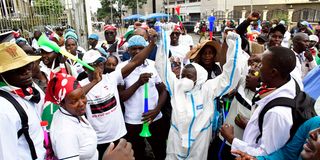
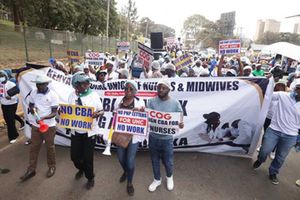
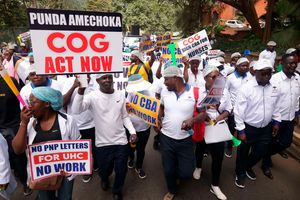
A section of health workers employed under the Universal Health Coverage (UHC) programme protest outside the National Treasury Building in Nairobi on May 27, 2025.

What you need to know:
- Jonathan Siwayang, the county secretary for West Pokot County, said the national government submitted the list of UHC workers late and that it arrived after the September payroll had been closed.
Universal Health Coverage (UHC) workers in Murang’a, West Pokot and Turkana counties have gone without their September salaries and are running out of ways to cope, it has emerged. The workers say the last pay they received was for August, from the national Ministry of Health.
Speaking on condition of anonymity for fear of victimisation, UHC staff from the three counties said they are yet to receive pay slips and commitment letters on when they will get their September salaries. They said county leaders claim there is no money to pay their salaries, even though they are still expected to report to work. The leaders have also failed to give them written assurance on when they will be paid.
“All the 210 of us have not been paid in Murang’a. They insist there is no money. The national government has not devolved our funds,” said a Murang’a County UHC worker.
The worker said counties were told to pay UHC staff from the county government’s additional allocation, which includes the conditional grant from the national government. The worker said the Intergovernmental Budget and Economic Council resolved that the Division of Revenue Act could not be amended to place the workers under equitable share revenue, and that this would happen only next year. In the meantime, counties were to use the additional allocation.
“On Monday, the 12th, we met the county secretary, who maintained that the county has no issue with UHC but cannot decide alone. He told us he must consult the county executive. In unofficial communication with the governor, he maintained the same position,” the worker said.
The worker said UHC staff were told they would not be paid until gratuity is paid, and that the same condition applied to their permanent and pensionable appointment letters.
The workers have given the county seven days to respond in writing and expect to meet the county secretary again on Friday or Monday. They have received only verbal responses so far.
“We told them, respectfully, that by the end of October we need a tangible solution because without our September salaries, how will we survive? Where will we get money to buy food and even to pay the fare to report to work? Many took long-term loans after the Ministry of Health announced in July and August that UHC workers would be placed on permanent and pensionable terms, and are now falling into arrears. We told the leadership that if a solution is not found, we would be forced to abandon work or seek locum positions elsewhere to sustain ourselves, but they said we should be patient,” said the Murang’a worker.
In Turkana, UHC workers said they have yet to be integrated into the county payroll.
“We haven’t been given pay slips for September. County pay slips were released on September 25, and we were told ours had not been processed because the county had already closed its payroll. A payroll manager has since promised verbally that we will be included in October’s payroll, with September arrears paid,” said a Turkana County UHC worker.
“But no one has put it in writing. We are not sure because there is no official communication. Even if you escalate the matter to higher levels, they can turn around and say it was just word of mouth. There is no communication on paper,” the worker said.
Workers who followed up were told the matter was administrative and required the county public service board. However, the county has had no board since its term ended in February. Interviews for a new board were held around June or July, and vetting was done, but the board has not been constituted. The acting chairperson reportedly said a salary scale was needed. The workers said the Public Service Commission has already sent guidelines, and the acting chairperson confirmed the county had received them.
However, the workers doubt this explanation.
“Counties such as Lamu and Kajiado were paid and given pay slips without even having a board,” the worker said.
“Here we are just being told stories about a board.” The worker said the leader was asked to press for a commitment letter, but officials appear “reluctant to write”.
Neither group has formally reported the matter to the national Ministry of Health, saying the ministry would likely send them back to their respective county managements.
In a statement, Murang’a County said September salaries for 210 UHC workers have not been paid because the county has not received any money from the national government for
UHC workers this financial year. The workers will be paid immediately after the President signs the County Governments Additional Allocations Bill and the National Treasury releases the money to counties, the county said.
The county said the Bill, which the Senate passed on October 9, 2025, is now awaiting presidential assent.
“From preliminary information, chances are that the UHC conditional grant money is contained in that Bill. We advise the workers to also check the Bill and, together with all health unions, push for the President to assent to it urgently. Once the Bill is assented to and the National Treasury disburses the money from the national government to counties, Murang’a County will immediately pay. That is the legal pipeline we are waiting for,” the statement read.
“Our position is that payroll should remain in the county, not return to the national government. We have engaged the Ministry of Health on headcount verification. Once funds are received from the national government, we will pay as per the agreement,” the statement added.
The county noted that UHC workers will be county staff, but their salaries are to be paid through money from the national government as per the Division of Revenue Act and the Intergovernmental Budget and Economic Council resolution. So far, the county has not received any money for this item.
“We wish to draw attention to the recent High Court decision in Matindi v Salaries and Remuneration Commission & another [2026] KEHC 755 (KLR), delivered on January 30, 2026, by Justice L.N. Mugambi. The court declared that any national or county government budget that exceeds the prescribed 35 per cent public wage bill-to-revenue ratio under the Public Finance Management Act and Regulations is unconstitutional and void. The court suspended the declaration of nullity until July 1, 2030, to allow transition. The judgment requires counties to adhere to the 35 per cent rule,” the statement read in part.
“This is critical for Murang’a. If we are forced to pay the 210 UHC staff from our own equitable share, it is an extra Sh18 million per month burden we cannot afford.
Murang’a already has 5,000 employees whose salaries consume 52 per cent of our total budget, against the 35 per cent set by law and now affirmed by the High Court. After adding the county assembly, insurance and electricity, only about 30 per cent remains for services to 1.1 million people. Paying from our own source would put us in direct violation of the court decision,” the county said, adding that it will respond formally in writing to the workers’ seven-day notice this week.
Jonathan Siwayang, the County Secretary for West Pokot County, said the national government submitted the list of UHC workers late and that it arrived after the September payroll had been closed.
“The UHC workers used to receive their salaries from the national government before they were devolved to the counties. The national government submitted the list of staff minus the money. There is a possibility that the September salaries will be paid with the October salaries, subject to the availability of funds,” said Siwayang.
Nation also reached out to Turkana County Secretary Richard Ekai, asking about the status of September salaries for UHC workers in the county, why they have not been paid, and the measures in place to ensure that this is done. However, calls went unanswered, and messages were not responded to or acknowledged.