Nationwide health workers’ strike deepens as nurses join walkout
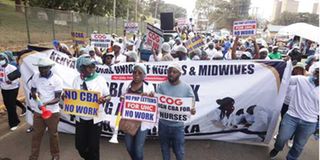
Kenya National Union of Nurses workers protest in Nairobi. They were demanding the implementation of their collective bargaining agreement.

The nationwide health workers’ strike entered its second day yesterday, with more patients turned away from public hospitals as nurses joined clinical officers, laboratory technicians and public health officers on the picket line.
At Pumwani Maternity Hospital in Nairobi, the corridors were unusually quiet. A nurse in charge of the milk bank unit, where mothers donate milk for vulnerable infants, was absent due to the strike, while three locum nurses were deployed to the Newborn Unit to bridge the gap. Striking nurses also staged peaceful protests outside the Ministry of Health headquarters, seeking an audience with Health Cabinet Secretary Aden Duale.
George Gibore, Secretary General of the Kenya Union of Clinical Officers (KUCO), warned that patients now have little choice but to seek treatment at private facilities. He said children and expectant mothers risk missing immunisations and routine clinic visits because of the shortage of specialised staff.
“The health indicators are going to change tremendously. Facilities that normally see up to 3,000 patients a day are now receiving only about 300. It is not a good picture,” he said.
Gibore said the dispute could be resolved if the parties returned to the negotiating table. He noted that Universal Health Coverage (UHC) workers have been demanding payment of service gratuity since 2023 despite the government allocating funds. They are seeking gratuity equivalent to about 31 per cent of their basic salary, estimated at Sh300 million.
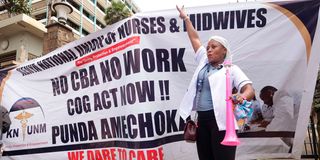
A nurse gesturing next to a banner at the entrance of Afya House in Nairobi on July 30,2026 during the Kenya National Union of Nurses workers protests demanding the implementation of their Collective Bargaining Agreement (CBA) and calling on the Council of Governors (CoG) to sign and honor the negotiated deal.
He added that although clinical officers signed their Collective Bargaining Agreement (CBA) earlier this year, implementation stalled after some counties declined to sign, saying they first wanted to internalise it.
Public health officers, who have been on strike for two weeks, warned of grave public health risks.
Brown Ashira, Secretary General of the Kenya Environmental Health and Public Health Practitioners Union, said disease surveillance had been severely weakened.
“In the event of an outbreak, we are likely to see an upsurge of diseases because there is no one doing the prevention work,” he said, warning that Kenya remained vulnerable to cross-border disease outbreaks, including Ebola, without officers screening travellers.
He also warned that food safety inspections had stalled, increasing the risk of disease outbreaks.
“Our outlets are now selling food that may contain contaminants that could lead to another cholera outbreak,” he said.
Ashira urged the national government and the Council of Governors to resolve the impasse through dialogue, saying the standoff was hurting ordinary Kenyans.
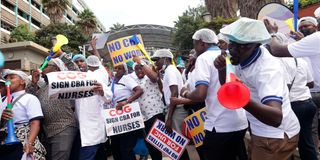
Nurses dancing outside Afya House in Nairobi on July 30, 2026 during the Kenya National Union of Nurses workers protests demanding the implementation of their Collective Bargaining Agreement (CBA) and calling on the Council of Governors (CoG) to sign and honor the negotiated deal.
Nicholas Odipo, Chairperson of the Kenya National Union of Medical Laboratory Officers (KNUMLO), said blood transfusion services had been crippled nationwide.
“Right now, blood transfusion services have been paralysed. I wonder what is happening when patients need surgeries. Emergency services are also at stake because they need blood,” he said.
He accused the government of discriminating against laboratory officers in implementing agreed policies, saying funds for UHC workers had already been allocated.
Dennis Oduor, the Nairobi branch Secretary General of the union, warned that laboratory technicians in the capital would soon join the strike if their grievances remained unresolved.
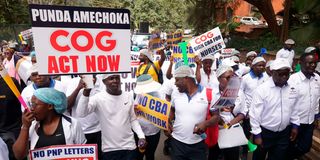
Kenya National Union of Nurses workers protest in Nairobi on July 30, 2026, demanding the implementation of their Collective Bargaining Agreement (CBA) and calling on the Council of Governors (CoG) to sign and honor the negotiated deal.
In Embu County, health workers downed tools to protest poor terms of service and delayed salaries, leaving patients stranded at Embu Level Five Hospital and other public facilities.
In Murang’a County, 79-year-old Susan Ndegwa said she had gone to Murang’a Level Five Hospital to check her blood pressure only to find services suspended.
“The guards at the hospital told me no services were being offered. I will go home and wait on my God since I do not have money to seek private health services,” she said.
Another resident, Wanjiku Githuka, said she could not obtain a postmortem for a deceased relative unless she paid Sh30,000 privately instead of the usual Sh3,000 mortuary fee.
Murang’a County Health Chief Officer Eliud Maina confirmed that public health facilities had been crippled, while County Director of Health Dr James Mburu said talks with union officials were underway.
The Kenya National Union of Nurses (Knun) said its members officially joined the strike at midnight on July 28, adding to the industrial action by UHC workers, clinical officers and laboratory technicians.
A spot check at Murang’a Level Five Hospital found maternity, High Dependency Unit (HDU) and emergency wards operating with medical interns, community health volunteers and health records interns filling gaps left by striking nurses.
At Coast General Teaching and Referral Hospital in Mombasa, new admissions were suspended as nurses stayed away.
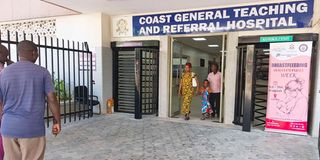
Members of the Public at the Main Entrance of the Coast General Teaching and Referral Hospital (CGTRH) in Mombasa as Kenya National Union of Nurses and Midwives (KNUNM) began a Nationwide Strike in this photo taken on July 30, 2026.
One patient from Tana River said he had travelled to the hospital seeking treatment but was turned away and forced to seek care at a private facility.
Although outpatient services continued, hospital staff said they were overwhelmed.
“We cannot effectively run the hospital without nurses. This is a huge crisis,” said a senior doctor.
Striking nurses accused the county government of ignoring their grievances.
Knun Mombasa Branch Chairman Erick Otieno said the county had failed to promote nurses, convert eligible staff to permanent and pensionable terms, remit statutory deductions and conclude the 2025-2029 CBA.
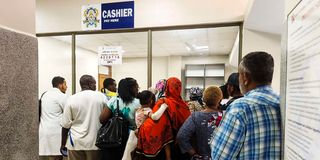
Members of the Public queue to pay at the Coast General Teaching and Referral Hospital (CGTRH) in Mombasa as Kenya National Union of Nurses and Midwives (KNUNM) began a Nationwide Strike in this photo taken on July 30, 2026. Most Patients were released to seek services at other facilities.
He said nurses also wanted full implementation of the 2017 Return-to-Work Formula and Public Service Commission career progression guidelines.
Operations were also disrupted at Port Reitz, Tudor and Likoni hospitals.
In response, Mombasa Governor Abdulswamad Nassir announced the immediate recruitment of 573 nurses on contract to maintain services.
“We cannot politicise health. We will not allow anyone to hold patients hostage,” he said, adding that the county would abide by any court ruling on the legality of the strike.

Mombasa County Governor Abdulswamad Nassir (right) with Farida Abdalla (centre), the County Service Board and Evans Oanda (left) the County Executive for Finance, addressing the press on the ongoing nurses' strike in this photo taken on July 30, 2026.
In Lamu County, more than 200 nurses joined the strike, although only a few took part in public demonstrations.
Knun Secretary Eric Otieno blamed the Salaries and Remuneration Commission (SRC) and the Council of Governors for delaying implementation of the 2017 Collective Bargaining Agreement (CBA), including the conversion of nurses on contract terms to permanent and pensionable employment.
“We shall strike until all our grievances are heard,” he said.
A spot check at King Fahd County Hospital showed services continuing, although some nurses admitted they had stayed away from demonstrations for fear of victimisation.
Rift Valley and South Rift
In Nyandarua and Laikipia counties, patients turned to private hospitals as public facilities remained crippled. The situation was compounded by delays in accessing treatment through the Social Health Authority (SHA).
James Maina, Secretary of the Nyandarua County Nurses Union, said the strike would continue until the workers’ demands were met.
In Kericho County, more than 200 health facilities remained disrupted despite the county government reaching agreements with three unions representing doctors, clinical officers and laboratory workers.
Kericho Referral Hospital and six sub-county hospitals were among the worst hit.
“We came here hoping services had resumed, only to find doctors, nurses and other health workers still on strike,” said resident Peter Serem.
Pauline Rono, a patient at Kapkatet Hospital, said she had gone without treatment for three days.
In Bomet County, services remained disrupted at Longisa County Referral Hospital and several sub-county hospitals as the industrial action entered its second day.
“We sought treatment at Longisa County Referral Hospital, but the medics do not seem bothered by the plight of patients,” said caregiver Joyce Cheptoo.
A similar situation unfolded in Narok County, where patients at the county referral hospital and other public facilities were forced to seek treatment at private clinics.
In Kisumu, medical interns and students on clinical attachment became the frontline providers of care at the county referral hospital as patients endured long delays in receiving treatment.
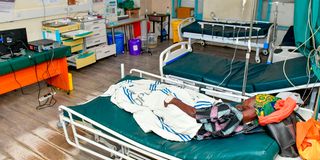
A patient lies unattended in the emergency unit at Kisumu County Referral Hospital on July 29, 2026, after being admitted overnight before the nationwide nurses' strike began. Most patients had yet to receive nursing services following the commencement of the industrial action at midnight.
In Kisii, Dorothy Kemunto spent the day moving from one hospital to another seeking admission for her ailing mother after operations at Kisii Teaching and Referral Hospital ground to a halt.
In Homa Bay, the county referral hospital suspended new admissions as the nurses’ strike entered its second day.
The expanding industrial action has paralysed healthcare services across much of the country, with nurses joining clinical officers, laboratory personnel and public health officers already on strike.
The unions are demanding implementation of collective bargaining agreements, payment of Universal Health Coverage (UHC) workers’ gratuity, promotion of staff, conversion of contract employees to permanent and pensionable terms, and adoption of Public Service Commission career progression guidelines.
County governments and the national government have continued to trade blame over implementation of the agreements, while negotiations remain stalled.
As the impasse drags on, the biggest casualties are patients, many of whom are being forced to seek expensive treatment in private facilities or postpone critical medical care altogether.
Report by Hellen Shikanda, George Munene, Mwangi Muiruri, Martin Mwaura, Hellen Aura, Winnie Atieno, Kalume Kazungu, Waikwa Maina, Mercy Koskei, Vitalis Kimutai, Domnic Ombok, Ruth Mbula and George Odiwuor