Nairobi’s flood survivors recount trauma as mental health crisis deepens

What you need to know:
- The floods in Pipeline and Mathare didn't just destroy homes; they shattered lives.
- Experts now warn that the psychological scars, manifesting as fear, sleeplessness, and depression, could be the disaster's longest-lasting effect.
Naomi Mutinda had barely unpacked her bags in Pipeline, Embakasi, before disaster struck. Just 23 days after her move, a sudden flash flood turned her relocation into a nightmare, leaving her four-year-old child missing.

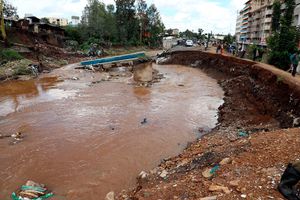
On Friday night, floodwater entered her house for the first time since her arrival. She wrapped her child on her back and stepped out to seek safety in their neighbours’ houses, which were on higher ground. Outside the gate, a ditch they would usually jump over had turned into a furious stream. An hour later, as they tried to figure out how to cross, a surge of floodwater swept them off their feet.
Residents say the water, worsened by poor drainage, had breached the walls of Kware Primary School, flooding the streets and entering homes.
"The water took us while my child was still strapped to my back. I still don’t understand the moment he slipped away. I was swept 100 metres downstream before I managed to grab hold of a shipping container and climb to safety. Eventually, the villagers threw me a pipe and pulled me from the current, but I was already empty-handed," says Naomi.
"We have been searching since the moment the water receded, but he is still missing. He is only four, and my only child, and the desperation is all I have left. I am staying with a friend now because I cannot face an empty house. Every day, we go to the City Mortuary to look at the bodies, hoping and praying at the same time that he isn't there," she adds.
Risper Atieno, Naomi’s neighbour, recalls seeking shelter at a nearby flyover.
"As the water breached the door, I strapped my child to my back and ran for the flyover. When I tried to double back just to grab him a sweater, the current had already turned the street into a river. From the height of the flyover, I watched the flood burst through our gate, swallowing everything we owned. I have been in these same clothes and shoes since Friday; I haven’t slept because my mind won't let me," she explains.

"We spend our days haunting the streets because our homes are still heavy with damp and silt. Most of us are casual labourers, but we are too terrified to leave for work. How can we go when we are scared our children won't be there when we return? The children we plucked from the floods are now shivering in the open air, falling sick with pneumonia and chest infections. We have no blankets to warm them and no medicine to help them recover.”
She adds that they are surviving on the grace of friends. “Those of us lucky enough to know someone unaffected are forced to leave our children behind just so they can have a meal and a safe place to sit while we go out to scavenge for a solution. I only moved here a month ago; the landlord never warned me that this home was actually in a flood zone. I walked into a trap I didn’t know was set," she says.
No help
Risper adds that despite multiple visits from officials who took down their names, no tangible assistance has been received.
"We are starting from nothing. The water took everything: our children’s uniforms, their schoolbooks, and the very ground we stood on. But the supplies don't matter when the children themselves are missing. Two of our little ones were swept away, and we are still searching the mud for them.”
In Mathare 4A, Charles Ombidi recalls the night floods of 2024 that claimed his sister, niece, and nephew, leaving his mother, the sole survivor, with post-traumatic stress.
"My mother had travelled to Nairobi for treatment and was staying with my sister for the duration of her care. My sister's house was close to a river, and when the rains began to fall in torrents, she decided to move the family to seek shelter at her friend's house on higher ground," he says.
That night, while they slept, the water kept rising, saturating the area and submerging their house with nine people inside. His 60-year-old mother was rescued by community members who heard her screaming. She would be the only survivor.
"When the news reached me that the water had taken people, I ran to the scene, praying it wasn't true. I found my mother shivering, soaked in mud from head to toe, limping, and bleeding from a gash on her ankle. She was in such deep shock she had lost her voice. I brought her home, sat her down with a meal, and then turned back toward the water to find my sister and the children," says Charles.
"I spent the entire morning searching, but the water wouldn't give them up. By 1pm, I had to stop to get my mother to the hospital. While we were there, the phone rang; they had found two bodies. One of them was my sister. We found her daughter that evening, but it took three more days for the river to release my nephew. A week later, we stood over three graves and laid them all to rest together.”
As his mother continued treatment, Charles slowly began to realise that she was now terrified of stepping outside, refusing even the short walks the doctor prescribed. And when she finally went home, she vowed never to return to Nairobi.
"I would soon realise that she had been mentally affected. She started saying things that didn't make sense; a total stranger to the woman I knew. It was the weight of being the only one left. It was as if she couldn't forgive herself for surviving while her child and grandchildren were gone," says Charles.
He explains that even though he understands his mother's trauma, accessing psychosocial support for her while upcountry is challenging and costly. This means that the only counselling she receives is from her children.
According to Arthur Gichuru, a psychologist at Serenityminds Wellness in Westlands, Nairobi, natural disasters such as floods and fires do not only leave behind physical destruction; they also cause deep psychological and emotional distress among survivors. He notes that the emotional toll of disasters can sometimes last much longer than the visible damage.
Mr Gichuru adds that while emergency response efforts often focus on rescuing victims and treating physical injuries, the psychological effects are frequently overlooked.
"From a psychological perspective, disasters disturb people's sense of safety and control. They may even feel they have lost their sense of belonging. This can affect their future stability, leaving them with a constant feeling that another danger could occur tomorrow or sometime in the future," he explains.
He warns that victims of disasters such as floods can develop trauma or even post-traumatic stress disorder if the psychological effects are not addressed in time.
"When someone goes through a traumatic event, they may start experiencing nightmares about the incident, panic whenever they hear heavy rain, or even feel anxious when they see dark clouds forming. Others develop a constant fear that another disaster might happen. Many also experience sleep problems, anxiety, and chronic stress," adds Mr Gichuru.
"People begin to worry about rebuilding their lives, about food, shelter, and their future. Some feel overwhelmed and helpless. Disasters also bring significant losses that can affect survivors' mental health. All disasters come with some form of loss. Some people lose cars, laptops, mobile phones, or even their homes. If that loss is not well managed psychologically, it can lead to mood disorders such as depression.”
He adds that depression among disaster survivors can present itself through hopelessness, withdrawal from others, and loss of motivation. The psychologist also stresss that disaster response should not only focus on physical rescue and relief but also on mental health support.
One key intervention, he notes, is psychological first aid, which involves immediate emotional support for survivors.
"The government should establish a structured system to provide psychological first aid to victims. The good thing is that we have seen humanitarian organisations such as the Red Cross doing this. After rescuing victims, they bring in psychologists and counsellors who walk with them through the healing process.”
He also emphasises the importance of safe spaces and support centers for displaced victims.
"For example, if your apartment has been affected by floods, you cannot simply return the next day. You need a place where you feel safe and supported.
These spaces can also be used for group counselling, child-friendly programs, and stress-management sessions.”
He notes that children are also deeply affected by disasters and require specialised interventions. “We can introduce child-friendly spaces where children engage in art therapy, storytelling, and other activities that help them process their experiences," he adds.
Public awareness, he says, is key in preventing long-term psychological damage among disaster victims.
“We must sensitise people about the symptoms and effects of trauma after disasters so that the psychological and emotional impact is not neglected. If we fail to address it, many people will end up suffering from anxiety or post-traumatic stress disorder.”
"We thank organisations such as the Red Cross and Médecins Sans Frontières for the support they provide during disasters. Professional bodies like the Kenya Counsellors and Psychologists Association have also been very vital in providing psychological support,” he concludes.