Nature under siege: From cranes to crocodiles, Kenya’s wetlands are losing their wild heart
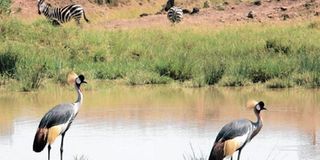
Grey-crowned cranes at a pond in the Maasai Mara: There has been increased destruction of wildlife and the eco-system in the country. /Reuters

What you need to know:
- With fewer than 8,000 grey crowned cranes left in Kenya and key wetlands drying up at an alarming rate, conservationists are sounding the alarm.
Kenya’s wetlands, once teeming with rare birds, shy antelopes, and white crocodiles, are vanishing under the weight of human encroachment.
Expanding farmland, swelling settlements, and large-scale development are swallowing these fragile ecosystems, triggering what experts warn is a national conservation crisis. With fewer than 8,000 grey crowned cranes left in Kenya and key wetlands drying up at an alarming rate, conservationists are sounding the alarm. They say that if no urgent action is taken, the country risks losing some of its most critical biodiversity hotspots.
The environmentalists note that wetlands, which cover just 3–4 per cent of Kenya’s landmass, are vital for climate regulation, water purification, and food security, in addition to providing habitat for endangered species. Yet most are under severe pressure from agriculture, infrastructure projects—especially hydropower—and human resettlement.
In response, agencies including the International Crane Foundation, Kenya Wildlife Service (KWS), Kenya Forest Service (KFS), and the National Environment Management Authority (NEMA) are working with county governments to restore degraded wetlands. Their efforts focus on afforestation, community education, and protection of remaining habitats.
“The increased demand for land for farming, resettlement, and water extraction for domestic and industrial use poses a serious threat to the survival of wetlands despite being home to rare wildlife species like the Grey Crowned Crane, Sitatunga, and crocodiles,” said Dr John Chumo, conservation secretary at the State Department for Wildlife.
Key habitats
He highlighted the sharp decline of the Grey Crowned Crane, now listed as endangered. Kenya’s population has plummeted to under 8,000 individuals, with key habitats in Nandi, Laikipia, Nyeri, and parts of the Rift Valley. Across Africa, just 30,000 remain in 15 countries; 80 per cent global decline over the past three decades.
“The Grey Crowned Crane is in danger. Habitat destruction, wetland drainage for agriculture, egg and chick harvesting for pets or illegal trade, and climate change—which dries wetlands and disrupts breeding cycles—are among the major threats,” Dr Chumo said during the Nandi County Crane Festival at Kosirai High School.
He added that the government is stepping up conservation through law enforcement, anti-poisoning campaigns, and rapid response teams to tackle wildlife poisoning.
Dr Chumo also highlighted the rapid deterioration of Lake Kamnarok Game Reserve in Baringo County, once a thriving ecosystem but now collapsing under the weight of charcoal burning, tree cutting, and farming.
“It is unfortunate that we have lost rare white crocodiles in Lake Kamnarok due to massive environmental destruction. More wetlands are likely to face extinction unless serious conservation efforts are enforced,” he warned.
Lake Kamnarok, gazetted in 1983 and spanning 87.7 square kilometres, was once ranked Africa’s second-largest wetland ecosystem after Lake Chad, hosting more than 10,000 white crocodiles, 15,000 elephants, and 13 other mammal species. Today, most animals have either perished or migrated to Rimoi Game Reserve in the neighbouring Elgeyo Marakwet County.

Conservation Secretary at the State Department for Wildlife, Dr John Chumo (holding a tree seedling), plants a tree to mark World Crane Day at Kosirai High School in Nandi County on September 20, 2025.
As part of Kenya’s 15 billion tree planting campaign by 2032, the government is targeting wetlands, including Yala, Nyando, Lorian, Ondiri, and Shompole swamps, for reforestation, working with local communities and county authorities.
“Wetlands are essential for regulating river flow, climate control, water purification, and waste treatment, but they are under threat from human settlement,” Dr Chumo said.
The Sitatunga antelope, a shy, semi-aquatic species, is also among the most vulnerable. Encroachment for farming, grazing, and other land use changes has shrunk its habitat.
“The change of land use for crop production, overgrazing, and siltation are some of the biggest challenges in conserving wetlands.”
Known for their elusive nature, sitatungas are usually spotted at dusk. Males, with their distinctive twisted horns, are often seen battling for dominance. According to KWS, King’wal Swamp in Nandi County holds the largest population—over 200 animals—while Saiwa National Park in Trans Nzoia supports just over 100 and Kesses Swamp in Uasin Gishu about 60.
Despite their ecotourism potential, their survival is increasingly uncertain.
“The water volumes in most wetlands have drastically declined due to massive destruction even though wetlands make up just three to four per cent of Kenya’s land mass and are crucial for soil formation and nutrient cycling,” said Eldoret-based environmental expert John Kosgei.
He stressed that wetlands act as natural flood buffers, prevent soil erosion, and purify water—functions now severely compromised.
Environmentalists are now calling on the government to tighten regulations, strengthen local conservation initiatives, and boost public awareness to prevent further destruction of Kenya’s shrinking wetlands.
Wetlands in global decline
•Fastest disappearing ecosystem: The United Nations estimates that wetlands are vanishing three times faster than forests. Since 1970, about 35 per cent of global wetlands have been lost.
•Biodiversity at risk: Wetlands are home to 40 per cent of the world’s plant and animal species, many of them endangered.
•Climate shield: Wetlands store more carbon than any other ecosystem. Peatlands alone hold twice as much carbon as all the world’s forests combined.
•People’s lifeline: More than one billion people rely on wetlands for food, water, and livelihoods.
•Global response: The Ramsar Convention on Wetlands (signed in 1971) remains the key international treaty protecting wetlands, with 172 member states.
Sources: UN Environment Programme, Ramsar Convention Secretariat, World Wide Fund for Nature.