No English name, no future: How language loss erases climate-resilient seeds
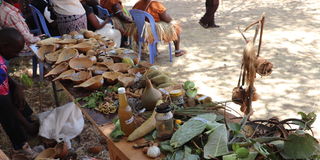
Indigenous seeds and herbs on display during the biocultural festival in Chiakariga, Tharaka Nithi County on September 22, 2025.

What you need to know:
- With every indigenous word forgotten, a seed disappears. Communities are now fighting to reclaim their language to secure their food future.
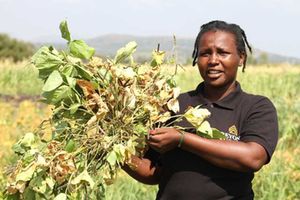
Francis Mugau remembers two crops that saved his village during droughts: Mukuumbu, a red sorghum with downward-facing panicles, and Mugeeta, a white-panicled millet that thrived when other crops failed. Both varieties survived Tharaka's harsh climate for generations, feeding families during lean seasons when rainfall disappointed.
Now, as climate change makes weather patterns increasingly unpredictable, these drought-resistant crops are gone, and Mugau says they may be impossible to recover because they never had English or Swahili names.
Climate-resilient crops lost to language shift
At 73, Mugau has watched Tharaka Nithi County's climate become more erratic over his lifetime. Rainfall patterns that were once predictable have become chaotic. Droughts last longer. When rains come, they often arrive at the wrong time for planting. Modern crop varieties struggle with these conditions.
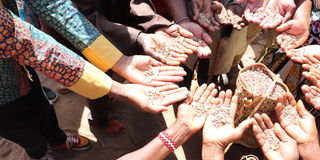
Seed savers display seeds during the Kibuka appeasement at Thana River in Tharaka.
The traditional varieties Mugau remembers were selected over generations specifically for Tharaka's tough environment. Mukuumbu and Mugeeta could withstand extended dry spells and produced reliable harvests even when rainfall was scarce. They were instrumental in making local brew and porridge during times of scarcity, providing nutrition when other food sources failed.
"We used to have Mukuumbu, which is a variety of sorghum but red in colour, and it grew with the panicles facing down, and another one called Mugeeta, which is millet, but with white panicles. These two varieties are long gone," said Mugau, a smallholder farmer from Materi village in Tharaka.
But the loss goes beyond these two varieties. Mugau says there are numerous crops that were extremely resilient to tough climatic conditions but have since disappeared. It is becoming impossible to trace them because they did not have English or Swahili names. As the Tharaka language fades from daily use, especially among young people, the knowledge of climate-adapted varieties is disappearing with it.
This is not just a cultural loss. It is a climate adaptation crisis. Researchers cannot trace crops they cannot name. Seed banks cannot catalogue varieties that exist only in fading memories and a marginalised language. And farmers cannot teach the next generation about drought-resistant crops when the words to describe them are vanishing.
Indigenous knowledge for climate prediction
The connection between language and climate resilience extends beyond crop varieties. Indigenous languages also encode sophisticated systems for reading environmental signals that help farmers adapt to changing conditions.
At the Tharaka Biocultural Festival in Chiakariga on September 21, Roseagnes Nkatha learned traditional climate prediction methods she had never encountered in formal education. The 24-year-old medicine student discovered that elders read bee migration patterns to forecast weather.

Simon Mitambo, the team lead at the Society for Alternative Learning and Transformation, at Kibuka Shrine where elders met to appease Tharaka ancestors ahead of October rain season.
When bees migrate from the hills down to the valley, it signals thaana, the onset of the dry season. When they return to the hills, rain will come within a week. This knowledge, passed down through generations in the Tharaka language, allowed farmers to time their planting precisely, a critical advantage in a region where mistiming can mean crop failure.
"I have also seen many plants, some which I never knew their names, being displayed by elders as essential remedies for different ailments including arthritis and high blood pressure," said Nkatha. "I have as well seen others like Matomoko, which I only knew as food, also being displayed as herbal medicines."
The festival brought together 3,000 people, including elders from the Maasai's Laibon, the Kaya from the Coast, the Ogiek, and the Gikuyu, led by the Mugwe elders of Tharaka.
The three-day gathering was organised to evoke ancestral spirits to bring down the rains and bless seeds ahead of the October planting season, a ritual that reflects traditional approaches to managing climate variability.
Dr Patrick Kanampiu, a linguist from Tharaka University, said indigenous languages encode detailed information that modern climate science is only beginning to understand and value.
"Language is the most important tool through which culture is expressed, and it is the custodian of indigenous knowledge," said Dr Kanampiu. "It is through indigenous languages that we find names of event, different crop varieties, herbs, trees, and it encode detailed information about soils, seeds, seasons, animals behaviours, and local ecosystems."
He said this ecological knowledge, refined over centuries of observation and adaptation, is precisely what communities need as climate change makes traditional growing conditions obsolete and forces farmers to experiment with new approaches.
Why language revival matters for climate adaptation
The Society for Alternative Learning and Transformation (SALT) is working with Tharaka University and local elders to revitalise the Tharaka language. The effort is explicitly framed as a climate adaptation strategy.
"Our languages carry the codes of our farming knowledge, our rituals, our ecological wisdom and instructions from our ancestors on how to live in harmony with nature," said
Simon Mitambo, team lead at SALT. "It will not be possible to revive the climate-resilient indigenous food systems without revitalising indigenous languages."
The organisation argues that indigenous food systems, developed over generations to work within specific ecological conditions, offer solutions to climate challenges that industrial agriculture cannot match. Traditional crops are often more drought-resistant, require fewer inputs, and are adapted to local soils and microclimates. But accessing this adaptive capacity requires the language in which that knowledge was developed and transmitted.
Mugau explained that knowledge about climate-adapted crops and cultivation techniques was traditionally passed from one generation to another through oral storytelling, traditional songs and dances, and through festivals like the one in Chiakariga.
"All these communication channels have been replaced with TV screens, smart phones and computers, which use foreign language, with little or no regard to indigenous knowledge," he said.
Dr Kanampiu attributed the marginalisation of indigenous languages to colonialism, which imposed foreign cultures and languages on Africa while portraying many African cultures as witchcraft and dismissing African languages as primitive. That mindset persists today, even as climate change makes the knowledge encoded in those languages increasingly valuable.
"Most of the youths in Tharaka as well as many other communities across the country tend to prioritise majority languages, which in this case are Kiswahili and English while ignoring or sidelining their indigenous languages," said Dr Kanampiu.
A study in the International Journal of Applied Linguistics and Translation supports the connection between language and sustainable farming. It finds that effective communication of agricultural innovations occurs through languages people understand best, and that language carries cultural beliefs, taboos, and attitudes that affect how people perceive and embrace new practices.
"Language is part of culture and culture as a way of people's life encompasses beliefs, taboos and attitudes," the study notes. "These aspects affect how people perceive, internalise, react to and embrace issues, innovation and technology issues included."
Seeds as climate insurance
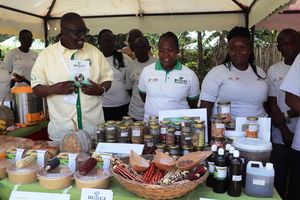
During the festival, farmers brought traditional seeds that have survived the harsh climatic conditions of Tharaka for generations. They exchanged varieties and shared observations about how different crops are responding to changing weather patterns.
The seed exchange serves as a form of climate insurance. Each traditional variety represents generations of selection for specific traits like drought tolerance, pest resistance, or the ability to mature quickly if rains are short. As climate change makes growing conditions less predictable, this genetic diversity becomes more valuable.
With temporary permission from the Tharaka Nithi County Government, participants brewed traditional drinks called uki and marwa using honey and indigenous grains. For three days and nights, people drank these brews alongside traditional dishes made from sorghums, pearl and finger millet, and cowpeas while dancing to honour their ancestors.
These grains, indigenous to the region, were selected over centuries for their ability to produce under local conditions. Unlike many modern varieties bred for high yields under optimal conditions, traditional crops often perform better when conditions are poor, exactly the scenario climate change is creating.
Herbalists displayed herbs used since ancient times to treat various ailments, exchanging seeds and knowledge. Many of these plants have adapted to thrive in Tharaka's challenging environment and could offer climate-resilient options for food security and medicine.
"These are our traditional seeds. They are not just sources of food and medicine, but they embody our identity, culture, history, heritage and survival," said Mitambo. "To restore our cultural food systems that are resilient to climate chocks, we must reconnect with the indigenous knowledge that sustained our ancestors."
The ceremony began with the appeasement of Kibuka, the legendary Tharaka ancestor, in the middle of Thana River, before culminating in the festival that brought together representatives from academia, Tharaka Nithi County Government, conservation organisations, cultural groups, and the legal sector.
The 2010 Kenyan Constitution provides some framework for this work. Article 11, sub-article 2(a) calls on the state to promote all forms of national and cultural expression, while sub-article 2(b) requires recognition of indigenous technologies in national development.
But constitutional provisions do not reverse decades of language shift or restore lost crop varieties. For Mugau, the question is whether efforts like the festival and language documentation can move fast enough to capture knowledge before the generation that holds it passes away, and before climate change makes that knowledge even more urgently needed.
As rainfall becomes more erratic and droughts more frequent, the crops that sustained Tharaka communities through past climate variability could offer solutions for the future. But without the language to describe these varieties precisely, even if seeds were found, the accumulated knowledge about cultivation, processing, and optimal growing conditions might already be irretrievable.
Mugau remains uncertain whether his grandchildren will ever taste Mukuumbu or know the specific conditions that made it thrive when other crops failed. He cannot predict whether the traditional weather forecasting methods encoded in the Tharaka language will survive into the next generation.
Still, he keeps coming back to the festival. He brings the seeds he has, shares what he remembers about which crops survived past droughts, and talks to young people like Nkatha who show interest in traditional knowledge.
"This is an annual event that brings together all clans of Tharaka community and elders from different communities, including spiritual leaders from the Maasai's Laibon, the Kaya from the Coast, the Ogiek, and the Gikuyu elders led by the Mugwe elders of Tharaka to celebrate, dance, eat traditional food, drink local brew, but most importantly, pray for the rains and exchange indigenous seeds ahead of the planting season," said Mitambo.