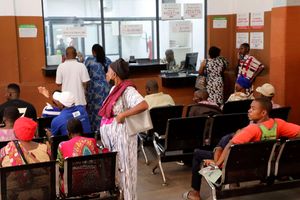
Nurses: The true frontline heroes we neglect at our peril

Meru nurses stage protests, accusing the county government of intimidation.

What you need to know:
- As we speak about UHC, the focus on service delivery does not seem to adequately address human resource for health.
- The nurses are the most important cadre in health service delivery.
- They are the true frontline workers, yet they are largely forgotten and, in many instances, go unsupported.
“I, XXX, solemnly pledge myself before God and in the presence of this assembly, to pass my life in purity and to practise my profession faithfully. I will abstain from whatever is deleterious and mischievous, and will not take or knowingly administer any harmful drug. I will do all in my power to maintain and elevate the standard of my profession, and will hold in confidence all personal matters committed to my keeping and all family affairs coming to my knowledge in the practice of my calling. With loyalty will I devote myself to the welfare of those committed to my care. So, Help Me God”. This sacred pledge is one our nurses live by.
Last week, those who took the Nurses pledge congregated in Kisumu at the Grand Royal Swiss Hotel for their annual scientific conference. The theme of their conference was “Nursing Power to Change the World: A Call to Transformative Healthcare”, a very apt theme for the tough times the profession is dealing with.
The current state of the health sector is quite shaky. The intent of the country to achieve universal health coverage (UHC) is clear. The challenge is in how we get there in a manner that is sustainable, realistic and equitable.
As we speak about UHC, the focus on service delivery does not seem to adequately address human resource for health. The nurses are the most important cadre in health service delivery. They are the true frontline workers, yet they are largely forgotten and, in many instances, go unsupported.
Take for instance Migori, where for months on end, the county was unable to employ any new staff due to a court injunction as the outgoing County Public Service Board took the devolved unit to court over their dismissal. This meant that the county was unable to replace their staff who were going into retirement, those who left the service, those who were away for further studies, and those who passed on.
The protracted court battle led to severe understaffing in the county, most noticeable in the health facilities. During a visit to Rongo Sub-county Hospital, the reality hit home. The facility could only afford to have two nurses on duty in the maternity unit at any one time. Yet this is a facility that attends to up to 150 deliveries in a month.
What struck me was not the shortage, but just how the nurses had normalised this occurrence. They had become accustomed to carrying the load, with the nursing officer in-charge splitting her time between the office and the maternity unit to help out, her administrative title notwithstanding. The nurses remained jovial in their service despite the overstretched ward with extra beds squeezed in to accommodate every mother and baby, a true testament of the amount of work going on there.
Overworked
The hospital has no obstetrician, but there is an operating theatre, where an extremely overworked medical officer literally lives as he attends to all emergencies as they come. The clinical officers hold fort at the emergency department and respond to all distress calls within the facility. What many don’t see is that every time the medical officer conducts a surgery, the nurses must be present to scrub in with them. Every time a clinical officer reviews a patient, a nurse must be at hand to execute their instructions.
There is no health system without nurses. When nurses go on strike, a situation that should never ever happen in any country that is serious about its health systems; the entire health facility shuts down, even where there is a full complement of doctors, clinical officers, pharmacists and laboratory teams.
Ward rounds
This is the moment one discovers that doctors have no idea how many of the drugs they prescribe look like. They realise they do not know how to reconstitute or even administer some of these medications. Doctors will come for their daily ward rounds and spend an average of 15 minutes at the patient’s bedside. They will heavily depend on
the nurse’s vital signs observation charts and reports as they make decisions on the way forward regarding the patient’s care.
After their ward visit, the doctors will head out to other duties, leaving the patient with the nurses. They are scheduled to ensure full-time presence in the wards as the immediate caregivers. They are the first to identify complications and flag them; the ones who ensure patients are fed, have clean linen on their beds and their treatment is administered in a timely fashion.
As a result, they feel the brunt of poor resourcing of health facilities the most. Their hands are tied when health facilities have no vital drugs, lack non-pharmaceutical supplies, or clean linen. They are the ones forced to innovate and make do to keep patients alive.
Also read: 138 days of silence at Kiambu Hospital
Despite these deep sacrifices, as a country, we fail to appreciate the value of these irreplaceable persons who keep our struggling health systems afloat. The current discussions around human resources for health in Sub-Saharan Africa seem to view health worker shortages as a result of inadequate numbers of healthcare workers being available to provide skilled healthcare. As a result, the solutions they advocate for tend to be unidirectional, seeking to replace skilled care with alternative limited skillset through task-shifting.
This is not what sub-Saharan Africa needs. What we need is to advocate for countries to put to use the skilled workforce they have that they have refused to employ. It is disconcerting to see donor support for task-shifting from countries that would never use the same approach for their own care.
This is what we call poor solutions for poor people. One cannot advocate for task-shifting while gobbling up our locally trained nurses to supplement their workforce. Nurses remain the highest in numbers when it comes to health worker migration. This is driven by better pay, improved working conditions, and career advancement; while resulting in brain drain in their home countries.
We cannot be a country that only seems to invest in training of highly skilled health care workers for other countries. This does not mean that health workers should not migrate at their own free-will. It simply means that we must remain competitive as a country, providing adequate remuneration, professional development opportunities, good working conditions that are well-resourced, and recognition for the work done whenever it is due.
As the nurses continue to grow their skills and expand their experience, they continue to be a force to reckon with in transforming our health systems, if only they are given a chance. Their innovation, research and commitment has not been adequately tapped into, yet they are the ones who are on the ground. Even the most remote dispensary in
Lokitaung will only be regarded as a functional health facility when there is a nurse present.
Our amazing nurses hold fort without fear or favour even when the health facility is in hostile territory. Like a good pilot, they will stay put, even as the last of them have disembarked. It may not be the International Nurses’ Week, but these true heroes require a daily celebration!
The writer is a gynaecologist/obstetrician