Nyandarua community restores ghost forest, one seedling at a time
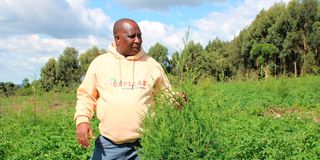
Thomas Ndiritu, COPICAD CEO, explains about a newly planted Cedar tree at Gikingi Unit in Olbolosatt Forest on April 28, 2025.

What you need to know:
- After the trees disappeared, the forest became an open grazing zone, with hundreds of cattle destroying young trees and natural vegetation.
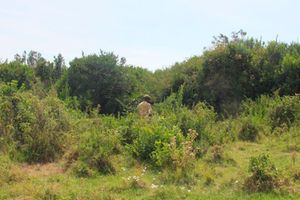
The dawn mist hangs like a veil over Olbolosatt Forest, where Faith Wairimu walks between rows of young seedlings, her hands gently brushing their tender leaves. Around her, the forest is awakening—not for the first time, but for the second. This is a story of rebirth.
"When I walk around Nyahururu town and see buildings owned by those who cleared our forest, it hurts," says Wairimu, one of the volunteer scouts now protecting the forest.
"They made riches but left us to pay the price."
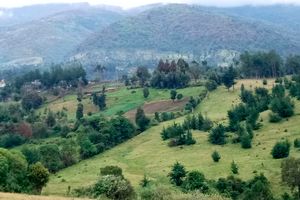
That price has been written across the landscape of Nyandarua County for decades. Since the massive logging operations of the 1970s and 80s, rains became scarce, destructive winds intensified, and the rivers feeding the precious Lake Olbolosatt gradually dried up—but the community that once witnessed its destruction is now orchestrating its revival.
Also read: How ordinary villagers transformed 90 hectares of devastated woodland into a thriving ecosystem
Joseph Njuguna, who moved to the area in 1950 to work for a colonial settler, remembers exactly how it happened.
"The degradation started in the late 70s to early 90s during the shift from colonial land ownership to settlement schemes. The government permitted the harvesting – these were influential people," he explains, regret evident in his voice.
Military trucks rolled through these hills day after day, hauling away the forest's wealth. Juliet Wambui recalls the strange juxtaposition of destruction and friendliness.
"The military personnel were friendly – they even shared biscuits and canned meat with us. But we're paying a heavy price today," she reflects.
After the trees disappeared, hundreds of cattle transformed the once-verdant forest into an overgrazed wasteland, destroying any young trees attempting to reclaim their birth right. The environmental domino effect rippled outward, affecting not just the forest but the entire watershed.
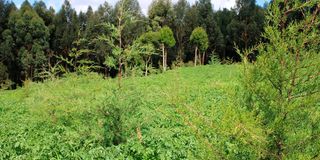
Young trees planted at Gikingi Unit of Olbolosatt Forest.
Today, that same community has become the forest's fiercest defender through an innovative partnership between the Kenya Forest Service and a local conservation organisation called Copicad.
Their approach is elegantly practical. The forest has been divided into nine units, each allocated to a neighbouring community. These units are further subdivided into smaller blocks of about 35 hectares, where community members progressively plant and nurture trees.
Wairimu and her team now stand guard over 2,000 seedlings planted during the annual Olbolosatt Earth Day celebrations. This hands-on stewardship gives communities both responsibility for and connection to the restoration process.
"We cultivate and plant trees in the blocks, then move to the next section when they're big enough," explains Njuguna, who manages the Gikingi Unit. His team has already planted approximately 100,000 trees and plans to plant 70,000 more by December.
The restoration follows ecological wisdom rather than arbitrary timelines. "We plant when it rains for at least two days," Njuguna notes.
"That way, we ensure the seedlings survive."
A forest that flows downstream
Thomas Ndiritu, Copicad's executive director, understands that what happens here affects millions of lives.
"Lake Olbolosatt and its catchment area aren't just about Central Kenya's only natural lake – they're the headwaters of the Ewaso Ng'iro River Basin, a lifeline for millions of people, wildlife, and ecosystems downstream."
The environmental fate of Laikipia, Samburu, Isiolo, and Wajir counties hangs on what happens in Olbolosatt, affecting farms, homes, pastoral lands, national reserves, and fragile ecosystems all the way to the Lorian Swamp.
The restoration is already showing promising results. Wachira Mugo, Nyandarua's Water, Environment, and Climate Change executive, reports that water levels in Lake Olbolosatt have increased from a concerning 10 per cent to about 60 per cent—tangible evidence that the community's efforts are making a difference.
Looking toward the future, Copicad has ambitious plans to expand their work to neighbouring counties by the end of 2025. They're also focused on the climate benefits, projecting that their efforts will sequester 21,000 tonnes of carbon per year, helping Kenya meet its climate commitments while restoring ecological balance.
Passing the torch
What makes this story particularly powerful is how it bridges generations. Young community members like Wairimu are working alongside elders like Njuguna, creating a continuity of care that promises long-term sustainability.
Local schools are now incorporating forest visits into their curriculum, teaching children about native tree species like cedar, olive, and croton. These educational initiatives ensure that younger generations understand both the historical mistakes and the current solutions.
"We're teaching our children that environmental protection isn't just about planting a tree – it's about nurturing a relationship with the land that sustains us," explains a local teacher who brings her students to help with planting days.
The community has developed economic incentives too. While protecting the newly planted areas, they're permitted to cultivate crops between young trees, creating immediate benefits while waiting for long-term ecological restoration.
The Olbolosatt story demonstrates that environmental healing requires acknowledging past failures, community ownership of solutions, and patience. "Rectifying a mess that took place many years ago is not an easy task," Ndiritu acknowledges. "But we are making progress."
Reclaiming future
As visitors walk through the forest today, the suspicious glances from community members watching for potential threats to their trees speak volumes. This isn't just another conservation project—it's a community reclaiming its future, one seedling at a time.
The principle guiding their work, as Ndiritu puts it, is simple but profound: "One tree, one voice, one community."