Optician, optometrist, or ophthalmologist: Who should you see for your eyes?
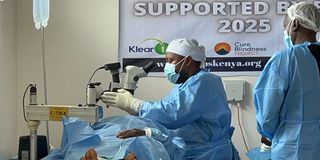
Eye specialists operating on a patient during a cataract surgery camp organised by the Maasai Mara Rotary Club at Emurrua Dikirr in Narok County on May 22, 2025.

What you need to know:
- Mixing the professionals up is not just a matter of semantics. It can mean the difference between a routine prescription update and a missed diagnosis of a disease that could cost someone their sight.
In 2021, Kenya’s health regulator sounded an alarm that most Kenyans never heard.
The Kenya Health Oversight Authority directed all optometrists and opticians in the country to submit their personal and professional details for authentication after its then-CEO, Dr Jackson Kioko, flagged growing concern over the rising number of unregistered or uncertified optical shops and eye clinics springing up across the country. He said most of these outlets were being run by people who were not qualified, and that some Kenyans had suffered worsening eyesight or total blindness after seeking treatment there.
That warning points to a confusion that runs deeper than most Kenyans realise: the belief that anyone behind an optical counter, or any provider offering “eye services,” is equally qualified to diagnose and treat eye problems. In truth, Kenya’s eye care system is built on three distinct professions, each with its own training, legal scope, and regulatory body. Mixing them up is not just a matter of semantics. It can mean the difference between a routine prescription update and a missed diagnosis of a disease that could cost someone their sight.
The dispensing optician: hardware, not health
A dispensing optician trains through a diploma or certificate programme in optical technology or ophthalmic dispensing. Their role is technical rather than clinical, involving fitting and dispensing eyeglasses, contact lenses, and other visual appliances, but only against a prescription written by someone else.
Opticians hold no surgical authority and cannot prescribe medical drugs; their expertise begins and ends with the hardware that sits on a patient’s face.
They are, in effect, the tailors of eye care, skilled at fitting what has already been prescribed, but not trained or licensed to determine what a patient actually needs.
The optometrist: primary eye care
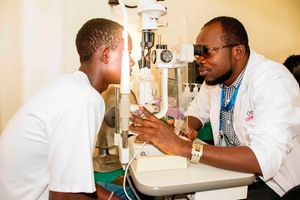
A step up the clinical ladder is the optometrist, who holds a Bachelor of Science degree in Optometry. Optometrists are trained to conduct full visual examinations, diagnose refractive errors, manage low vision, and detect early signs of ocular disease. Unlike opticians, they can write corrective prescriptions themselves and, depending on the regulations governing their practice, prescribe select topical medications.
Optometry remains a non-surgical discipline, and any condition that requires surgical intervention must be referred upward, to an ophthalmologist.
Optometrists also run public awareness campaigns on eye health and the role their profession plays in preserving vision.
For optometrist Victor Opiyo, the biggest threat to Kenyans’ eyesight is not disease; it is delay.
“The behaviour of seeking medical attention for Kenyan patients is worrying. Most of the time, patients come with eye diseases or eye problems at the end stage. We sit with sickness for a very long time, maybe we do over-the-counter eye drops, while something is worsening at the back of the eye,” he says.
Part of the danger, he explains, is that some of the most serious eye conditions give no warning at all.
“We have some eye diseases like glaucoma, which is a silent thief of the eye. You won’t feel any pain, you won’t get any signs. There’s a type called open angle glaucoma that is most of the time painless. You are losing vision from the periphery, so patients are normally not aware of what is happening.”
Opiyo, who is also the President of the Kenya Optometrists Association, points to a stark human-resource gap behind the delays. By his account, Kenya has just over 220 ophthalmologists and around 770 optometrists and optometry technologists serving a population of more than 56 million. That shortage, he says, is compounded by geography.
“Most of the eye specialists are most of the time in the urban and peri-urban areas. The rural areas are left unattended to.” Even where county and sub-county hospitals have dedicated eye units, he says, they often lack basic instruments and consumables, pushing patients to travel to Nairobi for care they should be able to access closer to home.
He is calling on the national government to deploy optometrists to every county and sub-county hospital.
“An optometrist is a primary eye care worker. It is high time the government comes in and looks at eye care in totality, in terms of funding, human resources, consumables, and equipment,” says Opiyo, adding that children are increasingly showing up to health facilities with reduced vision at distance, a condition he links to reduced outdoor play and increased screen time.
The ophthalmologist: medicine and surgery
At the top of the scope sits the ophthalmologist, a fully licensed medical doctor who has completed a Bachelor of Medicine and Bachelor of Surgery before specialising with a Master of Medicine in Ophthalmology.
Ophthalmologists carry the full weight of medical and surgical authority over the visual system, including cataract extractions, corneal transplants, laser surgery, and prescription power over systemic drugs and complex therapies that fall well outside what an optometrist or optician is licensed to touch.
Theirs is the only one of the three professions trained to treat the eye as part of the body as a whole, recognising, for instance, when a vision complaint is actually a symptom of diabetes or hypertension rather than a problem with the eye itself.
Dr Albert Masua, an ophthalmologist with the Kenya Society for the Blind, says the leading cause of reversible blindness in Kenya is cataracts.
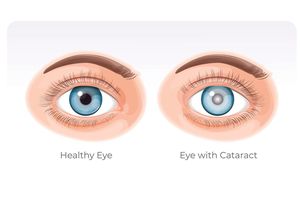
“It’s a disease of old age where the eye lens that helps us to see gets a coating that prevents light from going into the eye. The only way to reverse this is through cataract surgery. You can get cataracts due to trauma. Some children are also born with it. It can also be due to comorbidities such as diabetes and hypertension,” he says.
He notes that trachoma, a disease in which the eyelids turn inward, historically Kenya’s leading cause of blindness, has declined thanks to Health Ministry hygiene efforts.
Dr Masua recommends at least one eye check-up a year, noting that glaucoma in particular often has no symptoms until vision is already lost.
“Most people who come to hospital with issues such as glaucoma don’t know they have it until they are checked. They only wake up one morning and realise their eyes are blurry, or they’ve been bumping into things, because glaucoma affects peripheral vision first.”
He also advises regular breaks from screens using the 20-20 rule: after 20 minutes of close work, look at something 20 feet away for 20 seconds. He adds that welders and masons should use protective eyewear.
The World Health Organization (WHO) backs the scale of the problem Dr Masua describes. Uncorrected refractive errors and cataracts are the leading global causes of vision impairment, and at least two billion people worldwide live with some form of vision impairment, roughly half of it preventable. WHO also notes that early-onset vision impairment in children can delay motor, language, and cognitive development, while in adults it is linked to lower productivity and higher rates of depression and anxiety.
Regulatory oversight of the three professions is split. Ophthalmologists, as fully licensed medical doctors, fall under the Kenya Medical Practitioners and Dentists Council, the same body that regulates doctors and dentists across every specialty. Opticians and optometrists answer to their own specialised regulatory board, which governs their training standards, licensing, and scope of practice.
The boundary between these tiers exists to protect patients from receiving care that exceeds what a provider is legally and clinically equipped to give. An optician fitting glasses without examining the patient’s eyes is operating within scope, so long as they are working from a prescription. An optical shop diagnosing a condition and treating it without referral is not, regardless of how routine the visit might feel.
For the average Kenyan walking into an optical shop with blurred vision, the practical lesson is simple but easily forgotten: not every provider who sells glasses is qualified to tell you why you need them. A dispensing optician can fit what has already been prescribed. An optometrist can examine, diagnose, and prescribe for most everyday eye problems. But when the issue goes beyond refractive error, when there is pain, sudden vision loss, or a condition that does not resolve with corrective lenses, the next stop should be an ophthalmologist, not another pair of glasses.