Pesticides Cartels: Kenyan flower farm workers dying from toxic chemicals
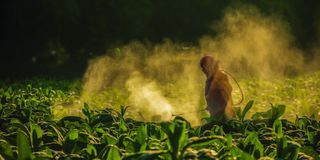
An Asian farmer working in the field and spraying chemicals or fertiliser on young tobacco without using a protective mask. PHOTO|POOL

What you need to know:
- In 2024, Agriculture CS, Mutahi Kagwe, announced the immediate withdrawal of 77 pesticide active ingredients from the Kenyan market and restrictions on 202 products
- The battle against this industrial poisoning began on September 2, 2019, when Uasin Gishu MP and environment lawyer Gladys Shollei submitted a public petition to the National Assembly.
This is the second of a two-part series on pesticides and their effects on Kenyans’ health.
Nancy Makena received the call that every spouse dreads. Her husband had collapsed at work and been rushed to a health facility. But when she arrived there, officials led her not to a hospital ward, but straight to the morgue.
Wachira Ngatia, 58, had died in his driver's seat after loading a dump truck at the flower farm. His health had deteriorated over the years, and it was an open secret that the pesticides used on the farm were to blame.
Ngatia’s death represents just one face of a mounting crisis. Behind it lies a powerful industry that has captured regulators, silenced critics, and turned Kenya into a dumping ground for pesticides, even those banned in their countries of origin.
A slow poisoning
Wachira's nightmare began in 1998 when his employer transferred him from excavation duties to operating a tractor-mounted sprayer, applying pesticides over vast French bean crops.
The consequences were immediate, his wife recalls.
"On the day he started working with the chemicals, he complained of stomach upsets. He started vomiting, and within days he had developed rashes that turned into wounds in his mouth, hands and legs," Nancy says.
When Wachira sought a transfer to his previous work station, the company declined. Then it capped his medical cover at just Sh15,000 annually.
"The doctor told me privately that I only needed to pray for him, because he didn’t have much time left," Nancy recalls.
A few months before his untimely death, he finally received a transfer back to excavation work. But the damage was done.
"His kidneys and liver had suffered significant damage. He developed a stench and swelling in his abdomen," she adds.

Nancy Makena holds a photograph of her late husband during an interview at Mia Moja village in Laikipia County on June 1, 2025. She lost her husband in 2011.
At Soy and Services Estate, Roselyn Mbaye worked 14 years sorting flowers before refrigeration. Workers often handled freshly sprayed blooms that hadn't completed the standard eight-hour waiting period between pesticide application and harvest.
"When you develop a health problem, company doctors would not tell you to stop working, even if the problem was directly linked to the hazardous working conditions," Mbaye explains.
She developed severe swelling on her foot and right hand, coupled with sudden breathing episodes.
When she consulted another doctor, he warned that the chemicals were toxic and could kill her. She resigned immediately. Five years on, the swelling persists, and her hand is so damaged that she cannot do heavy chores or stretch it to her shoulders.
Francis Wachira, a community health promoter, observes the broader devastation: "Most people who work at flower farms are depressed, and fall sick frequently."
Perhaps the most devastating impacts remain hidden due to shame. Amos*, who requested anonymity, has worked at a flower farm for more than 15 years. He reveals that sexual dysfunction affects him and other male workers, but whenever someone raised the issue, they were silenced, sometimes through termination.
"Company doctors who recommended transfers weren't spared either," he laments.

Roselyne Mbaye during an interview at her home in Naivasha, Nakuru County, on June 3, 2025. Her legs were affected after spraying pesticide chemicals in flower farms.
Dr Stephen Ngigi, Deputy Director of Medical Services in Murang'a County, explains how pesticides systematically destroy human health.
"Pesticides enter the human body through skin contact and ingestion. Patients present with allergic dermatitis and neurological symptoms like numbness and loss of limb function, often misdiagnosed as arthritis," Dr Ngigi explains.
When contaminated food is consumed, especially after cooking at high temperatures, thus integrating chemicals deeper, the results are severe.
"This leads to stomach lining irritation, which causes pain, nausea, vomiting and diarrhoea. This is often misdiagnosed as gastritis."
The liver suffers the most severe damage.
"As the first point of toxin landing, the liver struggles with heavy loads of organophosphates, leading to liver disease, cirrhosis, fatty liver and failure. This causes fluid accumulation and jaundice."
Dr Ngigi has observed a troubling demographic shift. "There's been a shift in cancer prevalence from older to younger populations due to increased chemical exposure."
The neurological and reproductive impacts explain workers' suffering. "Chronic exposure interferes with the nervous system, causes organ failure, and leads to infertility by disrupting ovulation and spermatogenesis. These manifest as Parkinsonism, dementia, memory loss and skin changes."
Fight for justice
The battle against this industrial poisoning began on September 2, 2019, when Uasin Gishu MP and environment lawyer Gladys Shollei submitted a public petition to the National Assembly. Representing four organisations, including the Biodiversity and Biosafety Association of Kenya, Shollei demanded immediate action against pesticides classified as carcinogenic, mutagenic, endocrine-disrupting, neurotoxic or harmful to reproduction.

National Assembly Deputy Speaker Gladys Boss Shollei during an interview at her home in Kitusuru, Nairobi on July 2, 2025.
Her petition revealed the explosive growth of Kenya's pesticide dependency: usage more than doubled from 6,400 tonnes in 2015 to 15,600 tonnes in 2018, with no corresponding safety measures, no data collection on contamination levels, and no adherence to the WHO and FAO international codes of conduct by the Pest Control Products Board (PCPB).
It demanded mandatory health impact assessments during pesticide registration, better monitoring of chemical residues in food, and amendments to include a list of pesticides withdrawn from markets based on severe health impacts.
Despite parliamentary approval and adoption, the petition disappeared into bureaucratic quicksand. Shollei appealed through multiple government levels but faced consistent resistance.
"I can say this with no fear of contradiction, that the board has been in bed with the agrochemical companies, because it's huge money. There's no other reason why they wouldn't do their job," she says.
She describes "a form of chemical colonialism" where Western countries protect their populations whilst exporting toxic chemicals to Africa.
Parliament finally passed the Business Law Amendment Bill, which prohibits importing any pesticide not approved for use in its country of origin, a measure that should have been automatic but required years of advocacy to achieve.
Shollei cites economic coercion, suppression of information and lack of alternatives that force workers to choose employment over safety. The MP says she has faced serious personal consequences for challenging the industry, including death threats through phone calls and text messages warning her to "drop this war or else your life will be in danger".
The threats stopped after she made them public.
Legal challenge
Three years after Shollei's initial petition, the African Centre for Corrective and Preventive Action (ACCPA) and environmental advocate Kelvin Kubai sued the government and Agro Chemicals Association of Kenya for violating environmental and consumer rights.
James Mwangi, ACCPA's founder, revealed the dark origins of the chemicals killing workers like Wachira: "The agrochemicals were initially produced for warfare during the Second World War, but were re-purposed for agricultural use once the war ended."
The legal challenge faces entrenched opposition from multiple power centres.
"A significant challenge is the influence of powerful individuals who own some of the companies importing these chemicals, making a complete ban difficult," Mwangi notes.
He also criticises county governments' failure to address the issue despite agriculture being a devolved function, noting that agrovets generate revenue for governors who aren't adequately considering the ultimate impact of these chemicals.
"As an organisation, we have developed a major petition that we are submitting to the Senate and the National Assembly to discuss with stakeholders the effects of agrochemicals and the amount Kenyans are spending to treat cancer, over-exhausting the SHA to fund cancer treatment," Mwangi explains.
Kelvin Kubai emphasises that Kenya's constitutional right to sufficient and quality food is being systematically violated.
He draws parallels to international legal precedents: "In the US, more than 177,000 cases have been filed by farmers alleging that glyphosate and paraquat have led to conditions like non-Hodgkin lymphoma and Parkinsonism, resulting in significant compensation. In Kenya, however, there's a non-existent compensation mechanism for those affected by pesticide use."
Kubai also highlights environmental contamination from inadequate disposal of empty pesticide containers.
"There are inadequate disposal mechanisms for empty pesticide containers, a lack of safe designated areas for disposal, thus forcing farmers to dump containers in water trenches, banana farms, hang them on poles, or burn them. When thrown into ditches, these containers frequently end up in drainage systems, contaminating water, aquatic animals and downstream communities."
Regulatory failure
The Pest Control Products Board (PCPB), Kenya's primary pesticide regulator, exemplifies how industry capture operates at the institutional level.
When confronted about the pesticide container disposal crisis that contaminates water sources across the country, Frederick Muchiri, the organisation's chief executive officer, deflects responsibility to county governments and the National Environment Management Authority (Nema).
"Counties, PCPB and Nema are supposed to work together to identify certain places where farmers can go and drop off empty pesticide containers for onward collection and disposal. Those centres are there, but they are not being used because of a breakdown between counties and the extension service," Muchiri explains.
However, when pressed to name counties hosting these supposed centres, he admits: "I cannot give you an outright answer. But that data is somewhere."
He blames county extension services rather than acknowledging PCPB's regulatory failures: "The only thing PCPB can do is build the capacity of the county extension service. If there was any shifting of blame, it would be the county’s extension service. They are not advising their farmers appropriately."
Muchiri attributes the presence of unregistered pesticides to smuggling through "porous Kenya-Uganda and Kenya-Tanzania borders", but when questioned about the documented health impacts across Kenya's agricultural workforce, he admits the agency's fundamental abdication of responsibility: "PCPB has not independently monitored these cases, and the Ministry of Health currently lacks the epidemiological data to link specific illnesses to occupations, despite our requests for this information."
Government action
After years of pressure, in late 2024, Agriculture Cabinet Secretary Mutahi Kagwe announced the immediate withdrawal of 77 pesticide active ingredients from the Kenyan market and restrictions on 202 products.
An additional 151 products are under review, with decisions expected by December 2025.
"Following scientific assessments and stakeholder consultations, we have identified certain active ingredients and associated end-use products that pose unacceptable risks to human health, crops, livestock and the environment," Kagwe stated.
The Ministry also implemented Shollei's key demand: all pest control products seeking registration in Kenya must now also be registered in their country of origin.
However, Kagwe's most significant revelation was his acknowledgement of organised criminal resistance to reform: "Powerful pesticide cartels are undermining Kenya's efforts to eliminate banned agrochemicals and enforce food safety. The cartels are fighting back, bribing officials, infiltrating institutions and manipulating the media to resist reforms."
The information war
"The local vernacular stations have 98 per cent reach, so even farmers on their farms are being told how good this thing is. However, I've not heard an advertisement that says it's harmful," Shollei observes.
This information asymmetry keeps workers and farmers ignorant of the risks they face daily. Whilst agrochemical companies flood vernacular radio with safety claims, independent voices warning of health risks are systematically excluded.
The industry's influence extends to agricultural education and research, creating a system where workers receive one-sided information about pesticide benefits while remaining ignorant of documented health risks.