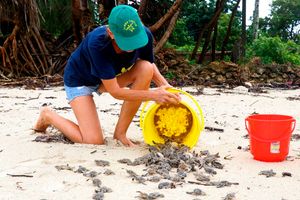
Protecting endangered sea turtles on Kwale beaches
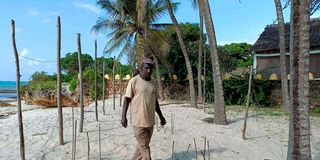
Some of the turtle egg nests set up by Said Hamisi who leads the Turtle Police group along Tiwi Beach in Kwale County. Once hatched, the turtles come to the surface and are redirected to the beach

What you need to know:
- Five of the world's seven species of sea turtles are found in Kenya — olive ridleys, green turtles and hawksbills, which nest along the coast, and the loggerheads and leatherbacks, which migrate through the waters.
- The International Union for Conservation of Nature has listed these turtle species as either endangered or critically endangered, calling for their protection to prevent their extinction.
Said Hamisi begins his day by taking a walk by the beach in Tiwi, Kwale County. He gazes at the clear blue sky while the ocean’s gentle waves lap against the shore, creating a calm atmosphere
But the morning walk at the beach, nestled on the white, cotton-like sandy beaches of Tiwi, is not in vain. A few metres away from him, several sticks are fixed on the ground in a circular pattern.
Hamisi, 64, is walking around them to collect eggs laid by turtles and put them in nests that are buried under the sand and marked using the sticks to become turtle nests.
Sea turtles are reptiles with a hard shell, usually found in the ocean. Five of the world's seven species of turtles are found in Kenya — olive ridleys, green turtles and hawksbills, which nest along the coast, and the loggerheads and leatherbacks, which migrate through the waters.
The International Union for Conservation of Nature has listed these turtle species as either endangered or critically endangered, calling for their protection to prevent their extinction. Just like the National Police Service provides protection and safeguarding to citizens, Hamisi and his team ensure that the creatures are not hunted for meat, oil or traditional rituals by fishermen or other community members.
Hamisi is a turtle police officer and a member of the Tiwi Turtle Police, a group of community members whose job it is to patrol and watch out for turtles and their eggs in Tiwi. The group started in 2020 under the Maisha Madrugada Foundation.
“We want to protect the eggs from being stolen or eaten by other animals like dogs or monitor lizards. Turtles love laying their eggs along the beach here in Tiwi, but they have faced many challenges in the past, including being polluted and poached, and I want to protect them, starting with their eggs,” said Hamisi.
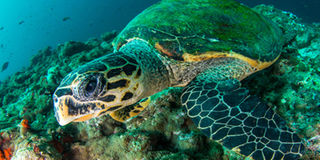
Sea turtles, also known as marine turtles inhabit the tropical and sub-tropical seas throughout the world, including Tanzania, and ecologists say they are a fundamental link in the marine ecosystem.
Growing up, Hamisi enjoyed seeing his father, a fisherman, come home with fish every day from work. Most people from his community depend on fishing as their main economic activity as well as food. By the time he was 10 years old, Hamisi says he wanted to learn how to fish.
“In a short while, I had learned how to operate a canoe, how to fish and how to swim. I would come to the ocean and go back home with a big fish. I can now swim across the Likoni crossing channel without fear,” he tells Healthy Nation.
His early interaction with the ocean made him love everything about it, and so did his love for conservation. Later, his group was trained by the Kenya Wildlife Service (KWS) on the life cycle of turtles and how to take care of them.
For instance, he says he learned that female turtles always come back to lay their nests where they were hatched, even after swimming to other parts of the world for more than two decades.
“They are unique features with a great memory. But once hatched, the female ones feel the wave sounds, the temperatures, and the smell of the beach where they were born and come back later,” he explained.
It is only in unique instances that a turtle lays eggs in another location, which Hamisi said could be a result of climate change. “There was one time a turtle came to nest here, yet it had beentagged by KWS in Bamburi,” he said.
In their patrols, Hamisi explained that they have to walk along the beach to gather the eggs laid by the turtles, usually between 3am and 4am before the beaches become occupied. A turtle can lay up to 100 eggs in a season. Once the eggs are put in a hole, they collect and record the data indicating the day the eggs were laid d calculate the day they will be hatched. It takes at least two months to hatch. It usually is a celebration for Hamisi and his team when hatchlings come to the surface of the sand and are released back into the water to grow. Other than patrolling the beach, the turtle police also monitor the turtles by tracking them.
Millicent Cherono, a science research coordinator at Tiwi Turtle Police, said they use satellite transmitters where every time the turtle leaves the nest, the transmitter reads the coordinates tracking its location. It is a satellite tag that is placed on the back of the turtle, just like a tracker, and has an antenna that transmits the information to a system.
“Every time the turtle gets out of the sea to breathe, the longitudes and latitudes are recorded, and we will know its location at that time.”
She explained that a turtle they had tagged recently was last spotted in Mozambique, but they suspect it was either killed or in danger because they suddenly lost track of it. According to Ms Cherono, threats such as marine pollution risk the lives of many turtles.
“Most turtles either swallow plastic, mistaking it for food, because they cannot distinguish the two, or are strangled by nets that have been discarded in the ocean. Those who eat plastic experience indigestion and die. Even though we play our role as police on the beaches, the biggest threats are now inside the water, where we do not know the fate of the turtles we have saved,” she said.
According to the National Wildlife Census 2021 report, Kenya recorded only 340 turtles found along the Kenyan Coast, with KWS raising concern about the declining numbers and the need for conservation. Other than Tiwi, more communities in the Coast region and Kwale County have been coming up to conserve the marine ecosystem, especially the endangered sea turtle. Earlier this year, a sea turtle festival was organised in Diani to raise awareness in the community about the importance of protecting sea turtles.
Schoolchildren engaged in art competitions, while others performed songs and plays with the theme of conservation. Conservation Education Society Programmes Manager Jenni Choma said there are still many risks that turtles face, hence the need to increase the community’s awareness on the importance of their protection.
Ms Choma, who works with the Diani-based conservation group that also organised the turtle festival, said it is important to use both education and research to protect the marine environment.
Dr Mohamed Omar, a principal scientist at the Wildlife Research and Training Institute, said plastics brought ashore by sea waves are affecting turtle nestlings and generally conservation work in the marine ecosystem. Explaining how climate change affects sea turtles, he said the sand’s temperature tampers with the gender of the turtles, where more females than males are born, limiting their multiplication.
In December last year, Tourism and Wildlife Cabinet Secretary Peninah Malonza launched the Sea Turtle Conservation Protocol to give guidelines for the conservation of marine animals in the country. Ms Malonza, during the launch, listed fishing, pollution from plastic materials, raw sewage and industrial wastes, coastal development, and climate change as the top threats facing sea turtles.
KWS Director General Erustus Kanga lauded the move, saying inadequate information on sea turtle nesting areas is a major setback for their conservation as it affects decision-making by institutions tasked with their conservation.
Hamisi and his community have called on other residents to adopt the protection of the turtles to ensure that their numbers are stable.
“I also conserve the fish, but the turtles are an endangered species that I empathise with. Imagine a mother giving birth to a child and then losing them, and she does it again and they are killed, and then finally the mother is killed. That’s tragic, and I would not want creatures to go through that,” says Hamisi.