Psychology of loss: Why you are so upset over someone you only saw on TV
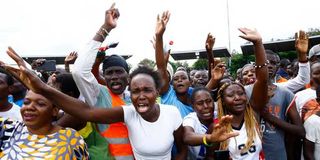
Mourners react on the day of the funeral service for former Kenyan Prime Minister Raila Odinga, at the Jomo Kenyatta Stadium in Mamboleo, in Kisumu County, Kenya, October 18, 2025.

What you need to know:
- For many, Raila did not just exemplify political leadership. He also symbolised endurance, having survived detentions, betrayals, and decades of struggle.
The weight of grief has many faces. For some, it arrives in the sudden inability to breathe. For others, it shows up as an empty stall in a bustling market, or in the quiet promise to name an unborn child after a fallen hero. Across Kenya, tears have mingled with disbelief, and the question hangs heavy in the air: How do you mourn a man who seemed immortal?
When news broke that former Prime Minister Raila Odinga had passed away, the shockwaves rippled far beyond the corridors of power, settling into the hearts of ordinary Kenyans who had never shaken his hand but had cast their ballots for him, election after election, year after year.
Lucy Wahome was tending to her farm in Kikuyu Town when her grandchildren came running with the news. At 60, she had voted for Raila in every election since she first registered in 1997, when he ran for president and finished third.
"Everyone in my family knows I have forever voted for Baba ever since that day," she says. "I had no interest in participating in political discourses at the time because there was a very brutal regime in place. But Raila taught me that your vote is the most potent weapon to effect change. He stressed that every vote matters, and this is why I decided to register to vote for the first time in 1997. I have been voting for Baba ever since."
The manner of his death hit her hardest. "That the man I have fondly loved for all these years just dropped dead after taking a walk is what struck me the most. I even struggled to breathe. Sometimes I feel it's all a bad dream that I am hoping to wake up from. But such is life."
In Kakamega Town, Simon Wanjala's market stall has remained closed since the news broke. The 32-year-old trader from Kakamega hasn't found the strength to return to work.
"Raila's demise shook me to the core," he says. "I still can't imagine going into an election without Agwambo, who I have religiously voted for ever since I turned 18."
Wanjala has never met the man he admired so deeply. "I have only seen him on TV and from a distance during a public rally at Bukhungu Stadium. To imagine that the only man who was ballsy enough to swear himself in as the People's President in broad daylight while the State helplessly watched is no more—it's just horribly painful."
But Wanjala has made a promise. His fiancée is expectant, and in a few months, their baby boy will be named Raila Amolo Odinga. "When he grows up, I will endlessly tell him tales of his namesake and the sacrifices he made for this country, because the man loved Kenya so much, beyond measure."
But how exactly should Lucy, Wanjala, and millions of other Kenyans—as well as citizens of the world who loved and adored Raila—overcome the grief and loss that has left them shattered?
Understanding the depth of grief
In an exclusive interview with Nation.Africa on Wednesday, Mercy Musisi, a counselling psychologist at The Retreat, a rehabilitation centre in Limuru, explains that foundational frameworks on grief and loss define it as a process that occurs in stages: denial, anger, bargaining, depression, and eventual acceptance. However, grief rarely
follows a straight line.
"These stages are not prescriptions but reflections of emotional currents that come and go," she says. "The depth of grief people feel reflects the depth of their connection with him. Those who followed him closely—his diehards—are likely experiencing acute emotional disorientation, a sense of personal loss and disbelief, as if a part of their identity has been shaken."
For many, Mercy explains, Raila did not just exemplify political leadership. He also symbolised endurance, having survived detentions, betrayals, and decades of struggle.
A generational divide
Joy Maele, a consultant child psychologist, notes that the death of a national figure like Raila exposes profound generational differences in how people experience and express grief.
"These differences are due to the diverse social, political, and emotional contexts in which each generation was raised," Joy explains. "For the older generations, Raila was not just a politician. He embodies struggle, resilience, and the fight for justice that defined Kenya's turbulent post-independence years."
The older generation of Kenyans experienced Raila's leadership during moments of national unrest, witnessed his imprisonments, and found hope, meaning, and identity in his defiance against oppression.
"His passing may, therefore, feel like the loss of an era, a symbolic closing of a chapter in Kenya's democratic journey," Joy says. "Their grief can be deeper, more personal, and identity-bound, due to shared sacrifice, activism, and lived experience."
In contrast, younger generations grew up during more stable, albeit economically strained times, and knew him primarily as a constant political contender rather than a liberation icon. This can lead to an aspect of detachment or ambivalence stemming from a lack of direct emotional investment, creating disparity from older generations who expect uniform reverence.
Joy points out that in younger generations, expression of grief is often different, seen through gallows humour, memes, or satire—not necessarily as disrespect, but as a coping mechanism shaped by digital culture and emotional desensitization in an era of constant information overload through social media platforms.
"These differences create a mismatch between generations in how grief is perceived, validated, or expressed," she says. "Older individuals may interpret humour or indifference as insensitivity, while younger people may see intense mourning as exaggerated or outdated. Such emotional disconnects can fuel tension, judgment, and social polarisation during a period that ideally calls for unity and empathy."
Recognising that every generation's response is rooted in its lived reality can bridge this gap, Joy suggests. "Encouraging intergenerational conversations, storytelling, and shared rituals can help reconcile these differences, turning the mourning process into a space for learning, continuity, and national cohesion."
Donald Okumu, another consultant counselling psychologist, agrees. "In essence, the generational divide in grief is not about who feels more, but how they feel and express it. Acknowledging these variations with compassion helps prevent emotional alienation and fosters a more inclusive collective healing process."
Why this loss feels different
Kenya has lost key political figures before, but Okumu explains why the loss of Raila feels different.
"This moment hits differently because Raila represented stability amid chaos, balance in turmoil, and composure in turbulence. His perceived immortality offered psychological safety," he says. "He was viewed as larger than life, almost beyond death. He was seen as an unbreakable constant, a figure who had survived political storms, betrayal,
imprisonment, and age itself. He had literally stood the test of time. This longstanding resilience created an unconscious illusion that he would always be there."
This perception of immortality can deepen psychological wounds, Okumu notes, because the loss feels disorienting, almost surreal, and shakes not only emotional attachment but also the collective sense of stability and continuity.
Mercy agrees. "Now, his absence creates a vacuum filled with fear and uncertainty. Psychologically, this evokes existential anxiety: 'Who carries us now?' These feelings are valid and part of a collective attempt to regain orientation."
The psychology of national grief
According to Mercy, grief manifests not only as sadness but also through fatigue, confusion, irritability, or withdrawal. Interpersonally, humans externalise pain through projection (attributing helplessness to others), emotional contagion (absorbing others' emotions), and transference (reliving old wounds through current events). These are
natural responses during collective mourning.
Grief can trigger or worsen mental, physical, and social health issues, leading to unexplained depression, anxiety, substance use as a coping mechanism, or interpersonal conflicts.
"Without care, these reactions deepen into distress or relapse of pre-existing conditions," Mercy warns. "We always remind Kenyans that grief is not weakness—it's love trying to find new expression."
Mercy reminds Kenyans that grief can become destructive, and there are always telltale signs. "When functioning deteriorates, hopelessness persists, or dependence on psychoactive substances increases, it rings the bell to seek professional support."
She also cautions that grief may persist long after Raila's funeral.
"Triggers may include national events, political rallies, songs, or quiet moments. Even workplace discussions or social media debates may reopen emotional wounds."
Recognising these triggers helps normalise emotion and foster patience toward oneself and others.
"For many, Raila was the fighter, the absorber, the glue, the calmer of storms. His absence may evoke fear of uncertainty and the anxiety of 'who carries the vision now?'
This uncertainty can surface as worry, hopelessness, or restlessness, especially for the many who anchored their sense of stability on him."
Nine ways to safeguard mental health while grieving
So, what should those grieving loss do to safeguard their mental health? The psychologists offer nine recommendations:
1. Maintain regular sleep, hydration, and meal routines to help restore the physiological balance disrupted by emotional turbulence.
2. Engage in mindful physical activity such as gardening, dancing, or walking. Movement metabolises grief.
3. Use breathing exercises (inhale for four counts, hold for two, exhale for six) to calm your body. This can help regulate the vagus nerve, reducing anxiety and somatic
distress.
4. Journal emotions or have structured conversations to aid closure.
5. Limit exposure to distressing media that can overstimulate the nervous system.
6. Reflect on Raila's values and live by them, especially the ones that align with your values.
7. Create safe spaces for expressing feelings without judgment.
8. Step back from polarising spaces to preserve emotional safety.
9. Integrate stillness, gratitude, or prayer for grounding to anchor the soul and spirit amid emotional noise.
Okumu reminds Kenyans that "grief asks not that we move on, but that we move with."
"Caring for oneself amid collective loss is not selfish—it is civic," he says. "Supporting one another, seeking help when needed, and embodying the values of justice,
courage, and hope turn mourning into meaning. Healing people heals systems. Healthy people build nations."


