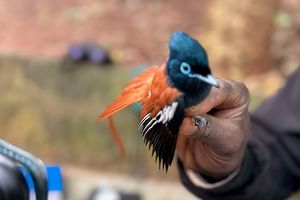
Rare endemic bird makes historic appearance in the heart of Nairobi
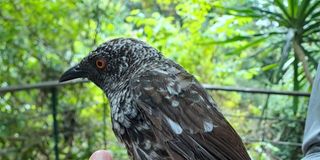
Hinde's Babbler at the Nairobi National Museum.
What you need to know:
- First sighted in 1900, the Hinde's Babbler has historically been found in the bushy valleys of central Kenya, near Meru, around Thika, and on wooded hilltops in Kitui - but never before in downtown Nairobi.
Birders in the country are buzzing with excitement following the first-ever recorded sighting of a Kenyan endemic bird in the heart of Nairobi.
Hinde's Babbler (Turdoides hindei), which is mostly found in the bushy valleys of central Kenya, has unexpectedly appeared in the city, and the record has been officially entered into the Kenya Bird Map.
What gives this pigeon-sized grey-and-black bird with a beady red eye - pretty ordinary in looks compared to the colourful ones like Malachite Kingfisher or Variable Sunbird - fame is that it is only found in Kenya.
A surprising urban discovery
On this particular morning early March, John Kasaya could not believe his eyes when he saw the rare bird in a net. An ornithologist at the National Museums of Kenya, he showed it to his colleague Timothy Mwinami. “I was hesitant to say there’s a Hinde's Babbler in our net to the others,” he narrates.
“Mwinami and I extracted the bird from the net and continued until we returned to the ringing station to remove the bird from the bird bag. Without doubt, it was a Hinde's Babbler.”
The WhatsApp group of Kenyan birders went agog after the first-ever record of Hinde's Babbler in the city. "Wonderful to have a Kenyan endemic right here in the capital city!" wrote Fleur Ng'weno, who started the epic bird walks in 1971 from the Nairobi Museum that has morphed into a national movement.
First sighted in 1900, the Hinde's Babbler has historically been found in the bushy valleys of central Kenya, near Meru, around Thika, and on wooded hilltops in Kitui - but never before in downtown Nairobi.
The species is choosy about its living quarters, preferring dense thickets along watercourses, including remnants on farms. Like most species on earth, this 'only-found-in-Kenya' bird is faced with a shrinking habitat. Research shows that between the mid-1900s and 2001, its range shrunk to 30 per cent of its original size to just 1,900 square kilometres.
Limited research on this bird indicates a fragmented population of between 1,500 and 5,600 individuals.
According to Fleur's post in theWhatsApp group, while small flocks have been observed at the University of Nairobi's Kabete campus and farm for about eight years, and more recently in the Rosslyn area of Nairobi, this marks the first sighting in the city centre.
What this means for Nairobi's ecology
"The museum grounds are a haven for birds that are both rare or out of range, including migrants. The museum gardens are like an oasis in the desert," explains Peter Muriithi, membership officer at Nature Kenya, the country's oldest natural history society established in 1909.
He's referring to today's Nairobi that is rapidly turning into a concrete jungle, though until recently it was famed as the 'green city in the sun'. Nairobi is also the birding capital of the world with more than 600 species recorded – but for how long?
The appearance of this endemic species in the city centre raises important questions about urban ecology and adapting wildlife. As development continues to encroach on natural habitats, some species may find refuge in urban green spaces that mimic their preferred environments.
The science behind the discovery: Bird ringing
The Nairobi Ringing Group has been monitoring bird populations since 1994 on the grounds of the National Museums of Kenya. This scientific practice involves carefully capturing, measuring, and marking birds before release.
When a bird is caught in a mist net, experienced 'ringers' carefully place it in a canvas bag and bring it to the ringing station. There, the bird is identified, weighed, measured, and fitted with a metal ring bearing a unique number ,which is recorded in a database before the bird is released.
When the bird is caught again, its unique number tells where and when it was ringed, revealing some amazing flight details.
For example, the Steppe Eagle, ringed in Russia, reading ‘AA 22 17 MOSKVA’ that landed at the gate of Makongeni Police Station along Jogoo Road on January 22, 2015, having travelled 5,719 km in three months. Or the Osprey that flew 6,948 kilometres to land in Siaya County in 2020.
The ringing scheme of eastern Africa is under the Bird Committee of Nature Kenya, partnering with the National Museums of Kenya. It coordinates and promotes bird ringing (also called banding) throughout the East African region and beyond through issuing of rings to qualified ringers, curating ringing data and tracking ring recoveries. The ringing scheme was started in the early 1960s and much about the origins and migration routes of migratory birds has been learnt from birds ringed and recovered in the region.
The avifauna of Kenya included a total of 1,164 confirmed species as of October 2024. Out of these, 11 are endemic – found nowhere else in the world.
"This systematic monitoring is what allows us to track unusual occurrences like the Hinde's Babbler in Nairobi," explains Sam Guchu, project manager for the Kenya Bird Map and Kenya Bird Trends.
"Without regular sampling and citizen science contributions, such significant range extensions might go unnoticed."
The Kenya Bird Map (KBM) is a citizen science project recording birds seen in pentads, each measuring nine square kilometres.
“The Bird Atlas of Kenya, published in the 1980s, is the first comprehensive book on the distribution of birds in Kenya,” says Mr Guchu.
“KBM is a powerful tool for birders because it offers real-time insight on where species can be found within Kenya. These are records submitted by avid birders. This information is considered by decision makers when deliberating on environmental issues.”
Be part of the solution
The discovery of the Hinde's Babbler in central Nairobi highlights how ordinary citizens can contribute to scientific understanding. By joining organisations like Nature Kenya and participating in regular bird walks, anyone can help monitor these vulnerable species while enjoying the great outdoors.
These citizen contributions are especially important for tracking endemic species like the Hinde's Babbler, whose limited range makes them particularly vulnerable to habitat changes. Your observations today could help protect Kenya's unique biodiversity for generations to come.
rupitheafricantrotter.wordpress.com