Ruto: Judge our health reforms by patients' experience, not laws passed
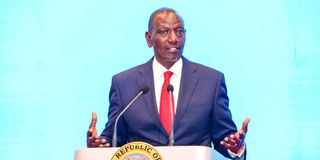
President William Ruto.

The government yesterday painted a rosy picture of the country's health system, saying it had made promises to the health sector while campaigning and had delivered against all odds.
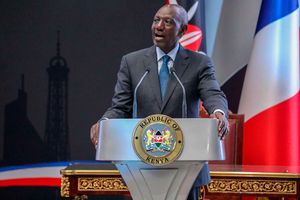
President William Ruto, however, said there was a need to measure progress honestly by listening to the experiences of Kenyans, then strengthening what is working, sealing loopholes and scaling successful innovations across the country.
He said that while reforms are important, the ultimate measure is not the laws passed or the numbers registered, but the experience of the patient in terms of dependable, affordable and dignified care.
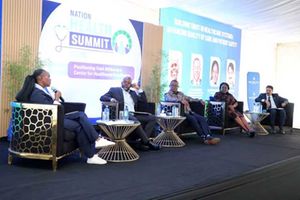
He spoke during the Health Ministry's first-ever Kenya Health Summit, themed "Reforms Delivered, Health as a Right," aimed at discussing challenges in the health sector and sharing progress made so far.
The president said that when he took office, one of his main agendas was to revive Universal Health Coverage (UHC), which he felt was on its deathbed. UHC therefore became one of the five pillars of the Bottom-Up Economic Transformation Agenda.
He said that at the time, he believed economic empowerment meant little when illness could wipe out a family's savings or push citizens into poverty. This is why he pushed for the enactment of four new health laws in 2023, which gave birth to the Social Health Authority.
"I consider it one of the greatest privileges of my public service to have been entrusted, in our time, with helping turn that national aspiration into reality," he said.
Of the 32.3 million Kenyans registered with the Social Health Authority (SHA), more than 8 million have received treatment to date. This includes about 1.2 million mothers supported to deliver safely and over 500,000 surgical procedures since its inception.
He made the remarks while dismissing critics who accused him of abandoning the ‘hustler’ narrative, insisting he has evidence that people in the hustler category are benefiting from SHA.
"Reform is not an event. It is a continuous journey of closing the distance between the promise we made and the experience of every Kenyan who seeks care," he said.
"This Summit is our national stock-take; bringing together the National Government, all 47 county governments, Parliament, development partners, the private sector, civil society, healthcare professionals, and communities to determine how we make a good system better," he added.
Sixteen years after the constitution devolved health, Council of Governors chair Ahmed Abdullahi said Kenya’s healthcare has not failed. What is holding the country back, he argued, is the failure to address the toxicity of politics
As conversations on health continue, the reality lies with the end users of the system.
On the sidelines of the event, we spoke to Nelly Munyasia, Executive Director of the Reproductive Health Network Kenya. She noted that while Kenya has made important progress in reproductive health, especially in policy development, gaps remain in implementation
"The key challenge now is moving from policy and programmes to consistent implementation at the point of care," she said.
"We need to look at the health system as a whole. That means sustainable financing, adequate commodities and infrastructure, a supported and skilled health workforce, functional referral and data systems, and stronger community-facility linkages," she added.
She said some of the best policies remain on paper because resources are not aligned with them.
"The next phase should be about building resilient systems that can deliver beyond individual projects or funding cycles. Government, counties, civil society and communities need to work together to strengthen accountability and ensure that reproductive health services are accessible, quality, respectful and responsive to the people who need them, because ultimately, that is where we should measure the success of government programmes," she said.
Patrick Oyaro, a Project Director at the Lvcthealth and Research Kenya project, which is funded by USAid - as one of the funders, said that beyond the summit, reforms should include services for people living with HIV under SHA.
"For a long time, HIV has been donor funded. When the initial packages of SHA were made, we didn't have packages for HIV. We need to change that," he said.
He explained that because of the transition away from donor funds, Lvcthealth is now helping county governments mobilise resources from private organisations.
"This will help in filling in the funding gaps. We are also training them in how to do the claims from SHA and follow up because this ensures that they have money. When they get this money, we are reminding them to budget for HIV and Tuberculosis programmes. That is part of the sustainability plan," he said.
The summit comes at a time when there is an ongoing industrial strike by Universal Health Care workers and nurses in the country.
Peterson Wachira, chair of the Kenya Union of Clinical Officers, said healthcare has fallen short of Vision 2030 targets, which envisioned Kenya as Africa’s medical tourism hub by 2030. He warned that the country is still far from meeting the Abuja Declaration, which calls for 15 per cent of the national budget to be allocated to health.
"Leadership and governance is highly segmented and many County Governments do not follow legal and policy imperatives, especially in Human Resources for Health (HRH) management. Nepotism has been normalised; many health workers are exploited by corrupt officials to either secure employment or promotion," he said.
"We are far from achieving adequate HRH staffing. Workers suffer fatigue, burnout and work-related stress, with some descending into depression and suicide. The fragmented HRH management under County Governments must be reviewed," he added.
The union is proposing a centralised HRH management structure under an authority established by Article 189 of the Constitution, alongside the creation of a Health Service Commission.
Brown Ashira, Secretary General of the Kenya Environmental Health and Public Health Practitioners Union (KEHPHPU), said the country is still struggling to finance and embrace public health activities. Despite the many public health threats, such as pollution and climate change, he feels the government has yet to fully embrace and support public health interventions.
"There is still low absorption, recruitment, replacement and uptake of public health officers, specialists and technicians in this country. Food safety and disease surveillance across our borders remain the worst-hit areas, particularly with the ongoing strike," he said.
Dr Dennis Miskella, Deputy Secretary General of the Kenya Medical Practitioners, Pharmacists and Dentists Union (KMPDU), said that even though the government has made important strides in the health sector, other areas still need improvement.
"We appreciate that for the first time, healthcare is finally an agenda in the national news. Whatever they are failing to face straight on is the issue of human resources in healthcare. In Isiolo, we are on day 80 of the doctors' strike. We know there is money for UHC, but two sides are fighting. As we speak, over 40 counties have not paid salaries of the doctors," he said.
"We must discuss leadership and governance. This summit should tell us what to do differently, especially if devolution is not working for us," he added.
He recommends that governors handle primary healthcare and leave curative care to the National Government.
"This will go a long way because when we have challenges in counties at level 1, 2 and 3, patients can still get care in the higher levels," he said.
Follow ourWhatsApp channel for breaking news updates and more stories like this.