Why mothers and newborns are still dying across Africa
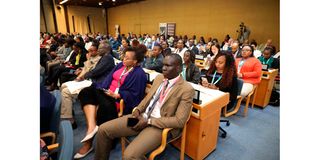
Delegates follow proceedings during the World Health Summit regional meeting at the United Nations Office, Nairobi, on April 29, 2026. Leaders and health experts gathered to deliberate on strengthening health systems, enhancing regional cooperation, and addressing emerging public health challenges in Africa.

What you need to know:
- Experts at World Health Summit warn preventable deaths persist because of funding gaps, weak systems and inequality.
- From Nairobi to Monrovia, health officials highlight adolescent pregnancies, unsafe abortions and fragile care systems.
The halls of the World Health Summit 2026 in Nairobi are filled with high-level diplomats and policy experts, but the data they are discussing tells a harrowing story of a “silent crisis” unfolding in villages and informal settlements across the continent.
In Kenya, the crisis is punctuated by a stark funding deficit. Experts at the summit revealed that the country faces a Sh19 billion funding gap in reproductive, maternal, newborn, child, and adolescent health. This financial vacuum translates into a grim daily reality where 92 newborns and 15 mothers die daily across the country, concentrated in high-burden counties where poverty, lack of infrastructure, and a shortage of skilled birth attendants converge.
The leading killers remain birth asphyxia, prematurity, and sepsis. Despite Kenya’s push for Universal Health Coverage, the lack of consistent funding for emergency obstetric care means that for many mothers, a manageable complication becomes a death sentence.
At the World Health Summit 2026 in Nairobi, Dr Jean Kaseya, the director-general of Africa CDC, announced that Africa loses about 20 mothers every hour, 114 newborns daily, and 300 children under five from causes that are entirely preventable. In Kenya alone, 92 newborns and 15 mothers die daily from preventable causes like preterm complications, birth asphyxia, and sepsis.
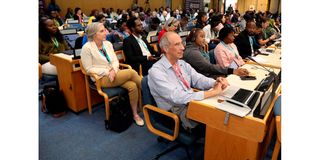
Delegates during the World Health Summit Regional Meeting at the United Nations Office, Nairobi, on April 29, 2026.
The challenges in East Africa find a mirror image in the West. Dr Teyah Moore, Liberia’s Assistant Minister of Health for Curative Services, shared that his nation is battling with a maternal mortality rate of 742 per 100,000 live births.
“Looking back at the years during the time of President Ellen Sirleaf, more than 12 years ago, we had a maternal mortality rate that stood at 1,042. And then over 12 years, we made progress under the leadership of Madam Salif, and we reduced that number to 742. This data was provided by the Demographic Health Survey in 2019-20,” he said.
“In terms of neonatal mortality, our national data, according to the Demographic Health Survey, stands at 37 per 1,000 live births. But the World Bank and other United Nations agencies, through a series of studies conducted, are reporting 25 to 29 per 100,000 births.
“We are all aware of the 'Three Delays' model: There is the delay in making the decision to seek care, the delay in reaching the facility due to road connectivity, and the delay in receiving an intervention once you arrive. In Liberia, a mother might be referred one day and reach the facility the next, travelling by motorbike or taxi because we lack a functional ambulance system.
“For the maternal side, postpartum haemorrhage, we know, is the leading cause of maternal death in most of the countries in Africa, including Liberia. Then you have the issue of short-term labour, sepsis, hypertensive disorder in pregnancy, anaemia, malaria, and other contributing factors. When you look at the newborn, because the referral system has challenges ranging from road connectivity for the mother to seek care, the impact on the foetus there is that you have most of the neonatal deaths resulting from asphyxia and prematurity because of maternal diet and nutrition, as well as malaria in pregnancy and anaemia.”
A shared concern between Kenya and Liberia is the skyrocketing rate of adolescent pregnancies, which directly correlates with maternal death. In Liberia, the teenage pregnancy rate has hit 31 per cent for girls aged 15 to 19, nearly double the regional average.
Liberia is also grappling with unsafe abortion, which, according to Dr Teyah, is the fourth leading cause of maternal death. He explains that restrictive laws mean many women turn to unsafe methods, including traditional herbs and untrained providers. A new public health law, currently before the Senate, aims to address gaps, but the debate remains divisive in the predominantly Christian nation.
While the legal process unfolds, the Ministry of Health is focusing on expanding Post-Abortion Care (PAC). In Kenya, similar trends are seen in informal settlements, where a lack of access to contraceptives and restrictive reproductive health policies drive girls toward unsafe abortions. “In Liberia, we have an unmet need for family planning of 29 per cent. We have to demystify contraceptives. There are myths that implants make you lose weight or get lost in the body. We must break these myths and provide youth-friendly services,” Dr Moore explained.
He also added that children also face malnutrition, with a stunting rate of 30 per cent. The World Health Organization defines stunting as a form of chronic child malnutrition defined by a low height for age, caused by long-term nutrient deficiency, poor maternal health, or repeated infections.
“We have children that are chronically malnourished. It’s affecting their cognitive development and also affecting their growth. Even as a country, over time, we have had shortages in complementary feeds, and even though we have some partners that have been helping us, we are thinking that it is not sustainable. As a country, we started thinking of local production of nutritional products, understanding that children need to grow and their brains have to develop,” said Dr Moore.
Local production
“We already started the processes that will lead to local production. We are now moving towards a piloting phase as a country. We have contacted manufacturers of local production equipment in Nigeria to see how well we can get two of those machines to use our local ingredients to make complementary feeding for our children. Africa is rich in terms of food supplements and food products. We cannot always depend on people sending things from the West.
“While true partnership is good, local production is the sustainable means. Once we get the machines, hopefully by May this year, we'll be piloting, and then we can scale up and see how the outcome will be.”
Somalia is navigating a complex and evolving health crisis that threatens to undo a decade of progress. As of April 2026, the nation is grappling with high maternal mortality and a significant reduction in humanitarian aid, all while a nationwide drought is expected to push 6.5 million people into acute hunger by June. In an exclusive look at the Ministry of Health’s strategy, Dr Mustafe Awil Jama, director of family health, describes a nation at a crossroads.
“Somalia continues to face a complex and evolving health situation, particularly affecting women, children, and vulnerable communities. We are seeing a convergence of challenges, including high maternal mortality (563 per 100,000 live births), under-five mortality (104 per 1,000), and newborn mortality (34 per 1,000), alongside reduced humanitarian funding and severe drought conditions expected to push millions into acute food insecurity. These pressures are placing significant strain on the health system and access to essential services,” Dr Jama says.
Perhaps the most jarring statistic emerging this year is a new study revealing that teenage pregnancy rates have hit 49.5 per cent. For the ministry, this isn't just a medical issue; it is a profound social and educational crisis that directly feeds the country’s high mortality rates.
“The high rate of early marriage and teenage pregnancy reflects deeper structural challenges that go beyond the health sector alone. While we are strengthening access to adolescent-friendly health services, we fully recognise that addressing early childbearing requires a broader, multisectoral approach.
“The Ministry is working closely with the different sectors across education, community leadership, and social services to keep girls in school, expand access to comprehensive, age-appropriate reproductive health information, and engage families and communities on the risks of early pregnancy. We are also supporting initiatives that address harmful social norms, including early and forced marriage, through community dialogue and advocacy led by local leaders,” Dr Jama says.
“Importantly, we are prioritising programmes that empower adolescent girls, improving access to education, protection services, and economic opportunities, while also engaging boys and men as part of the solution. Reducing teenage pregnancy is central to lowering maternal mortality, and it requires sustained investment, strong community engagement, and coordinated action across sectors.”
With millions facing acute malnutrition due to the 2026 drought, the government is attempting a radical shift in how it delivers aid. Rather than treating nutrition as a firefighting exercise handled by separate emergency responses, the Ministry is integrating it directly into primary healthcare.
“We are deliberately shifting from a parallel, emergency-driven nutrition response to a more integrated, system-based approach. This means that when a child visits a clinic for a routine immunisation or outpatient service, they are automatically screened for malnutrition. Nutrition is no longer a standalone intervention; it’s a core component of routine service delivery,” Dr Jama says.
This strategy extends to high-risk and hard-to-reach areas where security remains a concern. By expanding mobile outreach and working with local partners who understand the local context, the Ministry aims to ensure no woman or child is left out. The biggest hurdle, however, may be the global shift in donor priorities. As international funding for Somalia shrinks, the pressure on the health system intensifies, forcing difficult trade-offs in maintaining the health workforce and essential medicine supplies.
In a show of national ownership, the Somali government has committed an additional $5 million to the health sector this year. While significant, the ministry is actively engaging partners to align their support behind national priorities. “Shifting donor priorities and reductions in external funding are already placing significant pressure on the health system,” Dr Jama admits. “Programmes that support maternal, newborn, and child health are especially vulnerable if funding becomes less predictable.”
SDG targets
According to the Global Leaders Network, to which Kenya, Liberia and Somalia are members, most countries will, based on current trends, fail to reach 2030 SDG targets for improving women’s, children’s and adolescents’ health. This health diplomacy initiative, which supports the attainment of the 2030 Sustainable Development Goals related to women, children and adolescents, shows 46 countries are off-track in meeting the SDG target for maternal mortality, and 59 countries are off-track in meeting the under-five child mortality SDG target.
Dr Jean Kaseya, the director-general of the Africa CDC, identified four critical gaps that are slowing down Africa's progress in terms of reducing maternal and child deaths, as well as teenage pregnancies. Most striking is a staggering human resource deficit; Africa is currently short of more than five million medical doctors. This massive void has forced a reliance on community health workers to bridge the gap between life and death in rural areas.
Beyond the labour shortage, Dr Kaseya pointed to a chronic lack of domestic financing, a shortage of basic medical commodities that should be manufactured locally, and the absence of a robust digital agenda to track and use health data.
“The third one is lack of commodities; even the basic commodities that any country can manufacture, we don't have. The fourth one is the lack of a strong digital agenda that can help us collect appropriate and more complete information and then use that. These are the main challenges we have. We are trying to rethink and rebuild the system by addressing these challenges,” Dr Kaseya noted, though he highlighted beacons of hope, such as Tanzania, which has remarkably reduced its maternal mortality by 80 per cent over the last seven years.