Schools embrace energy-smart cooking boilers to save forests
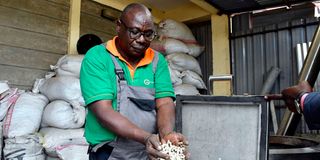
Festus Agisu, the CEO of Green Air Fire Solutions, throws pellets made from sugarcane waste, into a solar-powered miomass pellet boiler at his workshop in Kahawa West, Nairobi on September 18, 2024.

What you need to know:
- Nature Kenya estimates that each school in Kenya may be responsible for clearing up to 56 acres of forest annually. This totals more than 1.1 million acres of forest lost each year just to meet the firewood needs of schools.
Since 2000, Kenya has lost about nine per cent of its trees, in part because of the country's reliance on firewood for cooking purposes, according to Global Forest Watch.
Schools are among the major contributors to the deforestation. Nature Kenya estimates that each school in Kenya may be responsible for clearing up to 56 acres of forest annually. This totals more than 1.1 million acres of forest lost each year just to meet the firewood needs of schools.
Cooking technologies
But all is not lost as the adoption of clean cooking technologies is presenting a compelling solution.
Companies such as Green Air Fire Solutions are manufacturing manual biomass pellet burners and selling them to schools in Kenya and Rwanda to meet cooking needs. The boilers use pellets made mostly from sugarcane waste, sawdust and coconut husks.
In 2018, Festus Agisu, CEO of the company, embarked on a mission to promote sustainability in energy consumption.
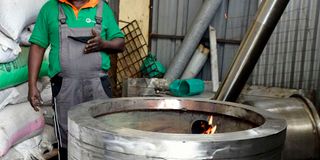
Festus Agisu, the CEO of Green Air Fire Solutions, throws pellets made from sugarcane waste, into a solar-powered miomass pellet boiler at his workshop in Kahawa West, Nairobi on September 18.
After earning a Bachelor of Design in Graphic Design from Taiwan National Normal University in Taipei, where he specialised in design and machine tooling, Festus focused his expertise on developing energy-smart solar powered biomass pellet cooking boilers.
This burner features solar energy with battery backup, which powers the pellet feeder and control unit of the boiler. It is made with stainless steel, fiberglass, and mild steel, with key components sourced from Europe and locally fabricated parts.
“It features a controller that manages the operation, pellet dosage, air intake, and remote control functions. The stove includes a pellet tank (hopper) for storage, a feeding system with a fan and an electric motor for pellet delivery, as well as a cooking vessel (sufuria),” adds Festus.
Before cooking, you set parameters on the controller for work and pause times. Work time controls pellet dosage into the fire pit to maintain a constant flame, while pause time prevents overflow by stopping the motor.
To ignite the stove, pellets are automatically fed into the fire pit, which is then lit using paraffin or small pieces of wood. Once ignited, the controller automates the cooking process based on the food being prepared.
The boiler is specifically designed for large institutions and efficiently utilises various fuel types, with biomass pellets being the most recommended option. This system provides an economical alternative to expensive gas and traditional firewood.
“The optimal size for these pellets ranges from 6mm to 25mm, where the fire intensity can be adjusted through the controller, similar to how one would operate a gas cooker. By modifying the air intake, you can increase or decrease the flame. Ash produced during cooking collects in an ash tray below the burner, which can be emptied every 24 hours to a maximum of one week,” adds Festus.
What makes the stove even more unique is that it also has a Wi-Fi connection to the controller unit. “This allows users to operate the boiler remotely, and the unit can be connected to a PC or laptop, enabling control from various locations,” he adds.
According to Festus, each meal may need unique settings, and the boiler comes with a manual that outlines various cooking parameters for different types of food. It is fully automated and accommodates pot sizes from 100 to 450 litres, capable of cooking for up to 1,000 people in a single batch.
"For a 200-litre boiler serving 650 students, pellet consumption varies depending on the meal. For example, preparing tea and porridge requires 2.5kg of pellets and takes around 50 minutes. Cooking vegetables needs 1kg of pellets and takes 25 minutes. Ugali requires 3kg of pellets and takes one hour and 50 minutes, while rice consumes 2.5kg over one hour and 30 minutes. Beans require 8kg of pellets and approximately two hours and 30 minutes to cook," he explains.
Festus notes that these biomass pellet stoves are highly beneficial for schools and institutions as they offer substantial financial savings.
“They cook twice as fast and are 50 per cent cheaper than traditional wood stoves. For instance, a school serving 1,000 students could cut annual costs from Sh900,000 for firewood to Sh378,000 with biomass pellets.”
This, he says, means that using biomass pellets instead would eliminate the need to cut down trees because the pellets are sourced sustainably from materials like sugar cane waste and coconut waste.
“We have formed partnerships with three biomass pellet manufacturers located in Migori, Mombasa and Nairobi. These pellets are produced from waste materials such as sugarcane, sawdust, and coconut husks,” he adds.
And in terms of convenience, biomass pellet stoves surpass traditional wood stoves. “Pellets are easily stored in bags and fed into the stove automatically from a hopper, requiring less space and manual labour than chopping and storing firewood.”
The biomass pellets provide a cleaner and more efficient burn compared to traditional firewood. “With carbon dioxide emissions of just 1.8 tonnes per metric tonne of pellets, compared to 3.67 tonnes for firewood, biomass pellets are a more environmentally friendly choice,” he explains.
The stove has met European Union certification standards, including the highest emission test category five. Globally, carbon dioxide emissions are classified from one (highest) to five (lowest).
The price of the boiler stove ranges from Sh485,000 for a 100-liter model to Sh650,000 for a 350-litre version. “Additionally, we offer a fully equipped 40ft container kitchen that includes two 200-litre boilers and two storage units for Sh 2,500,000,” he explains, adding that to date, 20 units have been sold, with five having been exported to Rwanda.
Festus’ journey, motivated by his experience with traditional wood-fired stoves and his academic background, led him to develop a more efficient and eco-friendly cooking method.
“Growing up in boarding schools where food was prepared using traditional wood-fired boilers, I was motivated to find a better alternative.”
He was also inspired by the global climate change mitigation efforts.
But it was while studying design and machine tooling at National Taiwan University that his perspective broadened.
“My initial focus was on identifying a more efficient and environmentally-friendly heating solution. I then studied the limitations of wood-fired stoves and the advantages of biomass pellets such as improved combustion efficiency, reduced emissions, and ease of handling,” he adds.
As a qualified graphic designer and machine tooling technician, he began designing a stove capable of efficiently burning biomass pellets. This included developing the combustion chamber, pellet feed mechanism, and heat exchange systems while ensuring the stove met safety standards and performed effectively.
Early prototypes were built in 2019 and tested for performance, safety, and reliability. Adjustments were made based on these tests to enhance efficiency, reduce emissions and improve user experience.
Other than convincing people to switch from traditional firewood stoves and the perceived complexity of modern systems, the biggest hurdle for Festus has been regulatory compliance.
“Kenya lacks proper local testing equipment, so I had to seek assistance from European associates for testing and certification to meet environmental and safety standards.”
He says it's crucial to emphasise the long-term benefits of modern systems such as improved efficiency, lower emissions and potential cost savings.
In the meantime, he has established a manufacturing process that includes sourcing materials, setting up production lines, and ensuring quality control.
“The stove is now being introduced to the market with comprehensive marketing strategies, distribution channels, and customer support, and feedback from users is actively collected to drive further improvements.