Women lead the way in forest conservation through energy-saving stoves
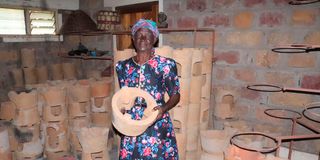
Oriang Pottery Women Group Chairperson Dorina Onyach displays an energy-saving jiko.

What you need to know:
- Stoves made from clay and sand retain heat for a longer period.
Increasing demand for charcoal and firewood in Homa Bay County continues to hamper efforts to attain the global recommended minimum forest cover of 10 per cent.
County Forest Conservator Sharon Cheluget said data shows that the county has one of the lowest forest covers, with just 3.1 per cent and a tree cover of 10.4 per cent.
“We only encourage the use of electricity, solar and liquid petroleum gas for cooking because they are friendly to the environment. However, many residents still make and use charcoal, which continues to put our forests under threat," she offered.
During routine patrols around forests, rangers often report coming across individuals ferrying charcoal to different parts of the county.
Ms Cheluget said the problem is persistent in Gwassi Forest in Suba, where criminals have infiltrated the forest and started cultivating.
"We have arrested many suspects and taken them to court. We will not relent in protecting our forests," she said.
The forest conservator urged residents to come up with alternative ways of cooking that do not continue to put pressure on trees or interfere with the environment. She said briquettes made from organic waste are one of the recommended ways of increasing tree cover as people will not depend on charcoal or firewood.
A group of women in Rachuonyo North are driving this change by making energy-saving jikos from clay and sand, in a bid to promote environmental conservation. Less fuel (wood or charcoal) is put in the stoves, thus reducing the pressure of sourcing wood and charcoal. The women are part of a conservation group, Oriang Pottery Women Group, made up of senior citizens, and they have been making jikos, pots and other earthware over the years. Stoves made from clay and sand retain heat for a longer period.
Ms Dorina Onyach, the chairperson of the group, said the jikos are having a positive impact on the environment.
“The benefits of using energy-saving jikos may not be felt immediately, but it is important for everyone to put efforts into fighting climate change,” she said.
Ms Onyach said members of the group were engaged in the production of pots at an individual level before selling the products in the market in the late 1980s. "We were moulding pots as an economic activity. We had not thought of mass production," she offered.
Later in 1991, the women came together to make their work easier by producing the earthwear as a team.
Former Karachuonyo MP Phoebe Asiyo spotted their work and offered to help them.
“We bought a piece of land, where we established a workshop. Ms Asiyo identified a donor who helped put up a building that we use until now,” Ms Onyach said. The group also bought another piece of land, where they excavate clay soil used in making the earthware.
Soil is excavated from the land and transported to the production centre. It is then tightly covered on the ground using black polythene for one week for it to absorb moisture and be soft.
Moist clay soil is later mixed with fine sand. When the mixture is constant and the correct viscosity is obtained, it is covered for a second time using polyethene for another week.
At Oriang Pottery Women Group, each member can make at least 20 jikos in a day. However, the members don’t take their products to the market because of logistical challenges and old age that prevents them from moving over long distances.
Buyers drive to the workshop and buy different items. Stoves are sold at Sh400 each and are of different types including jiko kisasa, insert jiko and two-in-one, which uses both firewood and charcoal.
Some traders purchase them in bulk before reselling them in other towns. Over the coming months, the group plans to start production of other items such as utensils made from clay. They aim to eliminate overreliance on plastic. Ms Dina Adipo, the deputy chairperson of the group, said the new products will also attract younger women into the group. “We have intentions of making jewellery from clay. We have machines that were given to us by environmental organisations which will facilitate this,” she said.
Most members of the group reported that their meals are prepared in pots.
The county also suffers from adverse effects of climate change, with floods and drought affecting residents.