Super humans: Science reveals how DNA, organs of Turkanas mutated for survival
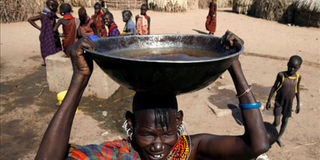
A Turkana woman carries water on her head before attending a drought and peace meeting in Lobei village of Turkana district in northwest Kenya, October 2, 2009.

What you need to know:
- The researchers scanned 308 genomes of the Turkana people, sequencing over seven million genetic variants.
- To understand different populations living in the same climatic conditions, they also sequenced 59 genomes from nearby Kenyan and Ugandan groups like the El Molo, Ik, Karamojong, Ngitepes, Rendille, and Samburu.
- The findings revealed something remarkable: even though these communities are culturally and linguistically distinct, examining common statistics shows that they have similar genomes.
In Kenya's most unforgiving landscape, where the sun scorches relentlessly and water is a precious commodity, an extraordinary mystery has puzzled visitors for generations. How do the Turkana people not just survive, but thrive in conditions that leave outsiders gasping for relief?
The answer, scientists have discovered, lies written in their very DNA — a 5,000-year-old genetic adaptation that reads like an evolutionary success story.
When Linet Njeri, who grew up in Eastern Kenya, first visited Turkana County, she felt constantly dehydrated. She remembers downing four half-litre bottles of water in under two hours.
"It was windy and dry," she tells Saturday Nation. "It feels like you are on the verge of a nosebleed."
As she struggled to acclimatise to that new environment, she noticed that the natives went on with their day as usual and didn't need as much water as she did.
"I was surprised that they were used to the weather. I took water even when I didn't feel like I needed it," she says.
John Ekadeli's experience tells the opposite tale. Having spent his childhood in Turkana, the first time he came to an urban setting was when he joined Alliance High School in Kikuyu.
"Growing up, the environment made me adapt naturally. When I moved to Kiambu County for high school, I noticed a difference," he tells Saturday Nation.
"Whenever I went back home during holidays, I would feel heat stress, get sunburns and drink a lot of water. I wasn't used to that when I lived in Turkana full time," he adds.
These contrasting experiences provided the first clues to a discovery by scientists from the Kenya Medical Research Institute (Kemri) in partnership with the Turkana Basin Institute (TBI), Vanderbilt University, and the University of California, Berkeley.
Gene forged by ancient climate change
The researchers, who published their findings in the journal Science, explain why the people in Turkana and other pastoralist communities survive the harsh environment. It's all in their genes—one that changed many years ago to naturally adapt to that punishing weather.
The breakthrough moment came around a campfire. Julien Ayroles, Professor of Ecology and Evolutionary Biology at Princeton University and lead author of the study, was visiting Turkana when the resilience of local women left him stunned.
His day-long hike at the Napedet Hills in Turkana drained him. He was baffled by how the women trekked long distances to get water for domestic use and still stood tall. Together with the Kenyan team, they started the Turkana Health and Genome Project in 2018.
Their research was ambitious. They scanned 308 genomes of the Turkana people, sequencing over seven million genetic variants. To understand different populations living in the same climatic conditions, they also sequenced 59 genomes from nearby Kenyan and Ugandan groups like the El Molo, Ik, Karamojong, Maasai, Ngitepes (also known as Tepeth), Poker, Rendille, and the Samburu.
The findings revealed something remarkable: even though these communities are culturally and linguistically distinct, examining common statistics shows that they have similar genomes.
The 5,000-year journey
Prof Julien explains that these genetic mutations occurred about 5,000 years ago, when these populations lived in North Africa near the Nile, hence the name Nilotic community. It was during the African Humid Period when the Sahara Desert was not yet a desert but a lush green region. That was when aridification in the northern part of Africa started. He says that this coincided with their migration down south, where some eventually settled in the northern part of Kenya.
During this time, there were changes in their genes.
"We found that there are a few places in the genome that were clearly impacted by natural selection, and the main one was the gene STC1," he tells Saturday Nation.
Kidney adaptation
He explains that this gene is expressed in a very specific set of cells in the kidney.
Think of a kidney as a sieve. As the blood gets filtered by the kidney, it decides whether it is trash that needs to go out as urine, or water that needs to be stored. As the filtration process goes on to the end, there is a cell called the duct cell that decides how much of the water should be excreted or reabsorbed into the blood.
The Turkana people have the STC1 gene, which allows them to do what many people cannot.
"They can reabsorb more water during that process of filtration. When they get dehydrated, there is a hormone called vasopressin or the antidiuretic hormone (ADH) that gets secreted. This gene is sensitive to this hormone. When the hormone goes up, the expression of the gene also goes up and then the process of reabsorbing more water starts," explains Professor Julien.
Dr Sospeter Njeru, Kemri's deputy director, Centre for Community Driven Research, who is also a principal research investigator, says the study is important since Africa is grossly underrepresented in genetic studies. This study changes the narrative.
"We are increasing the representation of the African genome within the global map," he says.
"What our findings explain is that these two problems—the heat and the dietary options—have been putting pressure on these people (the Turkana). In biology, you either survive or you are taken out," he adds.
The research revealed eight genetic signatures, not just one. Two of the genes had been identified prior among the Maasai, and six were discovered for the first time.
"This is critical," he says, adding that: "It means that we are giving to the scientific community six novel signatures of selection that would help people to survive such environments. Our star gene is the STC1."
The beauty of the "star gene" is that immense pressure helped these people to raise its force.
"What this does to their system is to help them deal with the water scarcity. Too much heat means losing a lot of water through evaporation. And that's why when we go there, you will most likely have a headache," explains Dr Njeru.
"They spare as much water within their system by ensuring that they pass on little of it. When we checked their urine, it was heavier than that of a normal person, but there was less of it," he adds.
Since there is no luxury of food diversity in the region, the Turkana survive on protein-rich food, yet there is no evidence of the community getting diseases related to overconsumption of meat.
"These genes help the Turkana people to break down these materials (the protein-rich food) in a manner that they will not be a health problem to them," he explains.
The urban challenge
But this genetic gift comes with a modern dilemma. The study examined how the shift of Turkana natives to urban centres affects their health—what scientists call an evolutionary mismatch.
Dr Njeru explains that even though the STC1 gene is beneficial to the natives when they are in their normal environment, a shift to urban settings predisposes them to non-communicable diseases.
"There is a shift from pastoralism to an urban lifestyle. When they shift, the same genes that were protective under a punishing environment become problematic," he says.
"We see those who have shifted becoming more vulnerable. We see more biomarkers associated with heart diseases," he explains.
Dr Epem Esekon, County Executive for Health and Sanitation, Turkana County, said in a press statement that the research demonstrates how ancestors of the Turkana people adapted to dramatic climate shifts through genetic evolution.
As urbanisation continues, Dr Njeru advises that the country should be prepared for a surge of non-communicable diseases caused by lifestyle changes.
"Times are shifting and the government should be ready for this. This should be a strong wake-up call to the health sector to prioritise non-communicable diseases," he adds.