She went for an eye check-up and left with a TB diagnosis: The health secrets your eyes can reveal
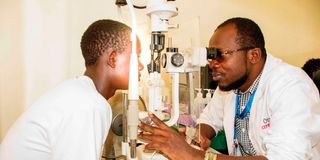
James Buore, an ophthalmic clinician at Jaramogi Oginga Odinga Teaching and Referral Hospital, conducts an eye checkup on a patient at the facility on July 14, 2026.

What you need to know:
- Apart from TB, other health conditions that can be detected during routine eye screening include diabetes, which often results in bleeding inside the eye cells.
- This can only be revealed through medical tests showing bleeding or leakage of proteins within the photoreceptor cells, retina, and choroid.
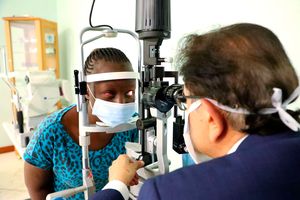
Two months ago, Mary* walked into Jaramogi Oginga Odinga Teaching and Referral Hospital (JOOTRH) with painful, light-sensitive eyes and vision that had started to fail her. What she thought was an eye problem turned out to be something far bigger: tuberculosis.
The woman in her late 30s had been referred to the regional facility for a specialised eye check-up, unaware that she was suffering from tuberculosis (TB) of the eye. According to her ophthalmologist, the screening revealed inflammation in the innermost layers of her eyes, a condition known as uveitis.
James Buore, an ophthalmic clinician at JOOTRH, says that although Mary did not present with any typical signs of TB, the inflammation in her eye cells was a symptom of ocular tuberculosis.
Also read: Explainer: What is red eye disease?
"I was referred for a TB test and diagnosed with the bacterial infection," says Mary, who is now on treatment and reports that her vision has greatly improved.
This was not the first time Buore had picked up an underlying health condition during a routine eye examination. He says eye screening is often overlooked, yet it can reveal health conditions that would otherwise go unnoticed until they are advanced.
"The sad reality is that the patients we meet at the facility on a daily basis are those presenting with blurry or reduced vision, persistent headaches, itchy eyes, inflammation, discharge, redness and other eye conditions," explains Buore.
Apart from TB, he says other conditions that can be detected during routine eye screening include diabetes, which often causes bleeding inside the eye cells. This can only be revealed through medical tests showing bleeding or leakage of proteins within the photoreceptor cells, retina and choroid.
"Eye check-ups can also reveal an increasing number of dead cells inside the eye, or meandering blood vessels in the organ, a symptom common among hypertensive patients," he says, adding that most diabetic and hypertensive patients present with reduced vision as their only symptom at the eye clinic.
Buore notes that eye examinations can also detect problems in the brain, including pituitary tumours and brain oedema, allowing patients to seek early intervention.
His observations are echoed by Dr Caleb Momanyi, a consultant ophthalmologist at Aga Khan Hospital, Kisumu, who says that beyond diagnosing eye conditions, a routine eye check-up can reveal infections such as carcinopathy, advanced HIV and syphilis.
"We work very closely with the neurologist and the neurosurgeon, because sometimes patients with persistent headaches may be having disease processes going on in the brain or in the brain cavity," says Momanyi.
He adds: "By examining the eye, particularly the optic nerve head, one can tell that there is maybe increased eye pressure in the brain, resulting in papilledema, which is swelling of the optic nerve. The beauty of ophthalmology is that when you examine the eye, you see the blood vessels in real time and find out lots of details."
Despite these health concerns, Buore says he has yet to come across a patient walking into the public health facility specifically for a routine eye check-up. Dr Momanyi reports the same trend at Aga Khan Hospital, where only a handful of clients come in seeking routine screening.
On a Tuesday morning visit to JOOTRH, tens of patients are waiting to see an ophthalmologist, presenting with a range of eye conditions: red eyes, itchy eyes, discharge, pain and persistent headaches, among other complaints.
Among them is a 15-year-old boy suffering from constant eye pain and low vision. He says his eyes have been itchy since he was 12, but his parents only grew concerned when his vision became blurry. He hopes to leave the facility with a pair of glasses that will allow him to continue with his studies.
Also in the waiting bay are a woman with a red left eye and a man who suffered an eye injury while working at a carpentry workshop, among other patients.
On a normal day, Buore attends to between 15 and 20 patients seeking eye care, most of them referral cases. Of these, between five and 10 often end up being diagnosed with an underlying health condition they were previously unaware of. Dr Momanyi reports a similar pattern at Aga Khan Hospital, where at least 10 to 20 per cent of the patients he sees on a daily basis end up being diagnosed with a disease they did not know they had.
"Before walking into an optical shop to change your glasses, one should at least see an ophthalmologist. At times, opticians do not have the kind of equipment we have that could diagnose other conditions," says Dr Momanyi. He adds that technology such as optical coherence tomography, a non-invasive imaging test that uses light to capture highly detailed pictures of the inner eye, has made it easier to diagnose such conditions at an early stage.
Buore says the eye is one organ that can be affected by a number of diseases, and that people living with HIV, hypertension, diabetes, rheumatoid diseases and sickle cell anaemia are at higher risk of eye conditions, some of which can result in permanent vision loss. Such individuals should be checked regularly.
He also cautions that people who spend more than four hours a day on televisions, laptops or phones should make regular visits to an ophthalmologist, as they are likely to suffer from dry eye syndrome, or what he calls computer vision syndrome, caused by rays emitted from electronic gadgets that affect the photoreceptor cells responsible for vision.
"Sometimes you may end up presenting too late for something that ought to have been corrected much earlier through screening. Remember, loss of vision is one condition that often comes with a great deal of depression," he says.
Another emerging concern, according to Buore, is the rise in eye conditions among children due to exposure to television and phones. A study published by the National Library of Medicine, titled Rural-urban differences in prevalence of and risk factors for refractive errors among school children and adolescents aged between six to 18 years, found that children in urban settings are more likely to have myopia, a leading cause of vision impairment and preventable blindness, compared to those in rural areas. The gap, the study notes, comes down to less time spent outdoors and exposure to sunlight, intense screen time, and academic pressure that demands longer study hours and less time for outdoor play.
"Children's screen time needs to be regulated in order for the young ones to embrace outdoor activities," says Buore.
He adds that eye screening should begin right from birth, in order to identify glaucoma, cataracts and some new-born cancers such as retinoblastoma for early management. Birth, he says, is the ideal time to check whether the eyes are missing, whether there are any congenital abnormalities, and whether all eye structures are present.
The clinician also urges industry workers to embrace specialised protective glasses to shield their eyes while at work.
"We receive patients here on a daily basis from a range of occupations, seeking to have foreign bodies removed from their eyes. That can only mean that their eyes are never protected while at work," he says, adding that a frequent need to change glasses is also a sign that one should be evaluated by an ophthalmologist or eye specialist.
Momanyi says frequent screening is important, both to rule out conditions that could otherwise lead to blindness and to catch undiagnosed health conditions early.
"Routine eye check-up is just as good as any other routine check-up that a person can opt for. One thing about the eyes: before they start screaming, they will be crying. When you visit the hospital early enough, we are able to reverse or offer an intervention before it worsens," Buore concludes.