SHIF spent Sh34bn more than it collected in first year
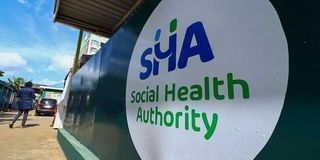
Social Health Authority signage at Mutuini Hospital in Dagoretti South Sub-County, Nairobi, on August 27, 2025.

The Social Health Insurance Fund (SHIF) spent nearly Sh34 billion more than it collected in its first year of operation, raising fresh concerns about the sustainability of Kenya’s new public health financing model.
According to the Kenya Economic Survey 2026, SHIF collected Sh57.7 billion in member contributions during the 2024/25 financial year through the mandatory 2.75 per cent levy on gross income, but paid out Sh91.5 billion in claims, including Sh33.4 billion in outstanding liabilities.
The figures translate to a utilisation ratio of 158.6 per cent, meaning the fund spent Sh1.59 for every Sh1 collected.
“The contributory SHIF collected Sh57.7 billion, but incurred claims amounting to Sh91.5 billion, including Sh33.4 billion in outstanding liabilities, resulting in a utilisation ratio of 158.6 per cent,” the survey states.
SHIF replaced the defunct National Hospital Insurance Fund (NHIF) after the Social Health Authority (SHA) took over in October 2024.
The deficit has been worsened by a sharp imbalance in contributions. Formal sector workers accounted for 90 per cent of total collections, contributing Sh51.99 billion, while the informal sector contributed only Sh5.72 billion, effectively leaving salaried workers to finance healthcare for a much larger population.
Although more than 22 million Kenyans had registered with SHA by May 2025, only about four million were making monthly contributions, leaving the scheme with a narrow revenue base.
The financial strain has been compounded by suspected fraud. Auditor-General Nancy Gathungu found that Sh26.8 billion had been paid to health facilities without supporting documentation.
The audit also identified 3,235 duplicate birth claims worth Sh445.4 million, alongside 6,392 cases of unlikely repeat births billed at Sh148.4 million.
In one case, a single patient was billed for open-heart surgery four times in one day, generating claims of Sh463.8 million, of which Sh445.4 million was approved and paid.
Health Cabinet Secretary Aden Duale acknowledged the irregularities but said they reflected the complexity of moving from NHIF to the new system.
“We view this audit not as a critique, but as an invaluable statutory tool that has played a critical role in helping us identify and address transition issues early on,” Duale said.
The financial difficulties have also affected hospitals. A survey by the Rural Private Health Association found that only 20 per cent of primary healthcare-accredited facilities received monthly payments in the first quarter of 2025, while 45 per cent received no payments at all during the period.
The overall SHA claims settlement rate averaged 34 per cent, with private facilities recording the lowest rate at 27 per cent.
Speaking at the World Health Summit Regional Meeting 2026 in Nairobi, President William Ruto defended the programme, saying 30.7 million Kenyans had registered under SHA, compared with eight million under NHIF two years earlier.
He said the government had collected Sh169 billion across all SHA-managed funds over the past two years, of which Sh124 billion had been paid to hospitals for services rendered.
Ruto also said the transition had lowered insurance costs for teachers, with government spending falling from Sh26 billion under private insurance to Sh18.2 billion, while expanding access from 900 facilities to 7,000 nationwide.
SHIF is one of three funds administered by SHA under the Social Health Insurance Act, 2023.
The other two — the Primary Health Care Fund and the Emergency, Chronic and Critical Illness Fund — are financed by the Exchequer and have recorded more stable performance.
The Primary Health Care Fund received Sh10.24 billion and posted a payout ratio of 95.5 per cent, while the Emergency, Chronic and Critical Illness Fund received Sh1.32 billion and recorded a payout ratio of 95.2 per cent.
SHA enrolment also remains uneven. Women account for 51.7 per cent of registered members and men 47.3 per cent, while more than 212,000 people did not indicate their gender. Another 4.4 million members did not specify their county of residence, creating a data gap that could complicate county-level planning.
Registration remains concentrated in urban counties, with Nairobi recording the highest number of members, followed by Kiambu County and Kakamega County.
Counties in arid and semi-arid regions recorded the lowest uptake, with Isiolo County posting the fewest registrations at 46,968, underscoring persistent barriers such as poor infrastructure, low literacy and widespread informal employment.
Follow our WhatsApp channel for breaking news updates and more stories like this.