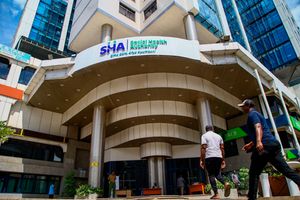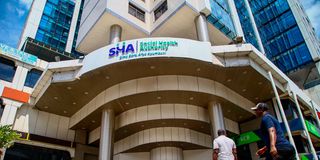
The Social Health Authority building in Nairobi.

The government owes county public hospitals more than Sh8 billion in unpaid claims, a growing debt which now threatens to cripple healthcare services across the country.
The arrears, which have accumulated since last year, have severely strained the operations of county-run facilities, raising concerns about the long-term viability of service delivery under the Universal Health Coverage programme.
According to the Controller of Budget Margaret Nyakang'o's latest County Governments Budget Implementation Review Report for the first half of the 2025/26 financial year, delayed disbursements are undermining the ability of public hospitals to function effectively.
“The mounting debt threatens the credibility of the universal health coverage programme. The delayed disbursements risk crippling services at the facilities,” reads part Nyakang’o’s report.
The audit reveals that Kisumu County has been hit the hardest, with claims amounting to 1.87 billion Kenyan shillings owed by the Social Health Authority (SHA). Nyeri is second, with claims amounting to Sh633.6 million, followed by Nakuru with Sh609.2 million and Kiambu with Sh474.85 million.
Other counties owed significant amounts include Bungoma (Sh387.2 million), Mombasa (Sh334.3 million), Kakamega (Sh311.2 million), Siaya (Sh287.5 million), Kitui (Sh243.85 million), Kajiado (Sh232.33 million) and Garissa (Sh222.3 million), among others.
The report states that Nyandarua is owed Sh219.7 million, Busia Sh204.87 million, Kwale Sh201 million, Embu Sh163.7 million and Kisii Sh111.9 million.
The counties owed the least include Bomet (Sh54.2 million), Baringo (Sh42.4 million), Narok (Sh34.9 million) and Migori (Sh10.1 million).
It has also emerged that county hospitals are owed millions by the defunct NHIF, further straining the facilities.
For example, the defunct NHIF owes county hospitals in Nakuru a staggering Sh482.6 million, while other hospitals in Mombasa, Kakamega, Migori, Kitui, Machakos, Baringo, Tharaka Nithi, Busia, Narok and Samburu are owed Sh 322 million, Sh 241.4 million, Sh 175.29 million, Sh 89.1 million, Sh 68.2 million, Sh 67.3 million, Sh 22 million and Sh 4 million respectively.
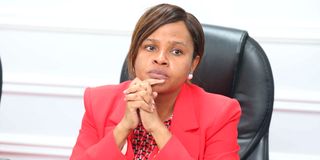
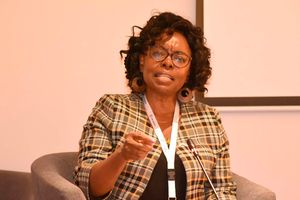
Social Health Authority CEO Dr Mercy Mwangangi.
The delayed disbursements are part of the broader challenge facing counties as they struggle to recover billions of shillings owed by the SHA and the defunct NHIF for services provided.
In the past, delayed disbursements have strained hospital operations and supply chains.
On Wednesday, April 22, the Health Cabinet Secretary, Aden Duale, informed the senators that the SHA would settle the Sh116 million group life and last expense claims for the defunct Edu Afya, which was under the NHIF, by May 8, 2026.
"The total pending claims for all Edu Afya schemes amount to a total of Sh735 million, but the Sh116 million will be settled in the next two weeks. The balance of Sh619 million will be settled upon availability of funds," revealed Mr Duale.
The CS said the National Treasury has allocated a further Sh4billion in the supplementary budget to clear NHIF debts.
He said other debts owed by the defunct NHIF will be cleared in the 2026/2027 financial year.
The CS further said SHA is working on improving efficiency in claims processing
The Social Health Insurance Fund (SHIF) under SHA was rolled out on October 1, 2024, with promises of faster reimbursements and clearer accounting.
However, more than one year later, both public and private hospitals continue reporting delayed reimbursements of claims.
Private hospitals, which account for about half of Kenya's healthcare services, have also been hit by delayed disbursements.
The Kenya Conference of Catholic Bishops (KCCB) in a statement on Thursday, April, revealed that SHA owes faith-based hospitals alone Sh5.7billion, including rejected claims.
The defunct NHIF also owes the faith-based facilities Sh3.3 billion in debts.
Over the past year, SHA has faced public scrutiny and outrage over out-of-pocket payments caused by system downtime and limited coverage, among other issues.
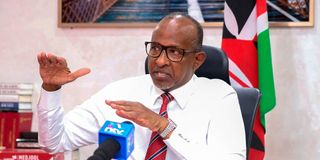
Health Cabinet Secretary Aden Duale during an interview in Nairobi on January 26, 2026.
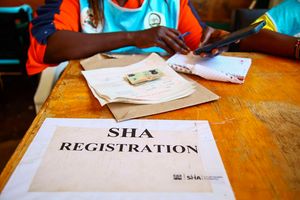
Two weeks ago, Duale revealed that, by April 2026, at least 30.5 million Kenyans had enrolled with SHA.
In recent months, the health insurance scheme has faced public uproar over the "poor" implementation of the healthcare fund, as Kenyans have termed it.
Issues cited include out-of-pocket payments due to system downtime and limited coverage.
The public has sustained its criticism of SHA over the chaotic switch from the defunct National Health Insurance Fund (NHIF) to SHA and the tragic realities of the healthcare system at the grassroots level.
Previously, Kenyans, healthcare professionals and leaders including Members of Parliament, publicly voiced their concerns ,with some feeling alienated by the fund.
Last year, MPs demanded answers on the poor implementation of the scheme, including delays to approve patient claims as well as specifications on what exactly SHA covers as they pointed out that the new SHIF system was susceptible to failures and slow speeds, emphasising the need for remedies.
However, the government says a lot has been streamlined and the Ministry of Health has been mobilising and encouraging Kenyans to register with SHA.
SHIF, one of President William Ruto's policies, seeks to provide affordable healthcare to all Kenyans.
Under the scheme, the government aims to provide Universal Health Coverage with equity in service delivery ,a vision that it describes as "leaving no one behind"
The SHIF replaced the decades-old National Health Insurance Fund (NHIF), which lost billions of taxpayers-contributed funds to corruption.
Follow ourWhatsApp channel for breaking news updates and more stories like this.