Sigh of relief as 2,000 Bomet villagers gain access to clean water, ending decades of struggle
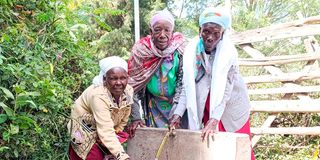
From left: Grace Turgut, Sally Kiget and Esther Cheruiyot collect water from a tap at the newly commissioned Gataret Water Project in Chebunyo Ward, Chepalungu, Bomet County. The initiative, a joint project between the national and county governments, is set to benefit over 2,000 families.

What you need to know:
- Schools struggled with sanitation, creating serious health risks for students.
- Contaminated water sources have historically led to outbreaks of bilharzia, dysentery, and typhoid among residents.
For over 60 years, Esther Cheruiyot has made a daily, back-breaking five kilometre journey to fetch water for her household. The 78-year-old grandmother, alongside other women and children from her community, would travel to River Chepkulo or distant water pans, carrying heavy containers on their backs or loading them onto donkeys.
This daily struggle defined life across several villages in Chepalungu, Bomet County.
Schools struggled with sanitation, creating serious health risks for students. Contaminated water sources have historically led to outbreaks of bilharzia, dysentery, and typhoid among residents.
“We have been fetching water from Chepkulo and Kibirir during dry seasons for years, especially after the rainwater we harvest runs out,” Ms Cheruiyot said.
Now, that decades long burden has been lifted. Through the Financing Locally Led Climate Action programme, the Bomet County and national governments have laid a five kilometre piped water network in the area, serving more than 2,000 residents.
The project benefits villages across Chepalungu: Koita, Lelbarak, Kiptenden, Gataret, Chebugon, and Chelelach, bringing water close to homes for the first time. It addresses longstanding challenges in public health, sanitation, nutrition, agriculture, and livestock management in this semi arid part of Bomet County.
Ms Cheruiyot said women in the area feel profound relief. Access to clean water has improved hygiene, health, and brought unexpected economic opportunities.
“Because of this water, we’re now able to do basic irrigation in our gardens,” she explained. “Vegetable production has gone up, which improves food security and has become an extra source of income for many families.”
Priscilla Rotich, on whose land a distribution tank has been installed, explained that since independence, locals have had no access to clean piped water. Women and children, especially girls, were forced to fetch water from distant rivers.
“Many women suffer from health conditions, especially spinal injuries, after decades of carrying water daily in this semi-arid area. With a consistent supply, this will finally end,” said Ms Rotich.
She noted that water is now available 24 hours a day, allowing residents to provide for livestock, cook, and wash with ease. This reliability has freed up time for women to pursue other economic activities.
“We are appealing to the government to extend the pipeline to neighbouring villages and set up more water troughs for livestock to ease the current pressure on the supply.”
Alice Simotwo described how, for years, women risked their safety washing clothes in rivers and fetching water year-round, facing dangers such as drowning. “Now residents can bathe regularly, wash clothes, water livestock, and irrigate their gardens.”
Annah Koskei, another resident, highlighted the broader social impact. “In the past, girls were exposed to the risk of assault while fetching water from remote areas. Having water points close to homes has solved that,” she stated.
She emphasised that the water supply has become a key socio-economic pillar for the community, most of whom are small-scale farmers.
Dr Joseph Sitonik, Bomet County’s Health executive, explained that carrying heavy loads on the back or head over long periods has lasting negative health effects.
“Carrying heavy loads misaligns the spine, places pressure on spinal discs, leads to poor posture, causes stiffness, and results in other health complications.”
He added that a lack of clean, safe drinking water has also left residents vulnerable to diseases such as dysentery, cholera, diarrhea, and typhoid.
Solomon Kimetto, Water chief officer, affirmed that both the national and county governments remain committed to easing the region's water supply challenges.
"Water supply is capital-intensive, and we need donor support to reach more people beyond those currently covered under the various programmes being rolled out in the county.”
He noted that rivers, streams, dams, and water pans remain the primary sources of drinking water for most residents, while the county government continues to promote rainwater harvesting techniques.
Bomet County lies in the South Rift Valley, a highly productive agricultural region where farmers grow tea, pyrethrum, maize, avocado, coffee, bananas, beans, potatoes, cabbages, and various vegetables alongside livestock rearing.
Governor Hillary Barchok acknowledged that historical gaps in water infrastructure have left parts of the county underserved; a shortfall his administration is now working to address.
"With population growth in both urban and rural areas, we are working to expand access to clean and safe drinking water. This will help address persistent health, nutrition, and economic challenges in the county," Prof Barchok said.
He added: "In the lower zones, residents have largely relied on water pans. We are now extending piped water to homes to curb waterborne diseases."
Many local schools and colleges depend on rainwater harvesting, but when tanks run dry, traders step in to supply water using bowsers; an expensive and unreliable stopgap.
Meanwhile, the county administration is also rehabilitating dilapidated pipelines across existing schemes in all five sub-counties: Chepalungu, Sotik, Konoin, Bomet East, and Bomet Central.