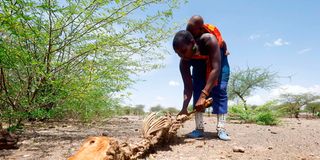
Deputy President Kithure Kindiki assured Kenyans that the government will mobilise resources to provide sufficient food, water and medical supplies to those in need.
Prof Kindiki said that in response to the failed October–December 2025 short rains, the government has scaled up interventions to address food and nutrition insecurity across the country.
“The government plans to spend Sh4 billion per month on procuring food, livestock feeds, water and other relief items,” Prof Kindiki said on Monday.
The meeting, attended by Cabinet secretaries, principal secretaries and heads of relevant agencies, reviewed the drought situation and agreed on measures to streamline aid delivery to the most vulnerable communities.
He said that more resources have been allocated to purchase food and non-food items for 3.3 million people across 23 counties, as well as to provide water, livestock feed and other interventions related to the drought.
The government has also reviewed food distribution networks to guarantee the supply of food, water, medical supplies, pasture and animal vaccinations to affected regions. Four counties have been classified as being in a state of crisis.
Development partners have been asked to complement this effort with an additional Sh2 billion to strengthen drought relief efforts.
Last week, the Supreme Council of Kenya Muslims (Supkem) warned that the worsening drought in Kenya has escalated into a humanitarian crisis. The council urged the national government, county governments, NGOs and citizens to take urgent action to save lives and protect livelihoods.
In a press statement on Thursday, National Chairman Al-Hajj Hassan Ole Naado described the situation as 'not just an agricultural crisis, but a humanitarian disaster that threatens the very fabric of our communities'.
He cited the Kenya Drought Report by the International Federation of Red Cross and Red Crescent Societies, which shows that the number of people facing food insecurity rose significantly between February and March 2025 compared to the previous year.
“Water scarcity has become critical,' said Al-Hajj. Families are struggling to provide water for themselves and their livestock. This dual crisis of food and water insecurity is a ticking bomb that will lead to irreversible suffering if not addressed,” he said.
The Sustainable Utilisation and Protection of Kenya’s Environmental Management project has identified 23 affected counties, including nine classified as arid and 14 as semi-arid.
Poor rainfall from October to December 2024, coupled with crop failures, low agricultural productivity, rising fuel and fertiliser costs, and increased pests, has exacerbated food and water insecurity, endangering health, education, and economic stability.
Al-Hajj urged the government to mobilise all available water resources, including tankers from the National Youth Service, the military and the Ministry of Water Resources, to provide immediate relief. He also called on President William Ruto to declare a national emergency to speed up aid delivery to the worst-affected areas.
“Such a declaration is vital to facilitate the mobilisation and deployment of necessary resources,” he said.
By late 2025, SUPKEM reported that conditions had deteriorated sharply, putting millions at risk. Communities in arid and semi-arid regions are experiencing severe hardships, and these vulnerabilities are expected to persist until the next rainy season.
Emphasising shared responsibility, Al-Hajj urged all stakeholders to take action.
“As we approach Ramadhan, a month of compassion and generosity, we implore Muslims, governments, NGOs and individuals to respond to this urgent crisis,” he said. “Together, we can alleviate suffering and embody the spirit of solidarity that defines our shared humanity.”
The Famine Early Warning Systems Network recently stated that 20 to 25 million people in Kenya, Somalia and Ethiopia require humanitarian food assistance, with more than half of these cases being attributed to drought.
The Kenyan government and organisations, such as the Red Cross, have increased their efforts to provide water by truck, food assistance, and cash support, but say they cannot keep up with the demand.