Six antenatal visits, a birth plan, SHA registration and still, a roadside death
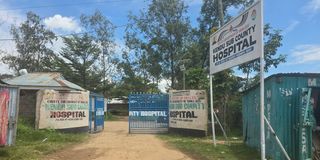
The entrance to Kendu Sub-county Hospital in Rachuonyo North, Homa Bay County. Lilian Otieno's first stop was at the Hospital, where a medical officer examined her, said she had lost blood, and referred her to Kendu Adventist Hospital, five kilometres away.

What you need to know:
- Every year, approximately 5,000 to 6,000 Kenyan women die from pregnancy or childbirth-related complications. That is about 16 deaths every day, according to the United Nations Population Fund.
- Lilian became one of them.
Lilian Otieno did everything right. She registered with the Social Health Authority. She prepared a birth plan and attended antenatal clinic six times at Oyombe health centre, where health workers assured her of a successful delivery. She had learned her lesson four years earlier, when she delivered by the roadside and nearly lost her life.
This time, she wanted to reach hospital on time.
But things did not go according to plan.
Lilian, 31, died while being attended to at Kendu Adventist Hospital in Rachuonyo North. She had first gone to Kendu Sub County Hospital, a public facility, but it had run out of blood. Her newborn also died.
She went into labour after midnight on April 26 at her home in Kauma Central village. Contractions began at 2am. It was raining. The nearest health centres; Oyombe, Adiedo and Omboga, were closed. They only operate during the day.
By 4am, the pain was unbearable. Lilian called Auma Goga, a community health promoter (CHP) in the village. Goga had been visiting Lilian since November 2025, encouraging her to seek skilled delivery. But no motorcycle rider would brave the rain and darkness.
"I screened her for pregnancy in November 2025 and encouraged her to attend antenatal clinic," Goga says. "She was one of the clients I have been visiting."
"On the fateful day, I told her to look for a motorcycle and go to hospital. But the riders who were called said they could not help her because of bad weather," Goga adds.
Goga walked over two kilometres in the rain to reach Lilian. Meanwhile, Lilian and her husband Joseph Otieno began walking to Rachuonyo North Sub County Hospital, 12 kilometres away. Joseph shielded her with a towel.
Lilian did not make it. She gave birth along the way, in the rain. The baby did not cry. By the time Goga arrived, the newborn was dead.
Joseph said his wife had been healthy. They already had three children aged 13, 12 and four, and were expecting their fourth.
"She ensured she did not develop any difficulties. She sought advice to make her delivery easy."
The nearest open facility was Rachuonyo North Sub-county Hospital. She never made it in time.
As Joseph walked his wife through the rain, he watched her lose energy. The pain was overwhelming.
She could not hold on. She gave birth along the way.
"I did not expect her to deliver in the rain," Joseph says. "I rushed back home to get materials. It was still raining when the baby came out. I had nothing to cover her."
Newborns must be wrapped immediately to prevent hypothermia. They cannot shiver. They lose heat fast. Lilian had no warm clothes.
The only lifeline
Joseph returned with wet cloth. "She asked me to cover the baby," he recalls. He tried gentle patting on the baby's back to stimulate breathing. He saw no signs of life.
Goga was their only lifeline.
The CHP had to gamble between sleeping and helping Lilian as the weather made it difficult to respond to her client’s needs. She finally gathered the courage to leave her house after no one offered to take Lilian to a medic.
En route, she frantically called boda boda riders to help get Lilian to the hospital. Most didn’t answer, except one, who agreed to take the expectant woman.
"I had to cross a river," Goga says. Along the way, she met the rider who was supposed to take Lilian to hospital. He ferried her. She arrived within minutes.
She found Lilian covered in a wet khanga, using her own body to shield the baby from the rain.
Goga checked the newborn first. "I asked if the child cried after birth. They said no. It was my worst fear. The baby had died."
Focus shifted to saving the mother.
In her bag, Goga had brought an umbilical cord clamp, gloves, and a pair of scissors.
Most community health promoters carry specialised kits to provide primary care at household level. Goga used hers to clamp and cut the umbilical cord, preventing bleeding and infection.
But the placenta had not come out. She called her supervisor.
A decision was made: the dead infant would be taken home. Lilian would be rushed to hospital.
Goga and Lilian boarded a motorcycle. Their first stop was Kendu Sub-county Hospital. A medical officer examined Lilian, said she had lost blood, and referred her to Kendu Adventist Hospital, five kilometres away. Goga recalls asking the health worker to help remove the placenta from Lilian’s womb, but they were told to seek help elsewhere.
By now, Lilian was unresponsive.
The journey to Kendu Adventist should have been short. But the motorcycle ran out of fuel climbing a steep slope from Kendu Bay town. The rider paused. They managed to reach the hospital before 6am.
Goga put Lilian in a wheelchair and took her to the maternity unit. She gave the patient's medical history because Lilian could not speak. She helped register her.
Medical officers began attending to Lilian. She became responsive briefly, then deteriorated. She was given blood and put on life support. But her blood pressure dropped.
Lilian died.
News reached home minutes later. The family decided to bury the infant before preparing for Lilian's burial.
Every year, approximately 5,000 to 6,000 Kenyan women die from pregnancy or childbirth-related complications. That is about 16 deaths every day, according to the United Nations Population Fund.
Lilian became one of them.
She attended antenatal clinic six times. She had a healthy pregnancy. She did everything right. She should not be dead.
Her death lays bare the failed health system in Homa Bay County: a shortage of blood in public hospitals, no functioning ambulances for referrals, and roads that turn emergency journeys into death sentences.
Homa Bay consistently records one of Kenya's highest maternal mortality rates: 516 to 583 deaths per 100,000 live births, well above the national average of 355 to 488. According to the 2022 Kenya Demographic and Health Survey, the county's neonatal mortality stands at 31 per 1,000 live births (national average: 21). Infant mortality is 42 (national: 32). Under-five mortality is 61 (national: 41).
Most deaths are from preventable causes: postpartum hemorrhage, obstetric complications, and eclampsia, all worsened by delays in skilled attendance and emergency care.
Poor roads, which delay hospital access, are also a major factor in high maternal deaths.
Dr Ephraim Onanga, a gynecologist at Homa Bay County Teaching and Referral Hospital, says the placenta should be removed within 30 minutes after delivery. He notes that delays cause severe bleeding. “It is one of the causes of postpartum hemorrhage (severe bleeding after childbirth),” he explains.
He also warns against using motorcycles for emergency obstetric transport. "A lot of women have reached hospitals dead after using boda boda," he says. The rider and passenger can squeeze the expectant woman, causing breathing difficulties. On bad roads, bleeding becomes intense.
According to Homa Bay County Medical Service Chief Officer Kevin Osuri, Kendu Sub-county Hospital had no sufficient blood when Lilian arrived. She was anaemic after losing blood at home and needed an immediate transfusion.
"She had to be referred to a facility where there was blood. Though we try our best, sometimes we have stock-outs."
He explains that while Kendu Sub-County Hospital offers blood transfusions, Homa Bay relies on the Regional Blood
Transfusion Centre (RBTC) in Kisumu for screening, which takes time. “We do not have sufficient quantities,” says Dr Osuri.
Dr Osuri confirms that Lilian also had a retained placenta, where placental fragments remain in the uterus over 30 minutes post-delivery. This prevents the uterus from contracting, causing life-threatening postpartum hemorrhage.
It is the second leading cause of fatal obstetric bleeding. Removal often requires a blood transfusion.
“What was done was to refer her to a facility which had blood,” Dr Osuri says.
Top county health officials summoned hospital management to explain why Lilian was not put in an ambulance.
According to Goga, a health worker only helped load Lilian back onto the motorcycle used to reach the facility.
“We were not given a referral document, which complicated matters,” she says.
Dr Osuri says Lilian should have been handled better. “We are trying to establish why she was not put in an ambulance yet the hospital has one. Homa Bay County has 19 ambulances.”
An official from the Health department says Kendu Sub-County Hospital management should have requested an ambulance from a nearby facility or the Kenya Red Cross. “They could have called Kendu Adventist Hospital to send one.”
Lilian’s case highlights sacrifices by CHPs. Homa Bay has 2,954 CHPs, each receiving a stipend of Sh2,000 monthly. Goga calls for more support, including umbrellas and gumboots to work in rain. “It is a calling,” she says.
County Health Director Amos Dulo says CHPs are not trained to offer medical services but to identify risks and refer patients. Some, especially reformed traditional birth attendants, can perform basic procedures like cutting the umbilical cord.