Struggles of a rural mother caring for child with cerebral palsy
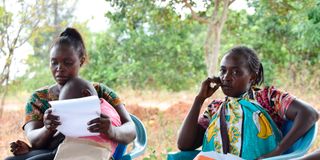
Ms Janet Kioko (left), her sister Faith Kioko, and Faith's son, who has cerebral palsy, during the interview at their home in Jimbo, Kwale County on February 29.

What you need to know:
- Nearly 38 per cent of Kenyan women live in rural areas where healthcare facilities are often under-resourced and distant.
As the sun shines brightly, casting long shadows on the dirt paths of Jimbo village in Lukore, Kwale County, Faith Kioko walks slowly, carrying her seven-year-old son on her back.
This has been Faith’s routine for the past seven years, a mother’s devotion to a child with cerebral palsy.
Faith's son, Amos Kioko, is unable to walk, talk, and sit on his own.
Trouble began when Amos was six months old. He started having convulsions, but Faith thought these were simply typical infant symptoms.
However, by the time he turned two, the condition had worsened, prompting Faith to seek medical attention. Medical assessments revealed that he suffered from hearing impairment, hyperactivity and elements of autism coupled with severe convulsions.
Faith notes that at times she gets overwhelmed as she juggles caring for her son, managing the financial strain of his condition, and dealing with the logistical nightmare of getting him to the nearest hospital.
For Faith, each journey begins with carrying Amos on her back for almost a kilometre to reach the nearest main road. From there, she boards a matatu to Musambweni Referral Hospital, some 30 kilometres away.
She makes this journey twice a month for Amos's scheduled check-ups, which are essential to managing his condition. These trips cost her at least Sh700 per visit, an amount she says is hard to raise, especially when combined with the cost of medication and therapies.
But Faith’s situation is not unique.
Statistics indicate that in rural Kenya, many mothers face similar struggles when it comes to accessing medical care for children with health conditions, especially in remote villages where resources are scarce.
According to the Kenya Demographic and Health Survey (KDHS) 2022, nearly 38 per cent of Kenyan women live in rural areas where healthcare facilities are often under-resourced and distant. Many mothers in these areas face difficulties in reaching the nearest health facility, which can be hours away by foot or public transport.
“The lack of adequate infrastructure, a shortage of medical professionals, and long distance to healthcare facilities make it incredibly difficult for families to provide the necessary care for their children,” explains Dr Joram Sunguti, a doctor and public health practitioner.
Dr Sunguti, who works as a senior technical advisor for Pathfinder International, a global non-profit organisation that focuses on sexual and reproductive health and rights, says such scenarios not only leave parents physically and emotionally exhausted but also directly impact a child's health and development.
Faith explains that as Amos grew, it became evident that he wasn’t meeting typical developmental milestones.
“I remember being told that it was a lifelong condition and that he would need constant care. The doctor said he would not be able to walk or talk, but I never gave up hope,” Faith recalls.
Since that diagnosis, Amos’s life has been characterised by a series of hospital visits, therapy sessions, and strict medication regimens. He is on Valex, a drug that helps manage his convulsions, and he also requires special shoes to help with mobility.
Amos must also see a psychotherapist every week to help him manage behavioural issues, adding another financial burden for Faith.
Despite the support of her parents, who are farmers, the cost of Amos's care is straining the family’s resources. “We depend on farming to survive, but it’s not enough to cover my son’s medical expenses,” Faith explains.
According to statistics, in rural Kenya, children with disabilities face more challenges than their urban counterparts, with disparity in healthcare access between rural and urban areas being so stark.
According to a 2018 study by the Kenya Institute of Public Policy Research and Analysis, children with disabilities in rural areas are far less likely to access specialised healthcare services. Only about 10-15 per cent of children with disabilities in rural areas receive the specialised care they need compared to 30-40 percent in urban areas.
And while urban centers have better access to medical facilities and specialists, rural families like Faith’s often find themselves relying on poorly equipped local dispensaries or making long, costly trips to distant hospitals.
The Kenya Health Sector Strategic Plan 2018-2023 highlights that rural regions are under-served by specialised healthcare professionals, including those trained to diagnose and treat disabilities such as cerebral palsy, autism, and physical impairments.
As a result, rural mothers like Faith are forced to rely on general practitioners who may not have the training or equipment needed to properly address the complexities of conditions like cerebral palsy.
“Children with disabilities in these areas are often left undiagnosed or without the necessary medical interventions,”explains Dr. Sunguti.
These difficulties are compounded by the lack of proper community-based support systems for children with health conditions.
“While urban areas may have specialised centers and support networks, rural families often face isolation, with little to no resources or guidance,” explains Dr Sunguti.
For mothers like Faith, the physical, emotional, and financial toll is overwhelming. “It’s exhausting. Every time we go to the hospital, I feel like I am running out of energy. It’s difficult, but I have no choice. I want my son to live a better life,” says Faith.
Lucia Mwende, Faith’s mother, also feels the weight of the situation. “As a grandmother, it hurts to see my grandson struggle. But we are trying our best to support them. However, there’s very little support from the government or the community.”
The solution, according to the public health expert, lies in improving access to primary healthcare services, particularly specialised care for conditions like cerebral palsy.
At the same time, Dr Sunguti strongly advocates for the capacity building of rural healthcare workers to deliver basic specialised care, particularly for children with complex health needs.
He emphasises that while many rural healthcare workers are well-versed in general healthcare, they often lack the specialised training to manage conditions that require specific expertise.
He recommends targeted training programmes to equip these workers with the necessary skills to provide early interventions and specialised care, ultimately improving health outcomes for children in rural areas.
Beyond medical care, Dr Sunguti highlights the need for comprehensive support networks for mothers, particularly in rural areas, which combine health education with economic empowerment initiatives.
“Rural mothers often face significant challenges not only in accessing healthcare for their children but also in managing the associated financial burdens. Integrating health education into economic empowerment programmes can help mothers make informed decisions about their children’s care while also alleviating some of the financial strain,” he notes.
Dr. Sunguti also stresses the critical role of digital platforms in overcoming some of the logistical and infrastructural challenges faced by rural communities. These solutions, he says, can bridge the gap between rural healthcare providers and more specialised care, enabling quicker responses to complex health issues.
“Teleconsultations and digital tools can connect local healthcare providers with specialists in urban centers, allowing for timely and accurate diagnoses, follow-up care, and treatment plans,” he adds.