Sun-powered learning: What happens when schools harness solar power

Solar panels installed on the roof of a dormitory at Friends School Kamusinga, Bungoma County. Photo/ Pauline Ongaji


What you need to know:
- Many rural boarding schools across Kenya currently spend more than 10 per cent of their annual budgets on electricity—a burden that has become increasingly unsustainable as energy costs continue to rise.
- A comprehensive study by the University of Nairobi found that over their lifetime, solar PV systems release only 5 per cent of the greenhouse gases produced by diesel generators
It's 7 pm at Friends School Kamusinga in Bungoma County, and the rain pounds mercilessly on the rooftops. Not long ago, a downpour like this would have plunged the entire school into complete darkness, but tonight tells a completely different story.
The classrooms are bathed in warm light, ceiling fans hum quietly overhead, and the telling silence of those dormant generators speaks volumes about a school that has boldly embraced the future of green energy.
In February 2025, the institution flipped the switch on a Sh12 million hybrid solar photovoltaic system. Electricity costs plummeted overnight, and this rural boarding school found itself at the forefront of a quiet revolution sweeping across Kenya's educational landscape—one that's not just about cutting costs, but fundamentally changing how schools operate, learn, and connect with their environment.
"We knew something had to change," says Paul Weloba, the school's Chief Principal.
In 2024, Kamusinga's electricity bill reached a staggering Sh4.3 million. The school submitted a proposal to a solar technology firm in October 2024, and within just four months, they had a complete solar system with battery storage and grid backup humming quietly on their rooftops.
The transformation was immediate. Energy costs dropped by nearly 80 per cent. During the April 2025 school holidays, administrators decided to test their new system's capabilities. They switched off the national grid entirely, running the school purely on solar power. When the Kenya Power bill arrived at the end of the month, in their telling, it read a beautiful zero.
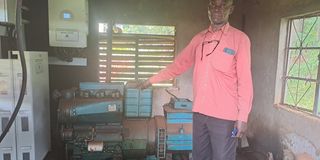
Josphat Oyier Ominde, Bursar at Friends School Lukhokho, displays a diesel generator that was previously used during power outages. On the left is a newly installed solar PV battery storage system now in use at the school. Photo/Pauline Ongaji
Just a few kilometres away, Joseph Ominde, the bursar at Friends School Lukhokho, shares a similar story. “We used to spend up to Sh60,000 every single month for electricity expense,” he explains. “Now it's down to Sh5,000. That difference alone pays the salaries of two board of management teachers.”
Jasper Sifuna, Kamusinga's ICT head, puts it simply: "As a STEM centre, we absolutely need stable power. From printing examination papers to running evening computer classes, all those frustrating disruptions we used to face are completely gone." The reliable electricity has extended study hours, boosted student morale dramatically, and eliminated the constant stress that teachers and students used to feel when the lights would suddenly go out during crucial lessons.
Also read:
The school has also installed an innovative biodigester system that converts organic waste from kitchens and latrines into clean biogas for cooking. Before this system, the school was spending Sh800,000 every single term on exhaust services to manage waste.
"Solar energy opened the door for us," Weloba explains. "Now we're conserving water, reducing harmful emissions, saving trees, and even farming more sustainably. It's changed our entire approach to education."
The school has also installed an Aerobic Bioreactor to treat wastewater from showers and toilets. This treated water now irrigates their school farm, supporting year-round food production and creating a closed-loop system that would make any environmental scientist proud.
Hundreds of kilometres away in Homa Bay Town, La Salle School was grappling with its own environmental and health challenges that were directly impacting student learning.
When the school's management introduced a home science club, they were puzzled by the lack of student interest.
"Some children were struggling to breathe during the sessions," recalls one teacher who witnessed the daily challenges.
The solution came through a complete switch to electric cooking. The school installed an industrial electric pressure cooker for preparing meals for students, along with smaller pressure cookers, induction cookers, and air fryers for teachers, guests, and home science practical lessons.
The transformation was immediate and remarkable. "The switch from biomass to electric cooking made more students interested in joining the home science club," explains the school’s director, Anthony Oloo.
Fleria Akinyi, a home science teacher at La Salle, sees the bigger picture. "We aim to instil knowledge about environmental conservation in young learners, besides teaching them cooking and other personal skills," she explains.
The technology behind these transformations is sophisticated yet surprisingly accessible. "A hybrid solar PV system combines solar panels with battery storage and another power source—either the national grid or a backup generator," explains Paul Mabonga, a solar energy engineer and the Managing Director of Sentimental Energy Company, a solar solutions provider responsible for installing solar panels in a number of schools across Western Kenya. "It generates electricity during the day, stores excess energy in batteries, and ensures continuous power even at night or during extended cloudy periods. This is especially valuable for regions that face frequent power outages."
Adrian Maina from Feion Green Ventures, which supplied equipment to La Salle School, has seen the economic impact firsthand. “Use of electricity cuts operations cost by up to 60 per cent,” he explains. His company installed a 100-litre institutional pressure cooker at La Salle, and during trial runs, the machine consumed just seven units of electricity to prepare beans and tea for the entire school. With Kenya Power charging at least Sh20 per unit, the savings are substantial and immediate.
"Modern technology enables cooking equipment to use much less electricity while producing more heat," explains Dorothy Otieno, founder and CEO of Nyalore Impact, an organisation promoting electric cooking in schools and homes. "This is far more economical compared to relying on biomass."
Many rural boarding schools across Kenya currently spend more than 10 per cent of their annual budgets on electricity—a burden that has become increasingly unsustainable as energy costs continue to rise. According to the Kenya Secondary School Heads Association, annual electricity costs can range from Sh434,000 to more than Sh900,000 per school, money that could otherwise be invested in teachers, learning materials, and infrastructure improvements.
Under the government's Free Day Secondary Education Programme, only Sh3,151 per student is allocated annually for both water and electricity combined. "However, actual utility costs frequently exceed these allocations, forcing schools to redirect funds from essential services such as staffing and learning materials," Weloba explains.
A comprehensive study by the University of Nairobi found that over their lifetime, solar PV systems release only 5 per cent of the greenhouse gases produced by diesel generators. Other global studies estimate that widespread solar adoption in schools could reduce the education sector's carbon footprint by up to 28 per cent.
The policy environment in Kenya is remarkably supportive of these transitions. Clean cooking has become a national priority, with the ambitious goal of achieving universal access to clean cooking solutions by 2028, based on the Kenya National Cooking Transition Strategy. This comprehensive plan involves transitioning away from traditional cooking methods that rely on heavily polluting fuels like firewood and charcoal, toward cleaner alternatives including LPG, biogas, bioethanol, and electric cooking.
In the 2023 RISE (Regulatory Indicators for Sustainable Energy) report, Kenya ranks first in Africa with an impressive score of 72 per cent, with Tunisia following at 69 per cent and other African countries falling below 67 per cent. "In the specific indicator for electrification planning that includes schools, Kenya scores a perfect 100 per cent—far above the Sub-Saharan average of 59.52 per cent," explains Aisha Abdulaziz, an energy specialist at the World Bank.
Aggregation models hold particular promise for educational institutions. "These innovative approaches allow multiple small projects—like individual school solar installations—to be bundled together into a single carbon credit portfolio, dramatically reducing costs and making participation feasible even for modest institutions,” Anne Kitelesi, a senior sustainability consultant at Lybra Kitelesi, notes.
Rhoda Wachira, Head of the Energy Unit at UNEP's Africa office, sees the broader implications. "Solar energy significantly strengthens climate resilience by supplying reliable, off-grid power during extreme weather events and reducing dependency on fossil fuels," she explains. Schools can become sustainability ambassadors in their communities, mobilising local adoption of green energy while nurturing an entire generation of climate-conscious citizens.
However, the International Renewable Energy Agency's 2025 report highlights a concerning global disparity in renewable energy growth. Despite Africa's vast solar potential, the continent accounts for only approximately 2.8 per cent of new renewable capacity worldwide.
Despite the remarkable progress, significant challenges remain on the path toward Kenya's ambitious goal of achieving 100 per cent renewable electricity by 2030. "Some of the persistent challenges include high upfront costs, a serious lack of skilled maintenance personnel in rural areas, continued reliance on backup systems during extended cloudy periods, and growing disparities between better-funded private schools and their public counterparts," explains Paul Mabonga, a solar energy engineer and managing director at Sentec. The solution, he says, may lie in innovative financing models.