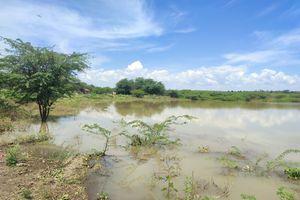
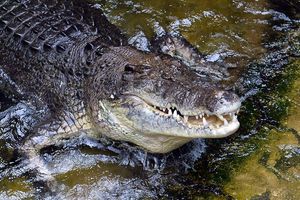
Taming a river of death: Kitui and Makueni's new defence against deadly crocodile attacks
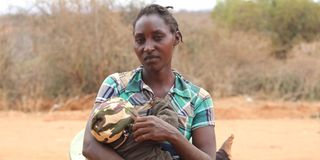
Catherine Mutua during the interview in Nzaini Village, Kitui County on October 3, 2025. She lost her husband to a crocodile attack.

What you need to know:
- A spot check by Healthy Nation confirmed that these attacks are a persistent and year-round threat in the region.
Two years after a crocodile killed Thomas Mutua, his widow is still trapped by the trauma. The peasant farmer was drawing water from Athi River, which flows through Nzaini Village in Kitui County, when the reptile lunged from the water. His sudden death shattered the family's stability.
The evidence lies in the ruins of a stalled building at their homestead; a silent testament to the future he was building and the immense void his death left behind. For his widow, Catherine Mutua, the loss is a fresh wound. She breaks down as she reflects on the two years that have felt like an endless struggle, her life forever unbalanced by the tragedy.
“Many days, I watch helplessly as my children go without meals. It is a painful experience. They are on the verge of dropping out of school,” Catherine told Healthy Nation.
Also read: Kitui boy recounts close shave with crocodile
The 35-year-old mother of seven now survives on menial work. She is one of a growing number in Kitui and Makueni counties grappling with the harrowing consequences of crocodile and hippo attacks in the region bordering River Athi.
A spot check by Healthy Nation confirmed that these attacks are a persistent and year-round threat in the region. “We had no problem with crocodiles or hippos in the 1970s; we assumed the River Athi had none,” said Nyiva Savali, whose 13-year-old son was mauled by a crocodile while drawing water from the river in Nzaini Village. “The animals started attacking livestock in the 1990s. Today, they are preying on humans.”
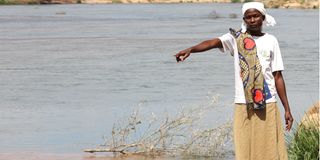
Mbatha Ndambuki, whose son was mauled by a crocodile on August 22, 2025, shows the spot in River Athi where the accident occurred in Makueni County on August 29, 2025.
“Nothing is more unsettling than returning to the same spot where your child was killed,” she added. “But we have no choice; the river is our only source of water.”
This grim reality is reflected in the data. According to the Kenya Red Cross, the section of River Athi forming the boundary of Kitui and Makueni counties claims more than 10 lives each year from crocodile and hippo attacks. Solomon Musia, head of the emergency response organisation in the region, provided a stark tally: “In the last two years alone, we have recorded 27 crocodile attacks and lost 14 lives.”
Survivors are left with harrowing tales of narrow escapes. "I saw death," said Kalekye Mwake, who suffered broken legs after miraculously escaping the jaws of two crocodiles. For most affected families, efforts to secure government compensation have been frustratingly unsuccessful.
Pump water
Jolted into action by the persistent threat, the Kitui and Makueni county governments have now embarked on separate initiatives to pump water from the river, providing a safer alternative for the thirsty communities.
The Kitui County government, under Governor Julius Malombe, has completed a major water project to pump water from the crocodile-infested river to neighboring communities. This comes as Makueni Governor Mutula Kilonzo races to complete three similar projects.
The Sh984 million Athi-Kangu Kangu project—a 12-year collaboration between the Kitui County government and World Vision International—includes a sump well, two treatment facilities, 224 kilometres of pipeline, 13 bulk storage tanks, and 52 water kiosks.
Governor Malombe has positioned the Athi-Kangu Kangu water project as a cornerstone of his water security agenda. “The scheme is designed to serve over 100,000 people in commercial centres, schools, and health facilities,” he said during the project's commissioning. “To fully optimise it, we are now installing a solar power system at the river intake.”
Gilbert Kamanga, head of World Vision International in Kenya, emphasised the project's broader social impact: “This project is designed to ensure children can go to school and women can spend their time on meaningful work, not fetching water.”
Governor Malombe stated that the project has already significantly reduced the number of people from riparian communities who must trek to the river to fetch water. He positioned the project as a major step in fulfilling both the UN's Sustainable Development Goal for water and sanitation and Kenya's Vision 2030, ensuring improved water
access for all.
“My government is committed to ensuring every Kitui household has access to safe water, with water points located within two kilometres and a collection time of less than 45 minutes,” he said.
However, this broader success has sparked a local debate. Athi Ward MCA Muthama Kieti has called for the project's immediate expansion to prioritise the very communities living along the riverbank. “The Athi-Kangu Kangu project should first benefit the community bordering River Athi, who have endured the greatest risk, before it serves areas further away,” Kieti argued.
In the neighbouring Makueni County, a similar water project has been stalled for years due to erratic funding. The Athi-Tunguni water project, designed to draw water from the river for thousands of residents in Kikumbulyu North, Nguumo, and Makindu wards, was initiated in 2017. The prolonged delays have left riparian communities along the River
Athi exposed to continued danger and hardship.
These infrastructure investments are a response to a grim realisation: the surge in crocodile and hippo attacks signals a deeper ecological crisis. At a recent forum in Kibwezi Township convened by the Utooni Development Organisation, environmentalists stressed that the root cause is human encroachment and pollution, which have degraded the river's ecosystem. The growing conflict between humans and wildlife, they concluded, is a direct symptom of this breakdown.
To solve the crisis of crocodile and hippo attacks, communities must stop farming and encroaching on the river's natural buffer zone, argued Nigel Casmiro De Mello, a pastor and environmentalist.
"Encroaching on the riparian zone doesn't just pollute the river; it destroys a vital life-support system for aquatic animals," De Mello explained. "This zone is a crucial source of food. When leaves, flowers, and insects fall into the water, they feed the small creatures that are then eaten by larger animals, including fish and crocodiles."