The agony of living with four dysfunctional kidneys and fight for a normal life

Mary Wanjiku, a kidney warrior, during an interview at Nation Centre, Nairobi, on August 8, 2025.

What you need to know:
- In 2007, Mary suffered a stroke, a shocking diagnosis for someone her age.
- Doctors later traced it back to untreated high blood pressure, a hidden enemy that had also silently damaged her kidneys.
- By 2008, she was told her kidneys had failed completely.
On a quiet Friday mid-morning, Mary Wanjiku walked into the newsroom, her steps slow, uneven, and weighed down by more than just her limp. Her right leg has grown shorter over the years, her back slightly bent, and her once perfect smile now show wide gaps between her teeth. These are just some of the physical reminders of the long, unrelenting war her body has fought for 17 years.
At 40, Mary calls herself a “kidney warrior” and her story is one of relentless battle, defiance against odds, and hope that refuses to die. “I have been battling kidney disease since I was 22,” she begins. “I was just about to turn 23 when my life changed forever.”
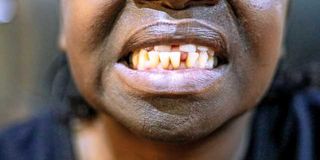
The disease has affected Mary Wanjiku's teeth.
In 2007, Mary suffered a stroke, a shocking diagnosis for someone her age. Doctors later traced it back to untreated high blood pressure, a hidden enemy that had also silently damaged her kidneys. By 2008, she was told her kidneys had failed completely.
Also read: From free surgery to Sh7 million bill: One man's journey through Kenya’s healthcare revolution
“I didn’t even know what kidney failure was. I only knew that I could not survive without dialysis. That’s when I first learned how dependent life can become on a machine,” she notes pensively.
Dialysis, a procedure to clean toxins from her blood, became part of her routine. And with it came other complications, the most notable one being a bout tuberculosis (TB) in 2009. Her dreams of a career in hospitality, fresh from graduation, vanished overnight.
Hope arrived in 2010 when her aunt donated a kidney to her and a successful transplant was done at Kenyatta National Hospital (KNH). For three years, life flickered toward normalcy until protein in her urine signalled trouble. A biopsy confirmed (Focal Segmental Glomerulosclerosis FSGS), a rare kidney disease. In 2013, the transplanted kidney failed and by 2014, she was back on dialysis and in desperate need of another chance.
According to Dr Jonathan Wala, a kidney specialist and one of Mary's doctors, kidney failure occurs when the kidney underperforms in its functions. "The first function of the kidney is to cleanse the blood of impurities (toxins) that come from what we eat but also from normal processes in the cells of our bodies. If this function decreases, then waste products (including creatinine and urea) accumulate, making the patient sick."
He further elaborates that the second function is to remove excess water from the body. "After drinking liquids, whatever the body does not need is removed as water in the urine. If this does not occur, then the body swells, starting with the legs and later the lungs, causing difficulty with breathing. This failure to remove excess water, combined with accumulation of salt, leads to high blood pressure.
The two other functions of the kidney that fail are making a blood-building hormone called erythropoietin (failure of which causes anaemia) and making active vitamin D (failure of which causes low calcium and fragile bones)."
That same year, a second transplant followed, funded by well-wishers.
Together with her mother who was the donor this time, they left for India where the transplant was done successfully. However, five days’ post-surgery, an acute rejection struck. Her body was not taking in the new graft well and that meant her being put on fresh medication. “The kidney peaked after treatment and once again I thought my life was on track until 2017 when the new graft started failing,” Mary says.
Local tests did not reveal anything, something that prompted a referral to India. The tests result revealed that a lethal form of TB had infiltrated her body, eventually destroying her mother’s donated kidney.
“By the time the diagnosis was made, the damage on my organs was irreversible. From 2018 until today, I survive on dialysis,” she says, softly. Her entire existence depends on being connected to a dialysis machine at least twice a week, an expensive procedure though she is grateful that the Social Health Authority (SHA), pays for her sessions.
“If I miss a session, my body swells,” she explains. “Sometimes, I can barely breathe because of fluid overload. Water, which is life for you, is death for me.”
“A banana can kill me in 10 minutes, oranges too because of the high levels of potassium. I live on strict portions of watermelon and apples. Imagine even fruits, which are supposed to make people healthier, are dangerous for me.”
According to Dr Wala, when the kidney fails, substances in food which are needed in the body in small amounts or are not needed at all and cannot be removed efficiently from the body. Among the nutrients in food that accumulate in kidney failure and cause disease are potassium, sodium, phosphorus, and nitrogen-containing substances (uraemic toxins).
Potassium comes from fruits and vegetables. Most have acceptable levels of potassium and can be taken especially if the patient can still pass some urine. However, some like bananas have too much potassium and have to be avoided. Some patients may need to soak their fruits and vegetables in order to leach out the potassium before cooking or eating.
Phosphorus is a bit trickier as it is found differently in plants and in animals, and avoiding it completely can lead to protein malnutrition.
Protein is found in plants and animals. Patients who have kidney disease accumulate nitrogen-containing waste products from protein. If one has kidney failure and is not doing dialysis, then one has to restrict protein intake, largely by minimising animal protein (meat and eggs). However, once one is doing dialysis, then the diet has to be high in protein (even higher than in normal people), otherwise the patient will have protein malnutrition, which leads to complications and even death in dialysis patients.
Years of battling kidney failure, medications, and dialysis have left visible scars. She limps when she walks. Her posture has changed. Her teeth, once aligned in a perfect dental formula, now stand apart with wide spaces. Her upper left arm is also lumpy with a bit of a buzz. “This is where they connect the dialysis machines twice weekly,” she says, pointing to a lump marked with two small scars.
“It is called CKD-MBD,” she says, referring to a bone disorder common in advanced kidney disease. “My bones are weakening, my height is shrinking, even my face is changing. Sometimes, I’m afraid that one day I’ll wake up and have no teeth left.” And yet, she still manages a wry smile as she describes her resilience.
Normal adult life
Mary studied Hospitality Management at university. She graduated in August 2008. By October that year, her kidneys had failed. “I have never had a normal adult life,” she says. “No career, no family, no children. My life came to a standstill at 22.” She pauses, then adds, “I don’t envy people who have big things. I just want to be healthy. That is all.”
Her condition has denied her the joy of starting her own family, something she admits weighs heavily. “Definitely, this disease took that chance away from me,” she says.
Today, Mary is living on borrowed time. She has four kidneys in her body. Her two original ones and the two grafts, all of them dysfunctional.
To make space for another transplant, doctors at India’s Fortis Hospital in Bangalore will have to remove at least one through a nephrectomy.
Mary got kidney failure and underwent a kidney transplant, with the kidney coming from a close relative. This graft kidney is put in the right lower abdomen. Mary's own kidneys are not touched as they are "hidden" high up in the back of the abdomen under her ribs. When this graft kidney fails, it also is not touched. The second transplant kidney is placed in the left lower abdomen.
She thus has four kidneys, two of her own, and two from two separate transplants. All the four kidneys are not working currently. She is therefore recommended to have a third kidney transplant. In this case, to create space for this thirdone, one of the graft kidneys will need to be removed first," Dr Wala explains.
Her cousin has already been confirmed as a donor. But the procedure will be expensive and complicated, requiring multiple rounds of plasmapheresis to prepare her body. The hospital has quoted a cost of about Sh15 million for the surgery and related treatment. Healthy Nation has seen Mary’s medical records and the Fortis Hospital quotation confirming this.
Yet, despite the urgency, she has not raised a single cent of the required amount.
Her doctors hope she can travel to India at the end of October for pre-tests, with surgery planned for early November.
“This is my last hope,” she says. “I just want to stop depending on machines. I want to walk without pain. I want to breathe without struggles and I want to live without the fear of becoming smaller and my bones weakening; and I want to be able to pass urine again like a normal human being. I just want to live,” she says as she balances tears.
Seventeen years into her battle, Mary has learned to live one day at a time. Friends and well-wishers help her with the monthly cost of drugs, which amounts to around Sh35,000 beside the weekly dialysis sessions.
Despite the struggles, her faith remains intact. “God has kept me this far. I believe He will see me through this third transplant.”