The boy from Ol Kalou who built a clinic in America
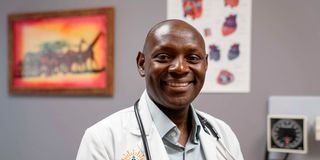
Dr Geoffrey Mwangi, a Kenyan Doctor of Nursing running Ahsante Healthcare, a hospital in Washington State.

What you need to know:
- He examines, diagnoses, prescribes, orders and reads tests, and manages illness, both sudden and lifelong.
- The doctorate trains him in leadership, quality improvement and population health as well as bedside skill, which is precisely why such clinicians end up where primary care is thinnest in poor neighbourhoods and rural towns.
Before the sun found Kagaa, the village belonged to the cold. Mist rolled off Ol Kalou in a steady descent, claiming the roofs, the footpaths, and the shivering children who learned early to walk with purpose.
It was a modest place then, of 2,000 people, and among them was a boy called Geoffrey Mwangi. No one had told him what he could be, and no evidence suggested greatness, yet he held fast to a prophecy that he would become a doctor.
He finished high school in 2000 and did what thousands of Kenyan boys with the same dream have always done: he waited. While he waited for a place in a Kenyan medical school, he was also writing letters outward, across oceans, on the small chance that one of them would answer. One did. The University of Wisconsin in Green Bay, US offered him admission and a partial scholarship. Then Kenya offered him medicine too, as a parallel student.
He chose the aeroplane.
Ask what he was carrying in his heart on that flight, and the answer is disarmingly plain. "I wanted to become a doctor and help people," he said. "I knew a long journey starts with the first step, which was in motion." The step took 14 years to land: a biology degree in 2006; work as a caregiver (work that involves other people's bodies and very little glory); and nursing school in Wisconsin by 2010.
Then Salem, Oregon, with his first wife, the mother of two of his three children, and shifts as a nurse at Salem Hospital while the degrees stacked up behind him, a master's in 2013 and a Doctor of Nursing Practice in 2014, both from
Oregon Health and Science University. That same year he moved to Spokane, Washington, and joined a local clinic where he stayed for more than a decade.
Those 10 years taught him the thing that would eventually cost him his sleep. There were not enough doors into healthcare in his city, and the people who most needed doors were finding them shut. So on July 15, 2024, at the West Central Community Center in Spokane, he opened one of his own: Asante Health- Thank you.
Swahili, his second tongue, after Kikuyu and before English, is a greeting and a declaration at once. "Thank you for allowing me to continue to practice and serve this community," he said. "It's a privilege I don't take for granted."
Now, a word for readers in Kenya who have always understood that hospitals belong to doctors and doctors alone. Dr Mwangi is not a medical doctor ‘in the Kenyan sense’. He is something the American system built deliberately, a Doctor of
Nursing Practice (DNP), the highest clinical rung of the nursing profession, and in Washington State that credential lets him practise independently.
He examines, diagnoses, prescribes, orders and reads tests, and manages illness, both sudden and lifelong. The doctorate trains him in leadership, quality improvement and population health as well as bedside skill, which is precisely why such clinicians end up where primary care is thinnest in poor neighbourhoods and rural towns.
“Primary care providers serve as the foundation of the healthcare system,” he said, and when a patient needs a specialist, he refers. Study after American study has found that nurse practitioners deliver outcomes comparable to other primary care providers. More clinicians mean shorter waits, and shorter waits mean disease caught earlier.
He is still the facility’s only provider, assisted by a medical assistant. Lisa Fuchs, the Women, Infants and Children coordinator at the centre, steers families in from Cheney, Airway Heights and Fairchild Air Force Base.
For a small clinic, it holds a great deal. Physicals, children and the elderly, women's health and men's health, telehealth, mental health treatment, and nutrition support. Diabetes, hypertension and asthma managed beside the humbler business of coughs, flu and infections.
The days stack up quickly in a place like this, each one bringing its own small urgencies and demands. Patients come in slow waves, and the room absorbs it all without complaint. “If I knew then what I know now, I would have thought much more carefully before opening a clinic,” he said. “The past year and a half has been one of the most challenging periods of my professional life.”
The mountain was paperwork. Credentialing and contracting with American insurance companies is a labyrinth built by people who will never have to walk it, and for more than a year, Asante Health treated patients while almost nothing came back from the carriers. Nearly two years on, several plans remain unresolved.
He decided early that the paperwork would not be the patient's problem. Rather than turn people away or hand them a bill they could not carry, he waived charges. The clinic bled for it. “I hope there will be meaningful reforms to simplify the credentialing process for new healthcare providers and small practices,” he said. “The current system creates many barriers to expanding access to care in underserved communities.”
What kept the lights on was a coalition of the willing. The Health Sciences and Services Authority put in $115,000. AHANA and GSI, through Spokane's Inclusive Business Catalyst programme, added seed funding that covered payroll through the first year and part of the second. Without it, he says flatly, the clinic would not have survived.
It survived. Two or three patients a day in the early months has become 10 to 15, and the satisfaction scores come back high, which is not an accident of temperament but of scheduling. A new patient at Asante Health is given between 30 and 60 minutes, a luxury that would make most American practices flinch.
“It requires a significant investment of time,” he said, “but I believe it is fundamental to providing high quality, patient-centred care.” The toll of that generosity is unforgiving, and he does not pretend otherwise. Staff must be paid. Supplies, laboratory services, records systems and equipment all have prices. He charges for what he does. And still, when a patient cannot pay, the fee goes.
“I believe that health and healthcare are fundamental rights, not privileges. At Asante Health, we strive to make a meaningful difference, even in small ways.”
Being an immigrant gives a clinician a particular kind of eyesight. Many of his patients speak Swahili, and he speaks it with them, no interpreter standing in the middle of the conversation like a wall with a window in it. What the shared language buys him is access to their stories, beliefs about illness, and the social facts that decide whether a treatment plan will actually happen.
“Effective healthcare involves more than diagnosing and treating disease,” he said. “It requires listening carefully, being fully present, recognising nonverbal communication, and creating an environment where patients feel respected and understood.” Patients ask where he is from. He tells them Kenya. “Many respond by saying, ‘we are so lucky to have you in the United States’,” he said. He has heard it often enough to be humbled by it, and often enough to know it is not flattery.
“When patients understand their disease process, they become active partners in their care rather than passive recipients of treatment. In many cases, education is just as important as the medication itself.”
He resists the idea that he stands in Spokane as a Kenyan flag. “The human body is the same, whether a patient is here or in Kenya. So I practice what I call common sense medicine, meeting people where they are.”
Something in him has turned along the way. Trials, he says, made him a rounder son, father, brother, uncle and provider, and considerably more spiritual. A Christian who has worshipped at Life Center since 2014, he now treats the body, the emotions and the spirit as one indivisible patient, and opens the last subject gently, asking people what spirituality means to them. “There are many things we can't explain in medicine,” he said.
His family has been reshaped too, and drawn closer. What he wants his children to inherit is not the clinic. “The legacy I hope my children inherit is the values behind it; perseverance, compassion, humility, faith,” he said, and then reached for Kikuyu, which reaches further than English does.
“Mwana mwega daagaga mumiria. A good child will always find someone to wipe their mucus. When you live with integrity, humility, and treat people well, you will never lack support.”
Home is not a memory he keeps in a box. He has been running mission work in rural Kenya since 2010, and it has since spread to several parts of the country. He carries basic medicines, a blood pressure cuff and a glucose monitor, goes door to door, and sends the serious cases to hospital. Purity, his wife, who owns and runs adult family homes and works in the clinic besides, travels with him, and afterwards they continue to her people in Voi.
The two countries no longer pull him in opposite directions. They instruct each other. America has taught him the value of prevention. Kenya, where too many people still arrive at a hospital only once the illness has finished arguing, has taught him what its absence costs. He is working with other stakeholders on how to move preventive care deeper into Kenyan life, past the barriers of cost, insurance, infrastructure and bureaucracy.
“Changing a culture is difficult, but it can be done slowly. You have to start somewhere.”
To the medical student in a Nairobi lecture hall dreaming in the light of somebody else's film, he offers no brochure. “The American Dream is real, but life does not become easy simply because you move to another country,” he said. The
US hands you more opportunity and not one thing more. He takes his children downtown sometimes to deliver sandwiches to people sleeping rough, so they learn early how delicate a life is, and how the same fragility waits at home in Kenya.
What does travel well is each other. Kenyans in Spokane, he says, are more united than divided, and where you come from inside Kenya stops mattering the moment you are all far from it. “Pursue your dreams, stay humble,” he said, “and remember that your greatest success will never be measured by where you live, but by the impact you have on others.”
Kagaa and Spokane sit half a planet apart, and in his hands they weigh the same. One room, one patient, and one word repeated until it becomes a way of working.