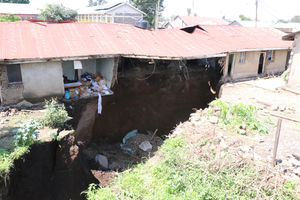
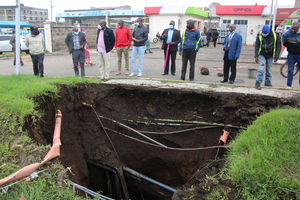
The faults beneath: Scientists explain Nakuru's recurring sinkholes
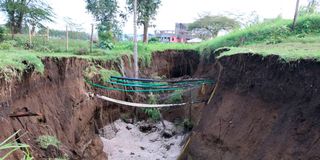
A three-metre deep fissure that developed near Eveready Rounder about in Nakuru Town following a heavy downpour that left a trail of destruction.

What you need to know:
- These fault lines act as invisible boundaries threading through Nakuru's Central Business District.
- While they may be masked by the rich, productive volcanic soils from past Menengai eruptions, heavy rains create perfect conditions for these ancient fractures to suddenly reveal themselves. When water meets ancient cracks
Two weeks ago, a section of the busy Nakuru-Eldoret Highway cracked and caved in, creating two sinkholes that brought traffic to a standstill. This dramatic event, which sent residents and road users into panic that the very earth beneath their feet could give way and plunge into an abyss, is not a new phenomenon for Nakuru. A year earlier, the ground had caved in at Eveready Roundabout after heavy rains; eerily similar to the recent incident that has once again put the spotlight on the city's geological vulnerabilities.
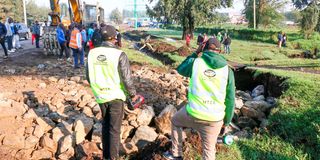
Engineers from the Kenya National Highways Authority (KeNHA) oversee the filling of a 30-foot deep fissure that developed at Eveready along Nakuru-Nairobi highway on September 4, 2025.
So, what makes parts of Nakuru split apart, creating the terrifying impression that the earth is literally falling apart?
Ancient crater, modern problems
The answer lies millions of years in the past. According to Prof Simon Onywere, associate professor of Environmental Planning and Management at Kenyatta University, Nakuru City sits precariously on the slopes of the Menengai Crater - a location shaped by the same ancient faulting that carved out the Great Rift Valley. "The town has been established along numerous fault lines that make up the Rift Valley," explains Prof Onywere.
Also read: Explainer: Understanding Nakuru’s growing sinkhole problem
"Upstream towards the crater, there have been reports of farmland breaking apart in the past, and that fault line can be traced back to the Menengai Crater. The fault gash that previously opened upstream now continues southwards into the present area."
These fault lines act as invisible boundaries threading through Nakuru's Central Business District. While they may be masked by the rich, productive volcanic soils from past Menengai eruptions, heavy rains create perfect conditions for these ancient fractures to suddenly reveal themselves. When water meets ancient cracks
"When it rains, more water flows into the fault gash and as it flows below, it sucks away the soil above ground," Prof Onywere explains. "That leads to areas appearing as if they're splitting apart, but the fracture has always existed. The soil cover was washed away and the earth's surface broke - similar to what happened in Mai Mahiu in 2018."
The process, known as subterranean erosion, creates underground voids that eventually collapse, forming the surface fissures and sinkholes that have become Nakuru's unwelcome trademark after heavy rains.
Mapping Nakuru's underground maze
The scale of the problem becomes clearer when mapped out. Five fault lines run along Nakuru's western side, with three cutting directly through the city center and its surroundings.
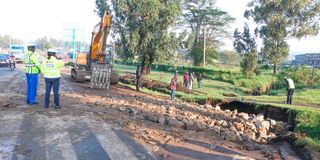
Engineers from the Kenya National Highways Authority (KeNHA) oversee the filling of a 30-foot deep fissure that developed at Eveready along Nakuru-Nairobi highway on September 4, 2025.
From Eveready Roundabout, the next fault line runs through Industrial Area Roundabout, extending toward Kwa Rhonda Estate. This fissure was dramatically exposed in 2020 when a section of road at Koinange Estate caved in after torrential rains.
Most critically, the vital Nakuru-Eldoret Highway - Kenya's crucial link to East African neighbours - sits directly above three fault lines emerging from
Menengai Crater as the highway cuts through the city.
The third fault line runs along KFA Roundabout, and Prof Onywere notes a telling pattern: "Those roundabouts have also developed sinkholes in the past. The three roundabouts are not normal - you'll see they have depressions because fissures have opened up on them previously and they were just filled with rocks and murram. But that's not how treatment should be done. A fault gash is a hole that must be filled from the bottom."
Engineering band-aids on geological wounds
"Our engineering systems have found ways to cover infrastructure, but they've never properly treated the fundamental problem of how big or wide these sinkholes actually are," Prof Onywere warns.
Currently, no government department has comprehensively assessed the depth and breadth of these fault lines to properly address past and present sinkhole impacts. When the Kenya National Highways Authority (KeNHA) visited affected sites, they only hinted at consulting geologists to find the best solutions should roads continue cracking.
Climate change adds new pressure
Dr Benjamin Sosi, a geologist and lecturer at Egerton University's Department of Natural Resources, provides additional context: "There's a phenomenon called subterranean erosion - when rains create underground voids that eventually collapse, leading to surface fissures and sinkholes. The scale we're looking at is localised along specific fault lines, not necessarily affecting all of Nakuru County." Both experts agree that climate change has intensified these geological revelations. Should heavy rains continue, they recommend that Nakuru County and National Government disaster management teams remain on high alert, monitoring geological movements throughout the Rift Valley.
Long-term solutions require major investment
Dr Sosi suggests that while KeNHA may provide temporary road repairs, authorities should consider diverting water flow along fault lines that intersect the highway, especially in areas where sinkholes have previously emerged.
"The porous, weak soil structure along fault lines is susceptible to instability. We can improve drainage systems to redirect surface water because if left to accumulate, it will continue affecting infrastructure along these fault lines," he explains.
Prof Onywere advocates for a more comprehensive approach: KeNHA needs to "fault-proof" the Nakuru-Eldoret Highway - an expensive but essential investment that would help the road withstand future sinkholes. "The engineering solution involves a concrete foundation with pillars underneath, anchored in the escarpments of the fault lines. This should be the priority for disaster management systems - a total response that actually cures the problem. It requires resources and the right personnel," he explains.
Good News: Nakuru isn't sinking
Despite the dramatic ground failures, both experts emphatically agree on one crucial point: Nakuru is not sinking as many residents fear. "Residents should not worry about Nakuru's geographic location ever changing," reassures Dr Sosi. "The extraction of geothermal power from the Menengai crater is actually decreasing pressure underneath the earth, and we do not expect the land to subside."
This revelation transforms the narrative: rather than threatening the city's stability, the geothermal operations at Menengai are actually helping to relieve underground pressures that could otherwise cause more severe geological problems.
Building smart in a geological hotspot
Both experts strongly recommend that all current and future construction must strictly adhere to building codes, with developers avoiding construction on or along known fault lines.
As Nakuru continues its rapid expansion as a key economic hub in central Kenya, understanding and respecting these ancient geological realities becomes crucial for sustainable development and public safety.
The message is clear: Nakuru's residents can breathe easier knowing their city isn't disappearing into the earth, but smart planning and proper engineering responses remain essential for living safely above one of Kenya's most geologically active landscapes.