The hidden cost of donor-driven farming in Africa

Farmers buy subsidised fertiliser at the National Cereals and Produce Board depot in Elburgon, Nakuru County on September 01, 2025.

What you need to know:
- Across Africa, many smallholders are locked into a system that requires the seasonal purchase of patented seeds and synthetic fertilisers.
- This system is often fronted and funded by multilateral and bilateral donors under attractive banners like ‘Climate Smart Agriculture’ and ‘Regenerative Agriculture’.
On a humid Monday morning in Kakamega County, Philemon Echoka consolidates loans from three mobile apps to buy hybrid maize seeds and a bag of fertiliser at Nangili market.
For this 49-year-old father of four, this cycle of debt is non-negotiable.
“This is how it works. Every season, I must buy seeds and fertiliser. And if I do not have money, I must borrow, and if I don’t, then you can be sure that I won’t harvest anything even if the climatic conditions turn out to be the most favourable.”
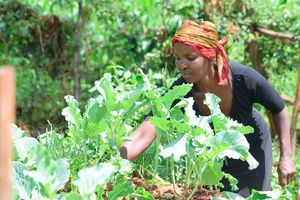
Not far away in the neighbouring Vihiga County, Ferdinand Wafula represents a different paradigm. He plants saved seeds, applies homemade compost, and intercrops maize with beans.The farm also features cover crops like pumpkins, different types of indigenous vegetable and fruit trees, revealing a mosaic of biodiversity that nourishes both the soil and his family of four.
Also read: Unlocking the potential of organic fertiliser to build healthy soils and resilient food systems
“I may not harvest so much maize compared to those who plant hybrid varieties, but my farming style does not enslave me to seed merchants every planting season. My soil does not require expensive fertilisers to produce, and I always have an alternative crop on the field all round the year,” said Wafula, who now trains other farmers on agroecology in Elununi Village through an organisation known as Bio Gardening Innovations (Biogi).
These two farmers embody a continental divide. Across Africa, many smallholders are locked into a system that requires the seasonal purchase of patented seeds and synthetic fertilisers. This system is often fronted and funded by multilateral and bilateral donors under attractive banners like ‘Climate Smart Agriculture’ (CSA) and ‘Regenerative Agriculture’ (RA).
CSA is a concept introduced by the UN Food and Agriculture Organisation (FAO) in 2010 to address food security through increased productivity in the face of climate change, using techniques that also reduce greenhouse gases from the atmosphere.
In the same vein, RA, popularised by NGOs, employs practices that restore and enhance ecosystems while regenerating soils through composting, minimum tillage and crop rotation, with strong emphasis on carbon sequestration.
Both approaches can be relied on. However, they do not challenge power structures that keep African farmers dependent on commercial seeds and imported farm inputs that must be bought every season, thereby profiting multi-dollar manufacturers and seed merchants abroad.
“Lack of money during the planting season means a failed harvest at the end of the season,” said Echoka. “Given that hybrid maize delivers barren kernels, which cannot be recycled, the only way is to buy new seeds every season alongside fertilisers.”
According to Ann Maina of the Biodiversity and Biosafety Association of Kenya (BIBA Kenya), farmers like Echoka do not have seed sovereignty, and the healthy state of their soil is dictated by the multibillion fertiliser firms abroad, who often dictate the price.
“Campaigns for increased use of fertilisers, including subsidy programmes, are strategies used by developed countries to create a need in Africa. This opens a multibillion-dollar market for hybrid seeds that cannot be recycled and fertilisers that deplete the soil, all at the expense of smallholder farmers,” she said.
She added that this explains why the donor community has often steered away from supporting Africa farmer-led approaches like permaculture and agroecology, which consistently call for farming with nature, reduced use of synthetic farm inputs, and promotes use of farmer saved seeds that have been regenerated from season to another season over thousands of years. Instead, they champion approaches that leave a wide, convenient window for commercial inputs, including agrochemicals—some of which are banned in their countries of origin due to their toxicity but are sold in Africa for profit.
In a number of African countries, for example, the World Bank among other donors have explicitly supported the e-voucher and private sector-led fertiliser subsidy programmes so that eligible farmers can buy inputs (seeds, fertiliser, agrochemicals) at local retail shops via mobile phone vouchers. This system keeps farmers dependent on these inputs, tying them to local sellers who represent seed and fertiliser companies and growing the market for multinational suppliers, thereby eroding farmers' food and seed sovereignty.
At the recently concluded second Africa Climate Summit in Addis Ababa, Ethiopia, leaders called for the world to view the African continent as an engine for climate solutions, not a net recipient of aid—which sometimes comes in the form of subsidised farm inputs.
“If we make the right choices now, Africa can be the first continent to industrialise without destroying its ecosystems,” said Ethiopian Prime Minister
Abiy Ahmed.
He added: “We are not here to negotiate our survival. We are here to design the world’s next climate economy. Africa must lead in championing solutions.”
According to Ann of BIBA Kenya, the right thing in agriculture means advancing food sovereignty by rejecting exploitative industrial animal agriculture and the high use of synthetic fertilisers. It also means rejecting the grabbing of Africa’s resources in the name of greening projects and carbon markets that benefit the global north at the expense of local communities.
Studies have shown that over-reliance on synthetic fertilisers can disrupt the natural balance of nutrients in the soil, leading to nutrient imbalances and reduced soil quality. They can also pose risks to groundwater quality, especially in cases where excess nutrients leach into water sources, given their high solubility.
According to experts and civil society movements, African nations should embrace and promote African-led farming solutions at climate negotiation platforms to secure resources for upscaling and building the capacity of farmers. This would help free them from the chains of costly, unsustainable, and externally driven farm inputs.