From three maize bags to 20: How farmers are breathing life back into their soil

Agnes Barasa, a farmer from Maeni ward, Bungoma County, tending to her crops. She uses compost manure, liquid fertiliser and plant-based pesticide to improve soil health, therefore boosting food production.

What you need to know:
- Land was dying from decades of synthetic fertilisers and sugarcane monocropping.
Agnes Barasa stares in wonder at her thriving maize field, its stalks standing tall and green. Just two years ago, this same acre yielded a pitiful three bags of maize. Today, she harvests 20 bags. This dramatic turnaround didn't come from expensive chemicals, but from listening to what her soil needed.
For decades, Agnes and her neighbours in Maeni ward, Bungoma County practised what they knew: monocropping sugarcane season after season, heavy reliance on synthetic fertilisers, and ignoring soil health warnings.

Agnes Barasa at her maize farm.
The consequences were dire – dismal harvests despite increased inputs. After watching her sugarcane harvests dwindle—and with them, her income—Agnes made a bold decision. She tore out her failing crop and planted rows of maize, beans, groundnuts, and indigenous vegetables instead. Despite the switch, crop yields remained stubbornly low.
Like many farmers in western Kenya, she blamed erratic rains until a soil test revealed the truth: her land was dying from decades of synthetic fertilisers and monocropping
"For years, I have been harvesting only three bags of maize from my one-acre land. To me, this was normal until I went for an agroecological training seeking to boost food security,” she says. From the training, the farmer learned the importance of carrying out regular soil testing, integrating organic manure and minimal application of chemical-based pesticides.
"From the results of the soil test, I needed to reduce acidity by applying lime and compost manure," says the farmer. She adds that planting early, minimal soil disturbance, use of soil cover and mulching can boost soil health. Agnes now makes her own compost manure and liquid fertiliser using locally available herbs such as Tithonia and Lantana Camara.
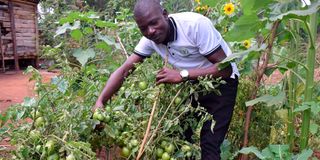
Jack Wafula displays tomatoes nourished using liquid fertiliser.
With readily available cow dung, sheep and goat manure, the mother of five makes compost manure enough for her crops.
Making liquid fertiliser
Twenty kilogrammes of tender Tithonia leaves are put in a sack and soaked in 100 litres of water. The content is covered with a lid for two weeks under a shade. The liquid fertiliser is then harvested but first diluted in water at a ratio of 1:10. Application of concentrated liquid fertiliser without diluting is likely to scorch the plant leaves and roots. "At times I use the diluted liquid fertiliser as top dressing for the maize, beans and groundnuts. This has boosted yields," explains the farmer.
She adds that she has also embraced push and pull technology to control the attack of maize stalkborers and fall armyworms. "Usually, I plant Napier grass at the borders of the maize field and desmodium in between the rows. Nowadays I hardly see any infestation of destructive armyworms, stem borers and Striga weeds.”
Just one year after adopting regenerative farming practices, Agnes’ fields tell a story of remarkable transformation. “My maize yields have skyrocketed from three bags to 20 bags per acre while vegetable production has doubled in both quantity and quality. This season I will have enough food and sell the surplus.” Elsewhere Samuel Juma Watitwa is producing vermicompost manure using earthworms.
Inside a small structure surrounded with black polythene material, he has put two blue plastic drums cut into halves. The farmers uses gravel, sand, dry leaves and stock, compost manure and earthworms. "The manure from animals acts as food for the earthworms. We use Tithonia which is high in Phosphorus. Once the components are laid in a systematic way in the tank, we start sprinkling water," explains Juma. After two weeks, the liquid fertiliser is collected from the tank into a container. The vermicompost can be applied as a bio fertiliser through top dressing and vermiwash (foliar spray)
The bio fertiliser is applied at Kimilili Agroecology Service Provider (ASP) Hub demo plot nearby, where various kinds of vegetables are grown. Kimilili ASP Hub Chairman Jack Wafula says bio fertiliser helps the crops to fight insects such as the Red Spider Mite. "Liquid collected from vermicompost is called vermiwash. We use it to spray tomatoes. It has helped in fighting infestation of Red Spider Mite," he says.
Food and Agriculture Organization coordinator for the BOOST project Jimmy Mweri notes that just like plants experience malnutrition, soils are likely to suffer from various deficiencies. According to a 2023 research done in 10 counties in Western region by USAID, soil tests show that 35 per cent of samples are acidic. "We are training farmers to embrace agro-ecology, which is basically farming with nature. It includes several principles such as integrated practices of boosting soil fertility and pest management," expounds the agronomist.
With the realities of climate change, the project goal is to help farmers boost crop yields amid unpredictable weather patterns. According to Mr Mweri, farmers can choose to blend organic and synthetic farming systems to improve soil health and crop yields.
The project, which is being implemented in Bungoma, Kakamega, Homa Bay, Migori and Nandi, targets 40,000 farmers. "We did basic soil testing on identified farms. Using the dry chemistry method, there were areas where the soil was acidic while very few were alkaline," he said. Soil acidity hinders plant nutrient uptake, particularly affecting access to calcium, sulfur, and magnesium. This acidity arises from various factors, including the prolonged use of acidifying fertilisers and leaching caused by excessive rainfall
"Excessive or improperly managed use of ammonium-based fertilisers can lead to soil acidification,” said the agronomist. Soil acidity can be neutralised by applying lime on soil. Soils that have high alkaline can be improved by using acidifying fertilisers and mulching with acidic materials.
To deal with pest and disease control, some farmers have embraced an integrated approach aimed at minimising the use of pest control chemicals. "The government has banned the use of 69 chemicals, which are dangerous. The use of chemical pesticides should be the final option. Consistent scouting, combined with physical removal of pests and affected plants are effective strategies for pest management in agriculture.
Other forms of evading pest and disease attack include planting and weeding early. "That way, the plant matures faster and is able to resist attacks from pests and diseases. Simple practices like planting onions and Mexican Marigold in between the rows of vegetables tend to repel pests and insects," explained Mr Mweri. Farmers are also finding success in using natural remedies to control pests like aphids and whiteflies. These remedies, often made from readily available ingredients like aloe vera, Tithonia, chili, neem leaves, and soap, are gaining traction as effective and environmentally friendly alternatives to chemical pesticides. "This combination of local herbs is less harmful andalso helps a farmer to cut costs.”