The hospital that bakes for patients
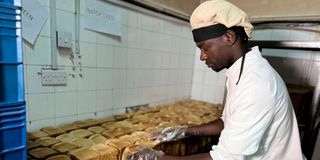
Patrick Muturi, one of the pastry chefs at Nakuru County Teaching and Referral Hospital. He has a hearing impairment.

What you need to know:
- Food plays a key role in the treatment of a patient, and the head nutritionist explains how having the bakery at the hospital has brought down feeding costs.
There’s something off-putting when one walks into a public hospital – from the long queues at the casualty bay, to the nonchalant over-worked health workers trying to stay afloat amidst a deluge of clients, and the forlorn client who has been waiting to get services in vain. These are the scenes that make a public hospital, especially the caliber of Nakuru Teaching and Referral Hospital, a perfect candidate for negative news.
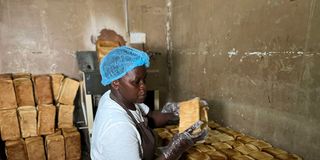
Beatrice Wanjiku at the bakery inside Nakuru Teaching and Referral Hospital.
Well, on this day, we have access to the hospital’s kitchen; another sensitive area at the 118-year-old hospital that has a bed capacity of more than 700 people on any given day.
We had heard about a bakery within the facility and this piqued our interest because, ideally, the primary focus of the hospital is to attend to the sick, and not to bake.
The kitchen in such a hospital is sacrosanct. There’s an unwritten rule of who goes in and out. How you get in and out. And while you may expect a huge team of cooks; they are just over a dozen. Segmented into sections, there are those preparing different foods for patients, and everything here moves with clockwork synchrony because the sick must eat on time.
The cateress, Caroline Kamango, welcomes us to the kitchen. Our destination of interest is the secluded room off the main cooking area. The bakery.
“Welcome, this is where we feed our patients,” she says with a warm smile.
Before the bread is baked, the flour must be weighed. This flour, notes Resident Public Health Officer Betty Timonto, is already fortified from the supplier.
“We have to weigh the flour again to confirm the weight indicated on the sack. We also check for the Kenya Bureau of Standards mark and we must test the flour samples with the government chemists here to ascertain the quality. The results are usually out within three days,” she explains.
Inside the bakery, three chefs work in silence. Two of them; Patrick Muturi and Tabitha Njeri, have a hearing impairment; but the speed with which they move sees them bake more than 700 loaves of bread per day. According to Arthur Gichuru, the head nutritionist, the inclusion of persons living with disability in the kitchen department was intentional.
“You know most counties have it on paper that they are an equal opportunity employer, but here at Nakuru Teaching and Referral Hospital, we walk the talk and the team at the bakery is a testament of our commitment to ensure people living with disabilitys get meaningful employment.”
Just like at the pharmacy, every ingredient is handled with precision. The production is determined by the number of patients admitted in the wards.
“We start by receiving the ingredients from the procurement store and then supply to the bakery. Every ingredient is measured in grammes,” explains the cateress.
Food plays a key role in the treatment of a patient, and the head nutritionist explains how having the bakery at the hospital has brought down feeding costs.
“We used to spend Sh4.2 million per quarter to buy loaves of bread. Now we are using Sh2.5 million to buy ingredients, plus other production costs like electricity and fuel. We are saving Sh1.2 million that is being injected back into the hospital.”
It has been six years since the bakery was established. On average 200,000 loaves of bread are baked annually at this facility. The loaves are also supplied to patients in other public hospitals within Nakuru City. This bread is also used as an incentive when the hospital conducts blood donation campaigns in the county.
“We have peripheral hospitals like Bondeni Sub-county and Langalanga hospitals, which source their bread from here, especially for especially mothers have deliver in their maternity wings. Further, during blood donor camps, we give out free bread. The donation helps us in building the blood bank at the hospital,” says Arthur.
So, how much bread do patients eat and how does this reflect on their healing journey? We ask.
“Our bread weighs 454 grammes. Every slice is 30 grammes and is fortified with iron and selenium. Mothers in the maternity wards as well as tuberculosis and cancer patients get four slices each because they need high energy intake to match the different treatments they are getting,” explains Arthur
While the demand has been rising, there are no plans to commercialise the bakery.
“We do not want to lose focus, our priority is for the patient to feed well and so we do not envision selling the bread like other bakeries, " adds Arthur.
The hospital also has an internal quality measure that ensures the processed bread is not harmful to patients. “We have a colour-coded system where each batch produces 150 loaves. A loaf is set aside for every batch that has been baked on any given day. These loaves will be set apart in green, red and yellow crates for 24 hours so that in case anything is wrong at the ward due to the bread, we are able to trace it,” explains Arthur.