The lake that turns pink: Kenya's hidden flamingo paradise
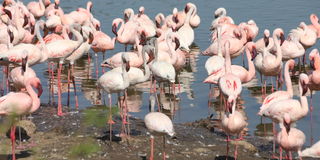
Flamingos at Lake Simbi Nyaima in Rachuonyo North, Homa Bay County, on September 11, 2026. The birds migrate from Rift Valley lakes to feed on algae between August and October.

What you need to know:
- Lake Simbi Nyaima draws visitors with its breathtaking pink tides and rich folklore.
- But local guides and conservationists say urgent action is needed to protect the lake from neglect and climate unpredictability.
In the quiet plains of Karachuonyo, Homa Bay County lies a lake that defies logic. Lake Simbi Nyaima has no inlet, no river feeds it, yet its water never dries up, even at the peak of the dry season when every other pan around it has cracked.
Local legend says the lake was once a village whose people were punished for failing to help an old woman seeking food and shelter. The entire village sank into water, giving birth to Simbi Nyaima, "the village that sank." Scientists offer another story; that it is a crater lake formed by volcanic activity.
But whatever the origin, the lake keeps surprising.
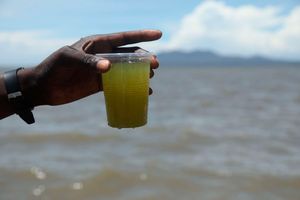
From August to October, its shores transform. For months, a thick blanket of green algae covers the water. Then, almost overnight, the green turns pink. Hundreds of flamingos, having flown hundreds of kilometres from the Rift Valley lakes: Nakuru, Bogoria and Elementaita descend on the small volcanic crater lake to nestle, feed and rest.
The soda lake, isolated and fishless, supports heavy growth of cyanobacteria—blue-green algae and plankton that thrive in its warm, alkaline waters. This algae is not only their primary diet but the source of their iconic pink colour.
Scientists say when pollution, drought or changing water levels make major Rift Valley lakes temporarily inhospitable, the birds seek alternative sanctuary sites like Simbi Nyaima.
Joseph Bolo, a resident of Simbi Kogweno, says they are accustomed to seeing a few birds flying to the lake as if inspecting the surroundings. When they stay for a few days, it indicates the environment is conducive, and others later join them.
"They have a buzzing sound when they fly to the lake at once. It is like an aeroplane passing overhead," he says.
In the morning, the birds bask in the warm sunlight before moving to the lake centre where they filter feed. At night, they move to the centre to avoid predation from domestic dogs.
For Bolo, the presence of the birds is something he is used to. Recently, farmers discovered that their presence is determined by weather patterns which also affect their yield. Bolo says residents get a bumper harvest when the lake has more algae.
"The birds leave after about two months when they exhaust the food supply, with weak ones left to die," he says.
Their presence has turned the small lake into a natural wonder. Visitors flock to its banks to watch the birds swim, feed and take off in unison, their wings painting the lake surface pink and white.
But for residents of Simbi, the wonder comes with worry. They say the county government is not doing enough to promote tourism and conserve the lake.
Bolo says residents took the initiative of guiding visitors around the lake to ensure they walk on the correct path and do not interfere with the birds. When taking visitors around, the residents earn some money.
Residents are concerned about environmental changes and lack of conservation efforts from the government which they say will make the flamingos vanish.
At Lake Nakuru, conservation and protection of the bird is anchored on a multi-agency approach led by the Kenya Wildlife Service, with strict protected status, regular monitoring of water quality, and biannual waterbird counts.
This does not happen in Simbi Nyaima, where plastic and human waste can be found in bushes at the edges of the water. The county government fenced the lake to control entry and exit and constructed an ablution block for visitors. But one of the gates was vandalised and stolen, leaving the site exposed. Some farmers also graze their animals at the edge of the lake, while Christians who visit for prayers defecate in the open and leave plastic bottles.
Also read: New hope for flamingo birds in Lake Nakuru
Visitors Anet Oyaro and Doris Owino from Siaya were disappointed. Anet says she learnt of the lake in school and wanted to see it. "I had a chance to see flamingos which I did not expect. There can however be some improvement to attract more tourists," she says. Doris notes there is no place to rest and proposes planting trees around the lake to create shade.
Kenya Wildlife Service warden Jackson Kibor says there is a need for the county government to make Simbi Nyaima better and use it as a revenue generation stream. He says local tour guides should be trained on marketing the site, with KWS ready to offer training. He also calls for improved infrastructure, regulated animal entry, and a community clean-up to remove plastic and other contaminants.
Flamingo migration has also become unpredictable. Bolo recalls he was sure the birds would arrive in August and leave in October. "The lake used to be pink every August without fail. These days we wait, and sometimes they don't come," he says.
Residents want the government to step in, protect the lake and the birds that depend on it, and market Lake Simbi as a tourism destination. More visitors, they argue, would mean more revenue, more jobs, and stronger conservation efforts for a bird species whose population has been dropping over the years.