The man who climbed Mt Kenya to honour his mother—and save others
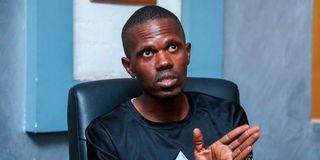
John Goma, who hiked Mt Kenya in honour of Kenyan women battling with cervical cancer, during the interview at Nation Centre, Nairobi, on December 10, 2025.

What you need to know:
- After losing his mother to colon cancer, John Goma spiralled into depression. But walking daily to Kenyatta National Hospital gave him unexpected endurance—the same strength he later channelled into ultra-running and cancer advocacy.
- Goma’s caregiving experience exposed him to the harsh realities of cancer care in Kenya: stigma, exploitation, financial strain and despair.
- Through support groups and mentorship, he found healing and a sense of duty. The “10 for 10” Mt Kenya challenge became his platform to champion screening, awareness and HPV vaccination.
John Goma's mother died on July 30, 2023. In the months that followed, grief threatened to consume him. But instead of surrendering to despair, he laced up his hiking boots and pointed himself towards the peak of Mt Kenya.
Recently, Goma joined a team of ultra-runners attempting what most hikers would consider impossible: summiting Mt Kenya in under 10 hours—a journey that typically takes three days. The challenge, dubbed "10 for 10," was designed to honour the 10 women Kenya loses to cervical cancer every single day.
They set off at 4am from the Moses gate, plunging into the frigid darkness. The early hours were treacherous—navigating black slopes, catching the glowing eyes of animals in the beam of their torches, battling the biting cold. Yet Goma maintained a blistering pace alongside 10 other ultra-runners, all of them fitter and more experienced than him.
The challenge was more than a physical test. It was an advocacy effort to empower women suffering from cervical cancer and promote the uptake of the HPV vaccine. The punishing ascent was meant to mirror the struggle faced by those navigating serious illness.
"The hike was gruelling, made tougher by the need to conserve breath at high altitude. Talking was forbidden to maintain momentum," Goma recalls. "Eventually, I reached a section so steep and taxing that it is called the Place of Despair. It tests every hiker and forces them to choose between pushing on or turning back."
He pushed on.
After conquering the Place of Despair, Goma reached Shipton's Campsite—the last stop before the final summit. Seven hours had passed since he left Moses gate. But there, his journey paused. The guide advised against proceeding to the peak. Goma's rapid ascent, they explained, posed too high a risk of altitude sickness due to lack of acclimatisation. Though disappointed, he accepted the expert counsel, claimed his victory at Shipton's Campsite, and took photographs for posterity.
It was enough for a first attempt.
From caregiver to advocate
Goma's connection to cancer advocacy is rooted in profound personal loss. His life changed irrevocably in September 2020 when his mother, then 72 years old, was diagnosed with colon cancer. At the time, Goma was working as a sales consultant. The diagnosis plunged him into a crisis. "I was unaware that cancer affected the less wealthy," he says. "I was thrust into the role of a full-time caregiver."
The mental breakdown and depression that followed forced him to resign from his job. He accompanied his mother to Kenyatta National Hospital for emergency surgery. She was discharged with a stoma bag—a reality that presented both financial and cultural challenges.
"It was taboo for a son to attend to his mother's personal body needs, but I was the only one available," Goma says. "Fortunately, we found help through the Kenya Colostomy Association, which provided free, life-saving bags."
But the ordeal was far from over. In 2023, a group claiming they could reverse the stoma took his mother to an unauthorised clinic in Kitengela. The botched operation created new complications, forcing her back to Kenyatta National Hospital (KNH) for seven more emergency surgeries. During this period, Goma walked daily from Umoja to the hospital to care for her, unable to afford transport. He walked until the day she died.
Purpose from pain
Left with grief and a vacuum of purpose, Goma channelled his energy into advocacy. He connected with organisations like A Fresh Chapter and the Kilele Cancer Support Group, led by breast cancer survivor Jane Kabaki, his mentor, and organiser Benda Kithaka.
Jane recognised resilience in Goma and guided him into patient advocacy. Kithaka, noticing the natural athleticism he had developed from months of walking to KNH, offered to sponsor him for the group's hikes. This marked the beginning of his identity as an ultra-runner and advocate.
Then Jane relapsed. She did not survive. "I was unable to attend the funeral due to the depth of my emotions," Goma says. "Following that moment of grief, I reached a turning point. I reasoned that my experiences might have been preparation for something greater. I began a period of deep self-reflection and realised there was a higher purpose waiting to be discovered."
The opportune moment arrived with cervical cancer awareness month. Goma spotted a poster advertising the "10 for 10" ultra-marathon. "Initially, I was astonished," he recalls. "The concept of ascending and descending in under 10 hours, when the standard Mt Kenya climb takes three days, seemed almost impossible. I was unaware that I would be called upon to participate."
When the invitation came, he embraced it. His training was unconventional and conducted in secret: walking from Umoja to the city centre and back, building the endurance that would carry him up the mountain. His determination earned him a place in the first team, setting off at 4am.
A message from the mountain
Though Goma did not reach the summit, he found meaning in the attempt. "I was comforted knowing I was hiking for a cause—to demonstrate to young girls and women that the battle against disease, just like summiting a mountain, can be won," he says.
His advocacy now focuses on a simple but urgent message: early screening and HPV vaccination can save lives. "Information about cancer is yet to reach all parts of the country, causing immense suffering due to ignorance. People still mistakenly believe a cancer diagnosis is a death sentence," he says.
"Our hike up the mountain is an urgent call to action, specifically for the HPV vaccination of young girls. Society cannot merely pass on information while four women die daily from cervical cancer."
Drawing parallels with the successful management of the HIV epidemic, Goma emphasises making screening accessible and affordable so that people can live with hope. The perception of cancer as a grenade ready to explode, he insists, must end. It must be normalised as a treatable disease. "There is hope at the mountain top," he says.