The river that refused to die: Maindaindu’s climate-smart comeback
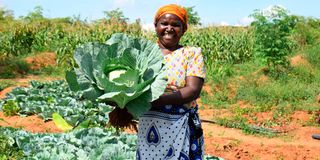
Veronica Wambua displays a harvested cabbage in Kisitimani village, Machakos County, on November 29, 2025. She has benefited from the rehabilitation of River Maindaindu, which passes through the village.

What you need to know:
- A failed rainy season has devastated most of eastern Kenya, but along River Maindaindu in Machakos, seven newly built sand dams have transformed the landscape.
- While neighbouring villages brace themselves for hunger, farmers along River Maindaindu enjoy thriving crops thanks to a bold community initiative that constructed seven sand dams.
- Women no longer trek long distances for water, and families are venturing into high-value crop farming for the first time.
Withered crops following a failed short rainy season have drained the Christmas cheer from communities in Kitui, Machakos and Makueni. Across much of the region, residents are bracing themselves for hard times. Yet a stretch along River Maindaindu in Machakos County tells a remarkably different story. Here, dozens of riverside farms flourish, their plots lush and teeming with crops at various stages of maturity—an unexpected abundance made possible by the rehabilitation of River Maindaindu.
“We are not bothered by the dry spell reported in other parts of the county,” says Veronica Wambua, a smallholder farmer who grows bananas, beans, cabbages and maize on a small parcel of land overlooking a recently built sand dam across River Maindaindu.
Though her confidence may seem exaggerated, it reflects the growing resilience in the region following the construction of seven sand dams along the river. The intervention has offered a lifeline to a community that has long borne the brunt of climate change. During dry spells, women spent long hours at distant water points while farmers drove livestock more than 20 kilometres to River Athi. Rampant sand harvesting further worsened the drought situation.
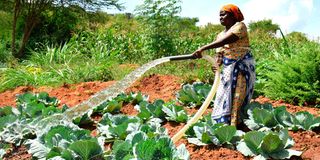
Veronica Wambua waters her cabbages in Kisitimani village, Machakos County, on November 29, 2025. She has benefited from the rehabilitation of River Maindaindu, which passes through the village.
“At the height of the dry spell in 2022, we said ‘enough is enough’. We set out to address water shortage and food security by rehabilitating River Maindaindu through sand dams. The actual work started in February 2024 after our cause secured the needed support from various organisations,” said Daniel Kimondiu, the chairman of Sustainable Community Initiative for Rural Development, the community-based organisation that initiated the restoration drive.
Two rounds of rainfall have since replenished River Maindaindu following the completion of the seven sand dams. These concrete weirs, built across seasonal rivers, slow the flow of water, sand and debris during the rainy season, creating an artificial aquifer upstream. The stored water then percolates into the surrounding area, recharging shallow wells and remaining accessible during the dry spell—when sand is scooped.
“Maindaindu will never be the same again. We tried cabbages and tomatoes for the first time and they did well. The government should introduce new high value crops in this region. We are geared to go big in agribusiness,” Martin Mutua, a community leader, told Healthy Nation.
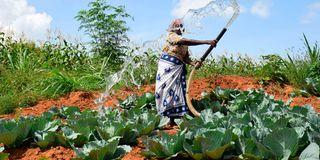
Veronica Wambua waters cabbage crops in Kisitimani village, Machakos County, on November 29, 2025. She has benefited from the rehabilitation of River Maindaindu, which passes through the village.
Much of the harvested produce now supplies the Kwa Mwaura and Tala markets. Donors provided cement and rebar, while the Maindaindu community contributed sand, stones and labour. Utooni Development Organisation, a non-governmental organisation promoting climate-smart agriculture and environmental conservation, offered the technical expertise needed to construct the sand dams.
The structures have revitalised the 25km river, which rises from Kyanzavi Hill and drains into River Kalala before flowing into River Athi. According to Snehar Shah, a board member of the Asian Foundation—one of the organisations that supported the project—each sand dam cost Sh1.5 million.
“We have made a significant step towards making River Maindaindu permanent. The throwback from each sand dam reaches the previous sand dam. What is going to happen is that the sand dams will trap sand, which will serve as a store of water during the dry spell.
"When drought hits this region, the community will still access water from the trapped sand. We are installing solar-powered pumps in wells along the river to bring water closer to the community and minimise the risks of accidents during the drawing of water,” Ashok Shah, Group CEO of APA Apollo Group told Healthy Nation during a ceremony marking the completion of the seventh sand dam.
The insurance company, which champions environmental conservation as part of its corporate social responsibility, saw an opportunity to test a new model for river restoration. “We have been restoring sections of rivers by constructing one or two sand dams in one river. With River Maindaindu, we saw an opportunity to concentrate seven sand dams in one river so that we can study their impact on the environment,” Mr Shah said.
To sustain the restoration work, Utooni Development Organisation has urged riparian communities to refrain from unlawful sand harvesting. “We are working with the Maindaindu riparian community to grow trees and set up terraces on their farms to minimise soil erosion and the silting of the river. Importantly, the riparian community should shun wanton sand harvesting,” said Regina Kamau, the organisation’s CEO.
The success of the project demonstrates the potential of rainwater harvesting in building climate resilience. Israeli ambassador Gideon Behar has also urged farmers in Kenya to move away from reliance on rainfall.
“The most urgent need today in Kenya, also in Africa and generally in Israel, is to move into irrigated agriculture. The time for rain-fed agriculture is almost over because of climate change, which has resulted in declining rainfall and shifting rain patterns,” Mr Behar told Healthy Nation during a recent tour of a solar-powered irrigation scheme supported by Israeli organisations at Ngomano in Makueni County.