The social health insurance is not working yet
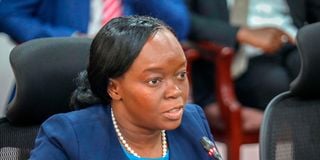
Health Cabinet Secretary Deborah Barasa when she appeared before the National Assembly Departmental Committee on Health on February 20, 2025.

What you need to know:
- I beseech our Cabinet Secretary to genuinely and honestly answer the questions being posed to her.
- For those of us who understand the language the Ministry of Health is employing, all we hear is that the ministry has no clear plan on payment of NHIF arrears.
Last week, I listened to Health Cabinet Secretary Deborah Barasa before the Senate as the legislators furnished her with question after question with regard to the functionality of the Social Health Insurance Fund (SHIF).
It was interesting to listen to the mounting frustration of the legislators as their questions hit a brick wall; bouncing back like a ping pong.
For two hours, the CS held her position, using what in healthcare is termed the “development world” jargon, to respond to the frustrated senators, essentially never giving a direct answer to the direct questions they were asking.
One senator’s frustration was palpable when he asked the CS to describe how she would respond to a member in the House convulsing there and then. It was interesting to see how the CS did not drop the script, she went on to respond that the Ministry of Health had in place policies and trainings for emergency response!
With such a drama-filled session, and the House eventually getting frustrated at not getting answers and moving on, it is no wonder that the reputation of SHIF remains at stake. If the legislators, who are supposed to be a representation of the people, are unable to wrestle a response from the Cabinet Secretary, how are the service providers, or Wanjiku, supposed to?
Last week, the Rural and Urban Private Hospitals Association called upon its members to down their tools and stop offering services to patients dependent on SHIF to get care. They argued that the crippling debt that the National Health Insurance Fund (NHIF) left them has pretty much taken away their capacity to extend any debt whatsoever to the Ministry of Health, through its agencies, whether NHIF, or SHIF.
While the narrative to the public is that these protests are a private sector problem, who only view healthcare provision as a business, the truth is that the public sector has it even worse; they only lack a voice to air their frustrations. The public sector health facilities are worse off.
They have no capacity to hire dedicated debt collectors to pursue their debts; they cannot be seen to be openly condemning the Social Health Authority for ignoring the liabilities it inherited from the now-defunct NHIF that has left them crippled; and the capacity to fully implement the Facility Improvement Fund is facing opposition from the Auditor-General’s office with regard to local collection and use of funds at the hospital without remitting to the consolidated fund first.
Even worse is the unclear funding system for primary healthcare. The capitation model that is in place has many challenges with regard to its implementation. Previously under NHIF, the capitation model worked with money being directly paid to a specific health institution in line with the number of clients who have pre-selected and have been allocated to the institution for service. This restricted the patient to accessing outpatient care only to the pre-selected institution. Further, an institution had to restrict itself to the fixed amount, or bear its losses.
The biggest downside to this model is that institutions with high visitations began to downsize the cost of care to fit within the limit, and to potentially make some profit. Herein lies the danger to patient care!
Currently, the proposed model is the global capitation model, which requires the health facility to treat and claim. The facility will have a cap to the maximum claims it can make, but access to that money will be based on the quantity of service provided.
What this means then is that even in primary healthcare, there is going to be a proposed schedule of pricing for the services provided; just like under SHIF. The only difference then between the two funds will be the source of financing for each fund, with primary healthcare relying on the exchequer while SHIF relies on contributions to SHA directly. Which then begs the question, pray tell, why would the restriction of services to certain health facility levels be necessary? And, are the proposed primary care units then going to make sense?
As the chairperson of the Heath Committee, Governor Muthomi Njuki aptly put it, this model will encourage health facilities to turn into service hawkers as each gets desperate to draw in clients to meet the claims quota. This right here is the reason for unnecessary treatments, procedures and tests; fueling corruption in the system; one of the key reasons fronted for the dissolution of NHIF. How then do we focus on the primary healthcare fund investing in preventive care, when funding is being tied to patients seen?
Even worse, counties seem to have been dumped upon the unenviable mandate of enforcing SHIF registration among their residents, and at the same time, finance the enrollment of the indigents. This is despite the fact that there is no additional funding that has been allocated to the counties for this exercise.
I strongly reiterate a position I have taken with regard to social healthcare provision; the discussion cannot continue to be one-sided! We cannot keep talking about how to fund the services without talking about the quality of care being provided! The two are inseparable. We must prescribe down to a T, how the patient is treated in line with the existing evidence, before we agree on what this care is going to cost us!
As a provider, with no enforced guidelines, I can choose to give an antibiotic to every child seen at my facility with an upper respiratory tract infection; even if the infection is viral and an antibiotic is not required. This means that I not only get to claim for consultation fees, but also for a bunch of unnecessary tests and for the antibiotic. Not only am I bankrupting the fund, but I am also exposing the entire population to the public health threat of building antibiotic resistance!
When will the proponents and implementers of this social health insurance pause and listen to the experts? Or are they so caught up in counting numbers of persons registered under SHIF as their end output; to look at the true picture of the impact Social Health provision is supposed to achieve?
I beseech our Cabinet Secretary to genuinely and honestly answer the questions being posed to her. For those of us who understand the language the Ministry of Health is employing, all we hear is that the ministry has no clear plan on payment of NHIF arrears. For the ministry to still be asking providers to submit their claims for verification, years down the line, means that it has not asked Treasury for moneys to settle the debt since they are openly admitting they do not even know how much is owed.
Further, we also hear from the CS that the ministry is still far from knowing how it is going about funding primary healthcare. The only clear information is that the amount of capitation is Sh900 per head, and how much has been released to the ministry from the exchequer thus far.
Primary healthcare is exchequer-funded. So then, pray tell, why are we denying services to those who have not enrolled in SHIF when the cost of their care is already budgeted for from our taxes? Shouldn’t this requirement only be invoked when the services being provided are covered by SHIF in levels five and six?
Social health Insurance is here for all of us, we need it to work. To this end, we shall continue to advocate for this care to not only be affordable and sustainable, but most importantly, it must be acceptable, and of evidence-informed quality.
Dr Bosire is a gynaecologist/obstetrician