Thirsty world: Alarm as billions of people face severe water shortage
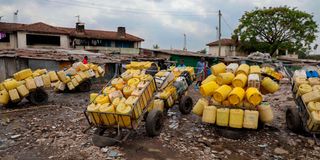
Water vendors in Kaloleni Estate, Nairobi County, selling water on September 11, 2025.

What you need to know:
- A UN report warns that 75 per cent of humanity now lives in countries classified as water-insecure, signalling the dawn of an “Era of Global Water Bankruptcy.”
Nearly four billion people worldwide face severe water scarcity for at least one month each year, as the planet officially enters a new post-crisis reality.
A landmark report released by United Nations scientists at the UN Headquarters on Tuesday warns that 75 per cent of humanity now lives in countries classified as water-insecure, signalling the dawn of an “Era of Global Water Bankruptcy.”
In Kenya, the crisis has accelerated, with water availability per person dropping to 647 cubic metres, well below the global security benchmark of 1,000 cubic metres. It is projected to fall further to 426 cubic metres by 2030.
The report, “Global Water Bankruptcy: Living Beyond Our Hydrological Means in the Post-Crisis Era,” argues that terms such as "water stressed" and "water crisis" no longer reflect the irreversible damage to the planet’s natural water capital.
Kaveh Madani, director of the UN University’s Institute for Water, Environment and Health (UNU-INWEH), notes that many regions are now living well beyond their hydrological means. He explains that societies have overspent their annual renewable water income from rivers and rainfall and depleted long-term savings stored in aquifers, glaciers, and wetlands. This metaphor describes a physical reality in which the world is drawing down its natural resources at a rate that nature cannot replenish, leading to the total insolvency of critical water systems.
Kenya’s situation is a local ledger for this global deficit. Even before the UN report was released, the country was already staring at a deepening crisis fuelled by a massive $2.52 billion (Sh325.57 billion) funding shortfall.
Experts warned in early 2025 that if the government and private sector do not act with urgency, the cost of inaction could drain billions from the economy and leave millions without reliable access. To secure universal access to safe water and sanitation by 2030, Kenya requires nearly Sh995 billion, yet the current funding trajectory remains woefully inadequate.
The economic impact of water mismanagement in Kenya is already considerable. The country loses an estimated $1.5 billion (Sh193.8 billion) annually due to inadequate access to clean, safe water for households and businesses, according to the report.
The Athi and Tana basins, which provide water to major economic hubs, are both expected to experience demand exceeding supply by 2030. These two basins together supply water to more than half of Nairobi’s population, further highlighting their importance.
Since 2018, development partners have contributed over Sh258 billion to the sector, but the heavy reliance on donor support underscores ongoing structural weaknesses. Persistent project delays are largely due to bureaucratic challenges and difficulties securing the national funds required to match external financing, which, in turn, hinder upgrades to the country’s water infrastructure.
In July 2025, the National Drought Management Authority (NDMA) reported that 23 of Kenya’s 47 counties were facing imminent water shortages due to poor rainfall and excessive groundwater extraction. These regions face acute hardship, with drought conditions persisting even after rainfall, and 1.8 million people classified as food-insecure. Among them are 500,000 children under five and 100,000 pregnant women. Rivers, boreholes, and shallow wells across these counties are drying at rates that reduce natural replenishment to below 30 per cent in many areas. In severely affected counties such as Lamu and Mandera, average domestic water use has dropped to well below the minimum recommended for basic health.
The desperation in these counties has led to a sharp spike in the cost of survival. In high-risk counties, water vending has increased. The price of a 20-litre jerrycan has risen from a source price of Sh2–Sh10 to as much as Sh50–Sh100 in the most stressed conditions. This price hike is a direct tax on the poor, forced upon them by the bankruptcy of their local water systems.
The crisis also intertwines with health risks and food insecurity. Livestock diseases such as foot-and-mouth and camel pox are spreading across affected regions. Pastoralists, facing depleted pastures and acute water scarcity, are increasingly drawn into conflict over the dwindling resources that remain.
This local situation mirrors a global trend. The UN report reveals that the world has already lost 410 million hectares of natural wetlands in the past five decades, an area almost equal to the 447 million hectares in the European Union.
These wetlands act as natural water filters and reservoirs, having previously provided ecosystem services valued at US$5.1 trillion per year. Additionally, since the early 1990s, half of the world's large lakes have lost water, directly impacting the 25 per cent of humanity, about two billion people who depend on them. As these natural buffers disappear, the world loses its ability to bounce back from shocks. Madani calls this a "post-crisis condition" marked by irreversible losses.
Also read: December rains: How 2024 offered women relief while 2025 deepens their struggle
Groundwater, which provides 50 per cent of the global domestic water supply and 40 per cent of the world’s irrigation water, is steadily being drained. Around 70 per cent of the world’s major aquifers are in long-term decline, which in turn leads to land subsidence affecting nearly two billion people worldwide.
In some cities, the ground is literally sinking by 25 centimetres every year as the aquifers beneath them are emptied and compacted. This highlights water bankruptcy, the persistent over-withdrawal relative to renewable inflows, resulting in a loss of natural capital that is either irreversible or prohibitively costly to restore. In it, a region can be flooded one year and still be in crisis if water usage continues to exceed replenishment.
The UN report calls water bankruptcy a justice issue, with the burdens falling disproportionately on smallholder farmers, Indigenous Peoples, and the youth. It argues that a fundamental reset that recognises water as an upstream opportunity must replace the current global water agenda, which focuses on drinking water and small efficiency gains. Investing in water is an investment in mitigating climate change, biodiversity loss, and desertification, addressing immediate community concerns, and advancing international environmental goals.
As world leaders convene in Dakar, Senegal, to prepare for the 2026 UN Water Conference in the United Arab Emirates, the call for coordinated, immediate action is clear.
As Madani warns, not every basin and country is water-bankrupt, yet too many critical systems have exceeded safe limits. These systems are interconnected through trade, migration, climate feedbacks, and geopolitical dependencies. To avoid compounding risk and loss, leaders must move beyond declarations and rapidly advance actionable policies and investments.