Tobacco industry wilts under economic and ecological strain in Kitui
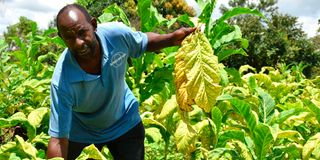
Patrick Ngeta on his tobacco farm in Kavalula village, Kitui County, on April 7, 2026. Tobacco production exerts pressure on the environment.

What you need to know:
- Rising costs, shrinking markets, and environmental damage are pushing Kitui’s once-thriving tobacco industry towards steady decline.
- Farmers grapple with falling profits and growing pressure as tobacco loses its place as a reliable cash crop.
A strong, earthy smell announces the tobacco section of the vibrant Kalundu market in Kitui town. Tens of boda boda operators deliver sacks of cured tobacco leaves to a building, triggering a beehive of activity as dozens of workers methodically shred the leaves using machetes—the first step in producing assorted tobacco products.
“We earn a living by making snuff and man-made cigarettes, a hot cake in the market,” says Robert Wathe, a specialist in pounding tobacco leaves into a pulp of uniform consistency to make a special snuff known locally as kang'aalikya.
The products are sold in markets across Kitui, Machakos, and Makueni counties. This hub of tobacco production reflects the promise of cottage industries in unlocking value from the crop. Beneath this industrious façade, however, lies an industry under intense pressure. A decommissioned tobacco curing barn, towering at the heart of Kitui town, completes the picture of a sector that has seen its best days.
“We are done with tobacco. We are now doing other things,” says Adeline Muthui, a manager of an association of tobacco farmers in Kitui County.
She is among the children of tobacco farmers who were educated through proceeds from the crop. She says she cannot do the same for her children. Trouble began with the termination of contracts between farmers and British American Tobacco and later Mastermind Tobacco Kenya, both of which cited declining tobacco production. This significantly reduced the acreage under cultivation.
As farmers struggled with the loss of a stable market, World Health Organization rolled out aggressive campaigns against tobacco production and consumption, citing health risks associated with nicotine. The organisation links nicotine to a range of diseases, including cancers.
Smallholder farmers, who have resisted these campaigns, argue that tobacco remains a reliable crop, especially in drought-prone areas. “In Kyangithya East and Nzambani regions, no other crop comes close to tobacco in terms of value,” says Simon Makau, chairman of the Kitui Tobacco Growers Cooperative Society.
One of the most persistent challenges facing tobacco farming is environmental degradation linked to curing leaves. The process relies on traditional kiln technology inherited from European settlers who introduced tobacco to the region more than 80 years ago. Besides extending shelf life, the delicate flue-curing process gives tobacco its distinctive aroma.
“One of the key challenges facing tobacco farming is the significant demand for wood fuel during curing. Tobacco curing requires a substantial amount of wood fuel to dry the harvested leaves, making it an energy-intensive activity. Tobacco production exerts pressure on forests and the environment at large,” says Kitui Agriculture executive Mbaya Kimwele.
Patrick Ngeta, a resilient tobacco farmer who intercrops the crop with maize and pigeon peas, has seen many veteran farmers abandon the crop because of rising production costs. “It takes at least a fully-grown tree to cure tobacco leaves once,” he says from Kavalula village, noting that he is fortunate to have access to a large forested area.
Lost appeal
Queen Nyamai, a small-scale farmer in Mr Ngeta’s neighbourhood, agrees that the drought-resistant crop has lost its appeal. She has significantly reduced the acreage under tobacco over the years. “It has become increasingly costly to produce tobacco. The bulk of the cost goes into buying firewood to cure tobacco leaves,” she says.
Aware of the environmental toll, some farmers have begun planting trees to restore degraded landscapes. This effort is particularly relevant in a region long affected by unregulated charcoal production. Environmentalists, however, argue that these measures are insufficient and overdue.
“Just like charcoal producers, tobacco growers tend to go for indigenous trees, which take decades to mature. Tobacco production, therefore, denies the environment the ecological benefits of the trees,” says Muendo Nyamu, a programme manager at the National Council of Churches of Kenya.
The administration of Kitui governor Julius Malombe has taken steps to address the environmental impact of tobacco farming. “To mitigate the environmental impact of tobacco production and ensure a sustainable supply of wood fuel, we advise farmers to maintain woodlots specifically dedicated to the production of wood fuel,” Dr Kimwele says.
The initiative is expected to boost forest cover in Kitui, currently estimated at about 7 per cent, according to the Kenya Forest Service, while supporting sustainable livelihoods.