Toxic threat: Dumped medical waste still exposed even as Kenya leads AMR push
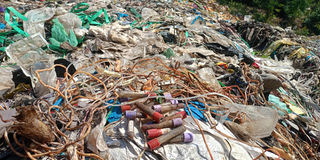
Illegal dumping of medical waste at Ganahola and Kalahari slums in Mombasa County.


What you need to know:
- Five months after illegal medical waste was first reported in Mikindani’s Ganahola area, residents still live alongside discarded syringes and biomedical debris, but as children play near the hazardous site, Kenya is co-sponsoring a global AMR resolution aimed at stopping this kind of environmental risk.
- The resolution on antimicrobial resistance highlights the long-overlooked environmental drivers of AMR, including poor waste disposal, pharmaceutical effluents and expired antibiotics.
It has been five months since the Nation team first visited a dumpsite in Mikindani, Ganahola, in Mombasa County, where residents raised alarm over illegally discarded medical waste.
Yet the waste still lies exposed. Juma Masha, who lives in Ganahola, told the Nation on Tuesday evening that although the dumping has stopped, none of the hazardous waste has been removed.
“Nothing has been done,” he said. “Children still play there; we don’t know how we can be helped. We just tell them to get out when we find them playing.”
Another resident, Beatrice Mudeizi, confirmed the same. “We have not been helped yet,” she said.
As the community continues to live alongside the abandoned syringes and biomedical litter, Kenya is co-sponsoring a resolution on antimicrobial resistance (AMR) at the ongoing United Nations Environment Assembly. The resolution focuses on the environmental dimensions of AMR—a long-neglected but critical area—including improper medical waste disposal of the kind witnessed in Ganahola.
While no evidence of AMR has yet been detected in the region, science shows that poor waste-handling can accelerate the spread of harmful bacteria resistant to existing drugs.
The resolution seeks to implement commitments made in the United Nations General Assembly’s political declaration on antimicrobial resistance adopted last year. It highlights the environmental impacts of pharmaceutical production, including manufacturing operations, waste generation, and effluent management, and how these influence the evolution and spread of antimicrobial resistance.
Environment, Climate Change and Forestry Cabinet Secretary Deborah Barasa told the Nation that the environmental sector has for years received little attention in the AMR conversation. Kenya is now pushing for a One Health approach that recognises the interconnection of human, animal, and environmental health.
“AMR is a silently growing pandemic and it may lead to high disease burdens if not addressed,” she said. While issues such as waste management and the disposal of expired antibiotics are known contributors to AMR, she noted that they still “do not get the attention they require”.
Ms Barasa said the resolution requests the United Nations Environment Programme’s Executive Director to support member states, including Kenya, in taking actions to prevent, address and reduce the discharge of antimicrobials into the environment. It also calls for enhanced research and knowledge-sharing, including indigenous knowledge, on the environmental dimensions of AMR through standardised protocols, indicators and thresholds.
Further, the resolution supports the provision of financial resources, technical assistance, access to best practices, and technology transfer to developing countries on voluntary and mutually agreed terms to address AMR in the environment.
Jean Pierre Nyemazi, Director of the Global Coordination and Partnership and the Quadripartite Joint Secretariat on Antimicrobial Resistance at the World Health Organisation, underscored the severity of the threat. He explained that when someone has an infection, they require antimicrobials such as antibiotics, antiparasitics or antivirals. AMR occurs when the infection no longer responds to these medicines because the organisms causing it have become resistant.
He noted that while some resistance occurs naturally, misuse of medicines—particularly when not prescribed by a professional—accelerates the problem. “We know that these drugs are also used by animals. They also need to be given appropriately. We need to manage waste because antimicrobials could be discharged to the environment through waste,” he said.
Africa bears a significant burden. Of the one million global deaths attributed to AMR annually, the continent accounts for about one in every five. “We don’t have prevention control infrastructure in our communities. When we develop resistance, it kills more people,” he said.
Dr Dave Ojijo, a medical doctor and climate and health expert, told the Nation that toxins entering the environment often end up on people’s plates through food. Animals consume contaminated plants, and humans then ingest the animals—possibly taking in resistant bacteria.
He added that for healthcare workers, the biggest concern is when patients fail to respond to treatment. “There is a huge gap when it comes to the link between environment, use of medication and human health,” he said, stressing the need for proper disposal of medical products to protect nearby communities.
Nahashon Gicheru, a member of the Quadripartite Working Group on Youth Engagement for AMR, noted that the resolution comes at a time of research advancement and growing recognition of the environmental sector’s role in AMR response. “We need to ensure all stakeholders in the environment sector come together to improve this knowledge base. Youth should join hands to change narratives in order to reduce deaths,” he said.
He added that advanced treatment due to drug resistance becomes costlier for patients, affecting them economically. Kenya remains hopeful that the resolution will be adopted before the end of the week, paving the way for implementation both locally and globally—and ultimately helping save more lives.