Two governments, two stories: Kenya, US officials flip-flop on controversial Ebola deal
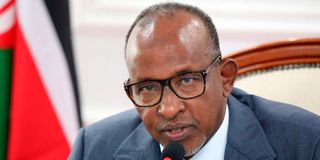
Health Cabinet Secretary Aden Duale.

Kenya and the United States officials seem not agree on who will use the proposed Ebola facility in Laikipia, how long the planning has taken, or whether it is a quarantine or an isolation centre.
The Nation reviewed and analysed 12 official statements and interviews from both governments regarding the facility inside the Laikipia Air Base, from Cabinet Secretary Aden Duale's parliamentary presentation to US official interviews, statements and press releases and Principal Secretary Ouma Oluga's television interview.
Health Cabinet Secretary Aden Duale said that the facility at Laikipia Air Base will serve multiple users.
"It is for everybody. The Kenya Defence Forces will use that facility. Other Kenyans will use that facility," he said.
However, an official of the Donald Trump administration, speaking hours later, said something entirely different.
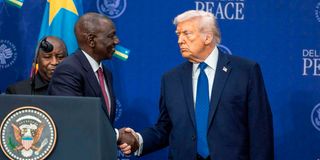
President William Ruto shakes hand with US President Donald Trump in Washington DC on December 5, 2025.
"The protocol on who's going to use it, and when they're coming in, that's still to be worked out. So this is why people are like, " Who is going to get it? And there's no patient identified, there's no patient up."
The contradictions extend deeper.
When Mr Duale appeared before the Parliament on Wednesday he said that discussions about the facility were not new.
He referenced the bilateral health cooperation framework signed in December 2015, implying that the Laikipia facility is part of an agreement both governments planned for when they entered the partnership.
However, the Trump administration explicitly rejected this claim.
"There's no connection," a US official said. "I didn't even know about the framework discussion until somebody else brought it up. This is purely a response to a health emergency."
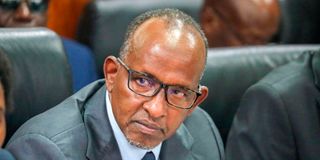
Health Cabinet Secretary Aden Duale before the National Assembly health committee at Parliament buildings in Nairobi on May 15, 2025.
When pressed on whether the framework agreement opened the door for the facility, the official said:
"The discussions on the framework are completely independent of the discussion we are having right now; the facility discussions started two weeks before the facility became public.”
CS Duale has also implied that conversations stretch back years, part of a longstanding partnership framework. But the US official placed the entire timeline in sharp focus: discussions began around May 16 2026 when the virus was declared a Public Health Emergency of International concern.
Quarantine or isolation centre
Whether the facility is a quarantine or isolation centre is also something that the two governments have failed to agree on.
The difference between a quarantine facility and an isolation centre is the difference between housing people who might be sick and housing people who definitely are sick. Kenya and the United States are giving two different answers about what Laikipia will be.
Kenya's government has repeatedly described the Laikipia facility as a quarantine centre, a place to house individuals who have recently returned from affected regions and are awaiting test results and have not tested positive for the virus.
Mr Duale told Parliament that the facility is part of Kenya's national preparedness architecture, designed to manage people who may have been exposed to Ebola but have not yet tested positive. The facility, in this framing, is a holding area for surveillance purposes.
However, the US Embassy's official statement describes something different: a "bio-isolation facility."
A quarantine facility houses people who are presumed healthy or at low risk. An isolation facility houses people who are confirmed to be infected.
"Expanding regional capacity to isolate and test asymptomatic individuals, including Americans working on the response effort, will enhance Kenya's readiness," the US statement said. "Isolate and test asymptomatic individuals" suggests that the facility will house both people awaiting test results and potentially confirmed cases.
Mr Duale also suggested the government had complied fully with the High Court's orders that temporarily halted establishment of the facility.
"Now that we have a court order, the court has given us 48 hours to submit our submissions. The Attorney-General, the chief legal advisor, has already submitted the submission," he said.
However, Justice Patricia Nyaundi, the judge hearing the case at the High Court, stated explicitly that the government had not submitted any response to the court's orders at the time she made her ruling.
President William Ruto has weighed into the matter, saying he approved the facility because of Kenya’s friendship with the United States and 30 years of partnership.
Additionally, government officials have given conflicting accounts of Kenya's readiness, claiming that KEMRI is the only laboratory in East Africa that can test Ebola samples.
Dr Oluga has also claimed that Kenya has quarantined 37 Kenyans returning from the DRC, including senior business executives and mining sector investors.
"Kenya has quarantined 37 Kenyans returning from the DRC. The who's-who, senior business executives, CEOs, mining sector investors with operations in DRC,” he said.
However, CS Duale's parliamentary statement made no mention of 37 quarantined Kenyans. Instead, Duale told Parliament that “to date, the national surveillance system has captured and investigated 22 suspected alerts from across the country. All have tested negative."
PS Oluga, in the same interview, told NTV: "In this particular response, we have trained about 800 so far. Overall, the number stands at around 2,200 health workers."
In his statement, CS Duale provided more specific numbers: "1,069 national and county healthcare workers have been sensitised on Ebola preparedness and response through structured virtual sessions. On-site training and simulation drills have been undertaken in Busia, where 60 health workers have been trained, and additional exercises are ongoing or planned for Turkana and Trans Nzoia."
That is 1,069 "sensitised" (not fully trained) plus 60 trained hands-on. The CS did not claim 2,200 trained health workers. He claimed 1,069 were sensitised and 60 trained on-site.
PS Oluga also claimed that KEMRI is "the only institution" in East Africa with the capacity to test all Ebola samples and that currently, all the samples are being brought to Kenya for testing.
This is not entirely accurate.
The DRC has multiple laboratories capable of testing for Ebola, including the Institut National de Recherche Biomédicale (INRB) in Kinshasa, which is a WHO-designated Ebola testing centre. Uganda has the Uganda Virus Research Institute (UVRI) and other facilities with biosafety Level 3 capability. These labs are actively testing samples from the outbreak.
More significantly, PS Oluga said that Kenya has far more than 100 PCR laboratories that can perform molecular diagnosis of Ebola
However, according to experts, this is not true.
“The PS needs to say exactly where these laboratories are. In the Lake Region alone, Western, we have only four, and here in Nairobi, we cannot even have more than ten. Let them tell us where the laboratories are, and whether we have the reagents that can be used to test this. Let’s stop playing politics with the lives of Kenyans and appearing on stations and telling lies,” said Prof Shem Otoi Sam, a senior scientists and infectious disease modelling specialist.
“We know that the incubation of Ebola is 21 days, and it is not yet 21 days since the suspicions were reported. How can we test negative before they complete the incubation period? It is just a matter of time before the government handles the whole Ebola issue; this is not politics but people’s lives involved,” Prof Sam warned.