Tyre burning fuel air pollution, experts warn
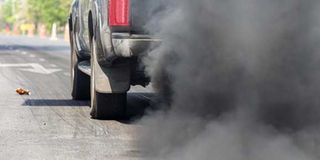
Air pollution from a vehicle's exhaust pipe.
What you need to know:
- PM2.5 refers to particles smaller than 2.5 microns—so tiny that they can bypass the nose and throat, entering deep into the lungs and bloodstream
- Medical experts warn that exposure to PM2.5 can cause a range of respiratory problems, including coughing, shortness of breath, chest tightness, and even asthma. Long-term exposure is associated with heart disease, lung cancer, and premature death.
Across Nairobi’s informal settlements and other urban fringes, jobless youths are increasingly burning tyres to extract copper and other scrap metals.
In open fields and back alleys, they set piles of worn-out tyres ablaze—oblivious or indifferent to the silent health and environmental hazards unleashed into the air, soil, and water. James Mwangi, a youth living in Kariobangi near Outer Ring Road, is among those involved in the activity.
“We earn something small by selling the scrap inside,” he admits. “We know it’s harmful, but there are no jobs. This is what we do to survive.” Like many others, Mwangi burns tyres without any protective gear, trading his health for a meagre income in an economy that has left him behind.
What happens when tyres burn?
Tyres are not just rubber—they are a complex mix of synthetic rubber, oils, heavy metals, and other industrial chemicals. When set alight, this toxic cocktail releases hazardous compounds into the environment. These include sulphur dioxide, benzene, volatile organic compounds (VOCs), polycyclic aromatic hydrocarbons (PAHs), and fine particulate matter known as PM2.5.
PM2.5 refers to particles smaller than 2.5 microns—so tiny that they can bypass the nose and throat, entering deep into the lungs and bloodstream. Medical experts warn that exposure to PM2.5 can cause a range of respiratory problems, including coughing, shortness of breath, chest tightness, and even asthma. Long-term exposure is associated with heart disease, lung cancer, and premature death.
Expert view
Environmental experts warn that the long-term consequences of this practice could be catastrophic. Prof John Musingi, a lecturer in Environmental Studies at the University of Nairobi, describes tyre burning as “a largely ignored but extremely destructive practice.”
“It’s not just about the smoke you can see,” Prof Musingi explains. “Tyre fires release a chemical cocktail that lingers in the air, soil, and water. These effects build up over time, especially in densely populated urban spaces.”
He insists that reactive efforts—like extinguishing fires or dispersing smoke—are not enough. “Depending on wind direction, toxic substances can spread kilometres away. The only sustainable answer is prevention. We need a proactive strategy that includes public education, enforcement of waste regulations, and viable economic alternatives for those involved.”
NEMA: Tyre burning is a violation of the law
The National Environment Management Authority (NEMA) has classified the open burning of tyres as a serious violation of waste management laws in Kenya. According to Samwel Lopokoiyit, NEMA’s Nairobi County Director of Environment, such fires release cancer-causing pollutants, including dioxins and polycyclic aromatic hydrocarbons.
“These chemicals are extremely dangerous even in small doses,” Lopokoiyit warns. “We have identified hotspots such as Outer Ring Road, parts of Thika Road, Mlolongo, and informal areas like Kariobangi and Huruma.”
He confirms that NEMA has undertaken enforcement actions, including arrests, in some of these locations. However, he admits the challenge is far from over. “Public awareness is still low. Many people don’t realise how harmful this is, not just to the environment but to themselves and their children.”
NEMA encourages the public to report tyre burning incidents to local authorities or the nearest police station. They also advocate for safe disposal alternatives, co-processing in cement kilns, and repurposing waste tyres into products like sandals and paving blocks.
Residents living in areas affected by tyre burning are growing increasingly concerned. Peris Mulonje, 33, a mother of two in Huruma, says the smoke from tyre fires has become part of everyday life. “The smell is terrible. Sometimes my children wake up coughing,” she says. “I don’t even let them play outside when I see black smoke rising.”
She believes the solution lies not just in policing but also in providing alternative opportunities. “These youth are not criminals. They’re just desperate. If they had jobs or training, they wouldn’t be doing this.”
A path towards safer recycling
Prof Musingi and Lopokoiyit both agree that a multi-stakeholder approach is essential. This includes stronger enforcement, better community education, and support for safe and profitable recycling methods. “We need partnerships involving local authorities, waste handlers, youth groups, and residents,” says Lopokoiyit. “Only then can we end this dangerous cycle.”