Uncharted irrigation path that could tackle chronic food insecurity
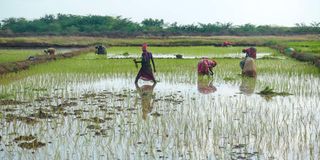
Workers plant rice in Hola Irrigation Scheme.

What you need to know:
- In 1989, the Tana Irrigation Scheme collapsed after River Tana, its sole water source, changed course. But 13 years ago, the scheme was revived and is now thriving.
- Tana was once known for cotton farming, but together with the Bura Irrigation scheme, they are now the country’s new frontiers of rice farming.
Kenya is currently experiencing the worst drought in 40 years due to the effects of climate change, putting millions of people at risk of hunger.
The government has been forced to go back to the drawing board to save lives and come up with fresh ideas for ensuring future resilience against climate-related shocks . Investing extensively in food production such as irrigation farming is one of President William Ruto’s main recommendations for reducing reliance on rain-fed agriculture. This has seen the rise of new frontiers in irrigation farming.
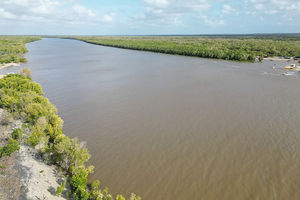
Tana River County, home to the Bura and Tana Irrigation schemes, is taking advantage of this. Bura was established in 1978, and Tana, the oldest irrigation scheme in the country, was established in 1953.
In 1989, the Tana Irrigation Scheme collapsed after River Tana, its sole water source, changed course. But 13 years ago, the scheme was revived and is now thriving. Tana was once known for cotton farming, but together with the Bura Irrigation scheme, they are now the country’s new frontiers of rice farming. There are 2,000 acres under rice farming in the Tana scheme and 2,200 acres in Bura .
“Farmers are pleased and we believe this one is a game changer. More acreage will be put under rice farming,” said James Kirimi, Tana Irrigation Scheme manager. Farmers here grow the Komboka rice variety developed by the Kenya Agricultural and Livestock Research Organisation.
But even as farmers report high yields in the rice paddies, Kenya still imports more than 600,000 tonnes of rice every year with an estimated value of Sh31 billion. This accounts for 1.44 per cent of the total import flow of goods to Kenya.
“As a country, we still have a big deficit as a result of rice production. The total requirement for this country is about metric tonnes but we are only producing a mere 200 metric tonnes,” said Charles Muasya, acting CEO of National Irrigation Authority (NIA). According to Mr Muasya, since independence, Kenya has only managed to put about 560,000 acres under irrigation even though the potential is 1.8 million acres to resolve food security crisis.
But irrigation is an expensive venture. At the Tana scheme, over 5,000 acres of land under irrigation depend on a pump fed system from the Makere intake.
And at Bura, 12,000 acres of land depend on a pump-fed system at the Korakora intake.
Diesel generators are used here, with millions of shillings used every month. But a Gravity Intake in Bura under construction is set to expand the land under irrigation to 25,000 acres through a 76 kilometre canal to supply water throughout the project.
“Right nowwe are using diesel powered generators. The NIA is constructing a gravity flow system, which will give us 11 cubic metres per second and thus we will be able to add acres under irrigation,” said Peter Oruwa, manager at Bura.
The potential of Bura and Hola is yet to be fully achieved. Sunflower, maize, green grams, watermelons, and bananas thrive here.
It could offer employment to thousands of Kenyans.
“When we are planting different types of crops, we must be able to have a continuous type of rotation without having to have a long furrow period,” added Mr Kirimi.
Hundreds of locals make a living from casual labor on the farms.
“All these people you see here are dependent on this job to support their families because they are unable to farm individually. Having a piece of land at the scheme is costly, you pay for the land, the tractor, and water so that you can start farming. They are here because they don’t have that money,” said Mwajma Ali, a casual Labourer.