Vultures: The endangered ecological doctors
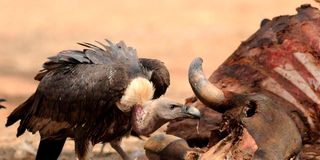
Vultures clean the environment by feeding on carcasses.

What you need to know:
- Africa is home to seven migratory vulture species: Egyptian, White-headed Vulture, Hooded Vulture, White-backed Vulture, Ruppell’s Vulture, Cape Vulture, and Lappet-faced Vulture. Six species are on the brink of extinction.
- BirdLife International has noted a steep decline in vulture numbers in Africa, and the IUCN Red List of Threatened Species classified Rüppell’s and White-backed Vultures as Critically Endangered.
Vultures exist in unwelcoming conditions. Their connection to unhygienic ecosystems is bizarre, but they offer crucial and indispensable ecological services free of charge.
During the recent drought, pastoralist communities lost thousands of livestock, leaving grazing fields strewn with carcasses as herders were too emotionally devastated to collect or burn them. Thanks to the vultures for the job well done through their scavenging activities that saw carcasses reduced and pathogens that would have caused epidemics in Northern counties such as Marsabit averted.
However, some pastoralist communities agree that vultures are the most loathsome bird species due to their association with feeding majorly on carcasses.
Mzee Mamo Guyo from Bubisa, Marsabit County, says he views these birds with scorn for their greed and unhygienic nature. On the flip side, he lauds vultures for playing a key role in the ecological clean-up, especially during the recent drought. He explains that little is still known to the pastoralist communities about the ecological importance of the vultures.
"We have always believed that vultures are lazybones that love to reap from where they never sowed. Little did we know that they save humanity from a lot of public health hazards.”
North Horr Public Health Officer Nuria Wario explains how the health fraternity in the region kept crossing their hands over the possible outbreaks of epidemics like cholera, anthrax, botulism or even rabies due to the overwhelming number of carcasses of the drought-stricken animals.
“Vultures play a critical clean-up role of the ecosystem and their extinction will see unprecedented proliferation of pests and bacteria in arid and semi-arid regions that are prone to droughts and massive deaths of livestock,” she tells Healthy Nation.
Public health officers tried convincing residents to collect carcasses and burn them, but all that reminded them of their huge losses. Some of the residents directed their anger on the vultures by either killing them using crude weapons such as stones or clubs or sometimes lacing the carcasses with pesticides.
The officer notes that vultures play key roles in cycling nutrients through the highly efficient disposal of organic waste from the environment; thus containing the risk of pathogen and potentially harmful bacteria spill-over to humans, livestock and wildlife.
She wants the pastoralist communities to understand that vultures play critical roles in safeguarding humans against vulnerability to the public health crisis. Without vultures, pets like dogs, cats or rats would try to fill in the gap by becoming the ecological crews, which they are not best suited for, and end up spreading infectious diseases to humans.
Echoing similar sentiments, Heinrich Boll Foundation Lead Coordinator of Agroecology and Food Rights Harun Warui explains that vultures’ capacity to devour large chunks of flesh in a few minutes and the acids in their bodies enable them to neutralise pathogens and limit the spread of bacteria and diseases.
He notes that the stomach acid of a vulture is corrosive, removing toxins from the environment through their eating and digestive process while at the same time combating sanitary diseases like rabies, botulism and anthrax. The scavenging birds also recycle important nutrients in the environment as well as avert the contamination of water bodies or water supplies by cleaning up carcasses that would otherwise contaminate rivers or lakes.
Dr Warui adds that by consuming the carcasses, vultures help limit the risk of large insect colonies, flies or disease-carrying bugs that would otherwise gather around the carcasses by keeping them in check and consequently averting the spread of diseases.
He says studies show that carcasses take longer to decompose; thus having implications for the spread of diseases in the wild, which potentially affect both domestic animals and humans.
Paul Gacheru from Nature Kenya is worried that despite vultures being ecologically vital, they are now the second most threatened group of wildlife after the black rhinos in Kenya.
Their population continue to drastically plummet and is facing imminent extinction.
Mr Gacheru asserts that the conservation of vulture species in Kenya and Africa ought to be a priority due to their importance in the ecosystem.
He say threats posed to vultures include deliberate or accidental poisoning, persecution, poor agricultural practices, shooting and persecution, habitat loss, electrocution and collisions on wind power and electricity lines.
To avoid complete extinction of the birds, he says there is a need to discourage the unsustainable practice of killing and use of vultures’ body parts. “There is also a need to discourage the unsuitable practices of killing vultures for witchcraft,” he notes.
In countries like Tanzania and South Africa, vultures’ body parts are used for ritual rites. Their eggs are used for money-making rituals and some people consume their meat as food.
Sometimes vultures may die after feeding on carcasses left behind by poachers as illegal hunters poison the corpses to confuse security officers who use vultures as beacons for illegal hunting. He identifies Tanzania, South Africa, Chad, Egypt, Zimbabwe and the West African countries as the hotspots for the vulture killings.
Additionally, vulture parts have local and international trade routes; with major hotspots being in Nigeria, Cameroon, Niger Republic and Burkina Faso.
Africa is home to seven migratory vulture species: Egyptian, White-headed Vulture, Hooded Vulture, White-backed Vulture, Ruppell’s Vulture, Cape Vulture, and Lappet-faced Vulture. Six out of the 11 species of vulture in Africa are on the brink of extinction.
BirdLife International has noted a steep decline in vulture numbers in Africa, and the IUCN Red List of Threatened Species classified Rüppell’s and White-backed Vultures as Critically Endangered. Mr Gacheru calls on relevant stakeholders in Kenya and Africa to embark on campaigns about the critical roles and importance of vultures to the ecosystem.
According to studies, a live vulture is worth between USD 85 to 140 while a dead one is worth betwen USD 40 to 60 in Africa as the demand is driven by the mystical beliefs that they can be used for traditional treatments.
Healthwise, India reportedly spent between USD 7,000 and USD 10,200 to cover the clean-up job that would have been contained by vultures in the 1990s and 2000.
The cost to public health climbed by an estimated USD 34 billion between 1993 and 2006 after the near extinction of vultures.